
Artemis II Moon Mission: NASA Locks in Early April Window for the Artemis II Moon Mission, signaling a historic moment in modern space exploration and America’s return to deep-space travel. For the first time since the Apollo era ended in the early 1970s, NASA is preparing to send astronauts beyond Earth orbit and around the Moon. The mission is part of NASA’s ambitious Artemis program, which aims to establish a sustainable human presence on the Moon and eventually pave the way for future missions to Mars.
If you’ve been following space exploration in the United States, you know the Artemis II mission has been one of the most anticipated events in the aerospace world. This upcoming mission will send four astronauts on a roughly 10-day journey around the Moon aboard the Orion spacecraft, launched by NASA’s powerful Space Launch System (SLS) rocket. The flight will test critical systems required for future lunar landings and deep-space missions. In simple terms, this mission is like the final dress rehearsal before NASA attempts the first human Moon landing in more than 50 years. Before humans step back onto the lunar surface, NASA must confirm that every life-support system, navigation technology, and safety protocol works flawlessly in deep space. Artemis II will serve as that real-world test flight. The mission is not just about science—it is about proving that humanity is ready for a new era of exploration.
Table of Contents
Artemis II Moon Mission
The decision that NASA Locks in Early April Window for the Artemis II Moon Mission represents a major milestone in humanity’s return to deep space. With the powerful Space Launch System rocket, the advanced Orion spacecraft, and a highly skilled astronaut crew, Artemis II will test the systems needed for future lunar landings and long-term exploration. More importantly, it will inspire a new generation of explorers and scientists as humanity prepares for an exciting future that includes permanent lunar bases and eventual missions to Mars.
| Key Information | Details |
|---|---|
| Mission Name | Artemis II |
| Launch Window | Early April 2026 |
| Rocket | Space Launch System (SLS) |
| Spacecraft | Orion Crew Capsule |
| Crew Members | Reid Wiseman, Victor Glover, Christina Koch, Jeremy Hansen |
| Mission Duration | Approximately 10 days |
| Mission Objective | Crewed lunar flyby to test deep-space systems |
| Distance from Earth | About 240,000 miles |
| First Crewed Lunar Mission Since | Apollo 17 (1972) |
| Official Source | https://www.nasa.gov/artemis |
Understanding the Artemis II Moon Mission
The Artemis II mission is the second flight in NASA’s Artemis program and the first mission that will carry astronauts. While the earlier Artemis I mission, launched in November 2022, successfully tested the Orion spacecraft without a crew, Artemis II will put humans aboard the spacecraft to verify that the system performs safely in deep space.
Instead of landing on the Moon, Artemis II will perform a lunar flyby. This means astronauts will travel around the Moon and return safely to Earth. While it may sound simple, the mission involves incredibly complex operations and precise navigation.
The mission will launch from Kennedy Space Center in Florida, the same launch site used during the Apollo missions. This location has served as the gateway to space for generations of astronauts and remains a symbol of American innovation and exploration.
During the mission, astronauts will test several critical components of the Orion spacecraft, including:
- Life-support systems
- Deep-space navigation technology
- Radiation protection measures
- Emergency procedures
- Communication systems between Earth and spacecraft
The mission will also allow astronauts to manually control the spacecraft during certain phases, giving NASA engineers valuable data about how humans interact with spacecraft systems in deep space.
Why This Artemis II Moon Mission Matters for the Future of Space Exploration?
The significance of Artemis II cannot be overstated. The last time humans traveled beyond low-Earth orbit was during Apollo 17 in December 1972. Since then, astronauts have primarily operated aboard the International Space Station (ISS) in low Earth orbit.
Artemis II marks the beginning of a new era of deep-space exploration.
NASA’s broader goals for the Artemis program include:
- Returning astronauts to the Moon
- Building a sustainable lunar presence
- Testing technologies needed for Mars missions
- Encouraging international collaboration in space exploration
The program is named after Artemis, the twin sister of Apollo in Greek mythology. Just as the Apollo missions first landed humans on the Moon, Artemis aims to bring humanity back there—this time with long-term plans.
Another key objective of the Artemis program is diversity. NASA has committed to landing the first woman and the first person of color on the Moon during the Artemis III mission.
Meet the Artemis II Astronaut Crew
NASA selected four highly experienced astronauts for the Artemis II mission. Each crew member brings unique skills and experience to the mission.
Reid Wiseman – Mission Commander
Reid Wiseman will serve as the commander of Artemis II. A former U.S. Navy test pilot, Wiseman previously spent time aboard the International Space Station and later served as NASA’s Chief of the Astronaut Office.
His leadership experience makes him well suited to command a mission of this magnitude.
Victor Glover – Pilot
Victor Glover will serve as the mission pilot. He previously flew aboard SpaceX Crew-1 to the International Space Station and has extensive experience as a naval aviator.
Glover will make history as the first Black astronaut to travel beyond Earth orbit.
Christina Koch – Mission Specialist
Christina Koch is one of NASA’s most experienced astronauts. She holds the record for the longest single spaceflight by a woman, spending 328 consecutive days aboard the International Space Station.
During Artemis II, Koch will become the first woman to travel to the Moon.
Jeremy Hansen – Mission Specialist
Jeremy Hansen represents the Canadian Space Agency (CSA) and will become the first Canadian astronaut to travel around the Moon.
Canada has been a long-time partner in NASA’s space exploration efforts, including contributions to robotics used on the International Space Station.
The Space Launch System: NASA’s Most Powerful Rocket
No deep-space mission is possible without a powerful rocket. The Space Launch System (SLS) is currently the most powerful rocket NASA has ever developed.
This massive launch vehicle generates over 8.8 million pounds of thrust at liftoff, making it more powerful than the Saturn V rockets used during the Apollo era.
Some impressive facts about the SLS rocket include:
- Height: About 322 feet tall
- Core stage powered by four RS-25 engines
- Two large solid rocket boosters
- Capable of carrying heavy payloads beyond Earth orbit
Many components of the SLS rocket are based on technology originally developed for the Space Shuttle program, making the system both reliable and familiar to NASA engineers.
Inside the Orion Spacecraft
The Orion spacecraft is designed specifically for deep-space travel. Unlike spacecraft that operate only in low Earth orbit, Orion must protect astronauts from extreme conditions during long missions.
The spacecraft consists of several key components:
- Crew module
- European service module
- Launch abort system
- Heat shield for Earth re-entry
The European Service Module, developed by the European Space Agency (ESA), provides propulsion, electricity, water, and oxygen for the crew.
Orion’s heat shield is one of the most advanced ever built. During Earth re-entry, the spacecraft will experience temperatures close to 5,000 degrees Fahrenheit, similar to the heat generated by molten lava.
The Mission Flight Path and Lunar Flyby
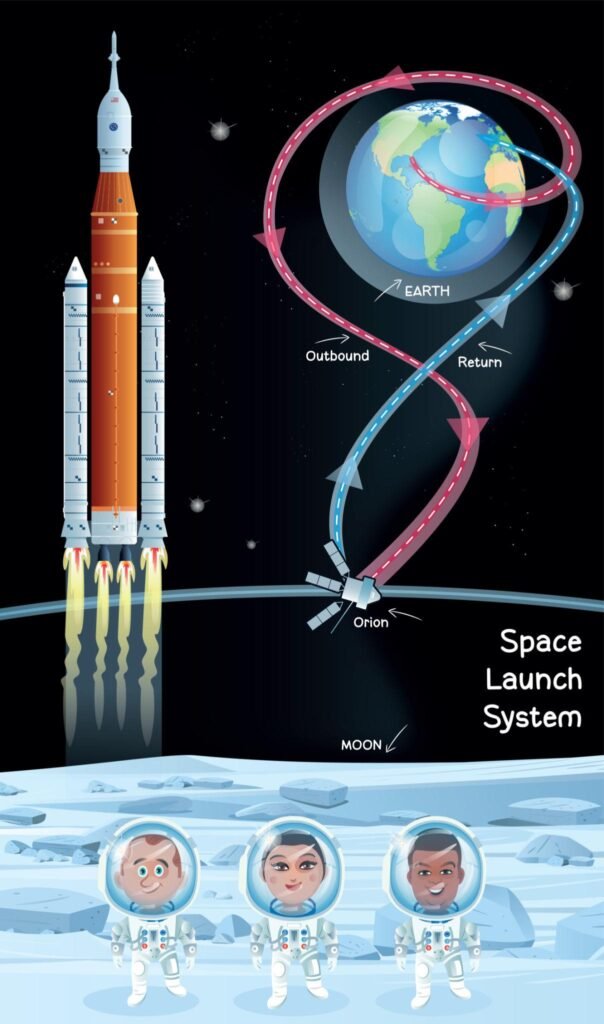
One of the most fascinating aspects of the Artemis II mission is its flight trajectory. The spacecraft will follow a path known as a free-return trajectory.
This trajectory allows the spacecraft to swing around the Moon and naturally return to Earth using gravity alone.
The advantage of this path is safety. If the spacecraft experiences any major issues, the gravitational pull of the Moon will automatically guide the spacecraft back toward Earth.
This trajectory was also used during several Apollo missions, including the famous Apollo 13 mission, which safely returned astronauts after an onboard explosion.
The Artemis II spacecraft will travel approximately 240,000 miles from Earth, reaching speeds of nearly 25,000 miles per hour during re-entry.
Step-by-Step Mission Timeline
NASA has outlined a general timeline for the Artemis II mission.
Launch Phase
The SLS rocket will launch from Launch Complex 39B at Kennedy Space Center.
Earth Orbit Checkouts
After launch, Orion will enter temporary Earth orbit while engineers verify that all systems are functioning properly.
Trans-Lunar Injection
The rocket’s upper stage will fire again to send the spacecraft toward the Moon.
Deep Space Operations
Astronauts will test spacecraft systems and conduct manual flight demonstrations.
Lunar Flyby
The spacecraft will travel around the far side of the Moon before beginning its return journey.
Return to Earth
The spacecraft will re-enter Earth’s atmosphere at extremely high speeds.
Ocean Splashdown
The mission will conclude with a splashdown in the Pacific Ocean, where recovery teams will retrieve the astronauts.
Why the Artemis II Moon Mission Launch Was Delayed?
Space missions are incredibly complex, and safety is NASA’s top priority.
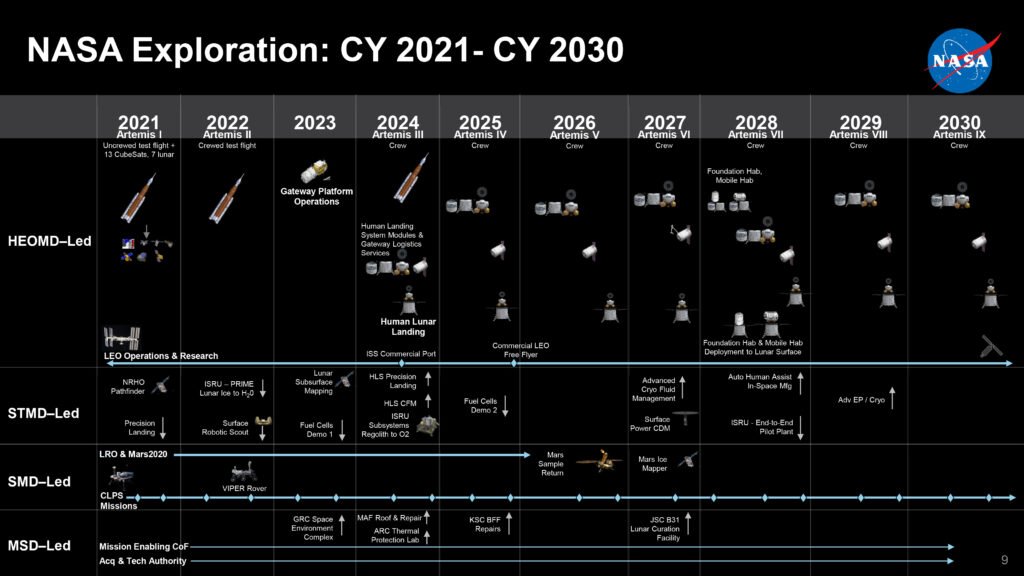
Originally, Artemis II was expected to launch earlier. However, engineers discovered several technical issues that required further testing and adjustments.
These included:
- Hardware inspections within the SLS rocket
- System verification tests
- Upgrades to Orion components
- Additional safety checks
NASA chose to delay the launch rather than rush the mission.
This careful approach ensures that astronauts have the safest possible conditions during the flight.
Economic Impact of the Artemis Program
The Artemis program is not just a scientific endeavor—it is also an economic powerhouse.
According to industry estimates, the global space economy could reach $1 trillion by 2040, driven by new technologies and commercial partnerships.
NASA collaborates with many private companies on the Artemis program, including:
- Lockheed Martin (Orion spacecraft)
- Boeing (SLS core stage)
- Northrop Grumman (solid rocket boosters)
- SpaceX (future lunar lander systems)
These partnerships support thousands of high-tech jobs across the United States.
Advice for Students and Future Space Professionals
The Artemis program is inspiring a new generation of scientists, engineers, and explorers.
Students interested in space careers should focus on STEM education, including:
- Physics
- Aerospace engineering
- Computer science
- Robotics
- Mathematics
NASA also offers numerous educational opportunities through its STEM engagement programs.
Participating in robotics competitions, coding camps, and science fairs can also help build skills for future space careers.
NASA Encounters an Unexpected Obstacle Just Before the Artemis II Countdown Rehearsal
NASA Observes an Unusual Ocean Color Change Near Remote Islands in 2026
NASA Spots Unusual Blue Aurora On Jupiter And Scientists Rethink The Planet Atmosphere