


Seniors Whose Memory Stays as Sharp as in Their 50s: Superagers are seniors whose memory stays as sharp as people decades younger, often performing at the level of individuals in their 50s or 60s despite being 80 years old or older. Scientists studying healthy brain aging say these individuals represent a fascinating group that challenges long-held assumptions about cognitive decline. While many people expect memory problems to appear naturally with age, Superagers prove that the brain can remain resilient and capable well into later life.
Across the United States, neuroscientists, gerontologists, and cognitive researchers are paying close attention to this rare group of seniors. Their goal is simple but powerful: understand why some people maintain exceptional memory and mental sharpness while others develop conditions such as Alzheimer’s disease or dementia. By studying Superagers, scientists hope to uncover strategies that could help millions of Americans preserve brain health as they age.
The concept of Superagers emerged from long-term research programs investigating how the brain changes over time. Researchers discovered that while most adults experience gradual memory decline after age 60, a small percentage maintain remarkably strong cognitive performance. These individuals consistently outperform their peers on standardized memory tests, particularly those measuring episodic memory—the ability to recall events, conversations, and experiences.
Table of Contents
Seniors Whose Memory Stays as Sharp as in Their 50s
The discovery of Superagers has transformed the way scientists think about aging and memory. Rather than accepting cognitive decline as inevitable, researchers now recognize that the brain has remarkable potential for resilience and adaptation. Superagers demonstrate that it is possible to maintain strong memory, mental clarity, and cognitive function well into the later decades of life. Their brains show unique structural characteristics, but their lifestyles also provide valuable lessons for the rest of us.
Regular physical activity, meaningful social relationships, intellectual curiosity, healthy nutrition, and a strong sense of purpose all appear to contribute to long-term brain health. As research continues, scientists hope the insights gained from Superagers will help millions of people around the world maintain their mental sharpness and independence as they age.
| Key Information | Details |
|---|---|
| Definition | Adults aged 80+ with memory comparable to people 20–30 years younger |
| Main Research Institution | Northwestern University Mesulam Center for Cognitive Neurology |
| First Major Study | Early 2000s SuperAging research program |
| Typical Cognitive Test | Delayed word recall and episodic memory tests |
| Estimated Participants | Nearly 300 individuals studied in long-term research |
| Importance | Helps scientists understand dementia prevention and healthy aging |
| Official Research Source | https://www.brain.northwestern.edu/superaging/ |
Understanding Superagers and Why They Matter?
Most people believe memory decline is unavoidable with age. While mild changes are common, research shows that severe cognitive decline is not inevitable. Superagers demonstrate that the aging brain can remain strong, adaptive, and highly functional.
The discovery of Superagers began when neuroscientists noticed something unusual during cognitive testing. Some individuals in their 80s were scoring as high as middle-aged adults on memory assessments. This prompted researchers to take a closer look at their brain structure, genetics, and daily habits.
According to research conducted at Northwestern University, Superagers often perform exceptionally well on delayed recall tests, where participants are asked to remember a list of words after a period of time. These tests measure episodic memory, which typically declines with age.
However, Superagers consistently outperform other seniors in these tests. Their performance is so impressive that scientists compare them directly with adults 20 to 30 years younger.
The implications are significant. In the United States alone, more than 6.7 million Americans live with Alzheimer’s disease, according to the Alzheimer’s Association.
Understanding how Superagers resist cognitive decline could lead to better prevention strategies, improved treatments, and new ways to promote healthy brain aging.
Seniors Whose Memory Stays as Sharp as in Their 50s: The Brain Characteristics of Superagers
Scientists studying Superagers often use brain imaging tools such as MRI scans to analyze structural differences. These studies have revealed several fascinating features that appear to distinguish Superagers from typical older adults.
Thicker Brain Cortex
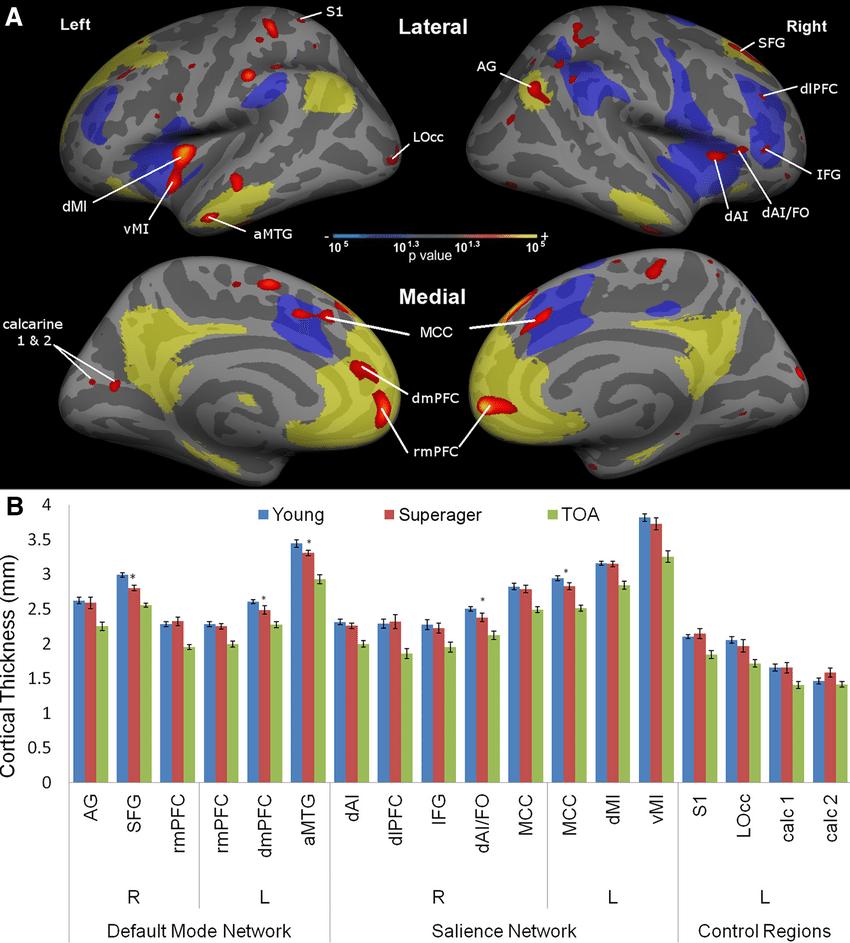
One of the most notable findings is that Superagers tend to have a thicker cerebral cortex, the outer layer of the brain responsible for higher-level thinking, memory, and problem-solving.
Normally, the cortex gradually becomes thinner as people age. This process is associated with cognitive decline and memory loss. However, MRI scans of Superagers reveal that their cortex remains unusually thick, especially in regions linked to memory and executive function.
Researchers believe this structural advantage may help Superagers process information more efficiently and maintain stronger neural connections.
Healthier Hippocampus
Another key brain region involved in memory is the hippocampus, which plays a major role in learning and forming new memories.
Studies show that Superagers often have a larger or more active hippocampus compared with typical seniors. This suggests that their brains maintain stronger neural pathways that support memory formation and recall.
Scientists also believe the hippocampus in Superagers may continue producing new neurons longer than in most individuals, contributing to better cognitive performance.
Greater Cognitive Reserve
Experts frequently use the term cognitive reserve when discussing Superagers.
Cognitive reserve refers to the brain’s ability to adapt and compensate for damage or aging. People with higher cognitive reserve can maintain normal function even when some neurological changes occur.
Superagers appear to possess exceptionally strong cognitive reserve. This may explain why some individuals with age-related brain changes do not experience noticeable memory problems.
The concept of cognitive reserve has become a central focus in dementia prevention research.
Lifestyle Habits Shared by Many Superagers
While genetics may influence brain aging, researchers emphasize that lifestyle factors play an equally important role. Many Superagers share common habits that support long-term cognitive health.
Regular Physical Activity
One of the most consistent findings is that Superagers stay physically active throughout their lives.
Activities such as walking, swimming, gardening, and recreational sports help maintain cardiovascular health and improve blood flow to the brain. Regular physical activity also stimulates the release of chemicals that support neuron growth and brain plasticity.
The Centers for Disease Control and Prevention recommends at least 150 minutes of moderate physical activity per week for older adults.
Strong Social Relationships
Superagers are often highly engaged in their communities. They spend time with friends, participate in social events, and maintain strong family connections.
Social interaction stimulates multiple areas of the brain simultaneously, including those responsible for communication, emotional processing, and memory.
Studies have shown that loneliness and social isolation can increase the risk of cognitive decline and dementia. Maintaining strong relationships may therefore act as a protective factor for brain health.
Lifelong Learning and Curiosity
Another common trait among Superagers is a love of learning. Many remain intellectually active throughout their lives by reading books, learning new skills, or engaging in challenging hobbies.
Activities such as playing musical instruments, solving puzzles, and studying new subjects help keep neural networks active and adaptable.
Researchers sometimes describe the brain as a muscle: the more it is used, the stronger and more resilient it becomes.
A Strong Sense of Purpose
Superagers frequently report having a strong sense of purpose in life. They remain involved in meaningful activities such as volunteering, mentoring younger generations, or contributing to community projects.
Psychological studies suggest that individuals who feel their lives have purpose are less likely to develop cognitive decline.
Purpose provides motivation, emotional stability, and mental engagement—all factors that support healthy brain aging.
Seniors Whose Memory Stays as Sharp as in Their 50s: Diet and Nutrition for Brain Health
Diet also plays a significant role in maintaining cognitive function. Many Superagers follow eating patterns similar to the Mediterranean or MIND diets, which emphasize foods known to support brain health.
These diets include:
- leafy green vegetables
- berries and fruits
- whole grains
- fish rich in omega-3 fatty acids
- olive oil and healthy fats
- nuts and seeds
These foods contain antioxidants and anti-inflammatory compounds that help protect brain cells from damage.
Harvard Health Publishing reports that diets rich in these foods are associated with slower cognitive decline and reduced dementia risk.
Practical Steps Anyone Can Take to Support Brain Health
While not everyone will become a Superager, research suggests that adopting healthy habits can significantly improve cognitive resilience.
Stay Physically Active
Daily movement supports both physical and mental health. Walking, stretching, cycling, or participating in group fitness activities can help maintain brain function.
Even small changes, such as taking the stairs or going for a daily walk, can have long-term benefits.
Challenge Your Mind
Mental stimulation encourages the brain to form new connections. Activities such as reading, learning languages, playing strategy games, or taking educational courses help strengthen neural pathways.
The key is variety—engaging different areas of the brain helps maintain flexibility and cognitive strength.
Maintain Social Connections
Regular interaction with others keeps the brain engaged and emotionally balanced. Joining clubs, attending community events, or volunteering can provide valuable opportunities for connection.
Strong relationships not only improve mental health but also stimulate brain activity.
Prioritize Sleep
Sleep plays a critical role in memory formation and brain maintenance. During sleep, the brain consolidates memories and clears waste products that accumulate during the day.
Adults should aim for 7 to 9 hours of quality sleep per night to support cognitive function.
Manage Stress
Chronic stress can negatively impact brain health by increasing inflammation and damaging neural pathways.
Mindfulness practices, meditation, exercise, and spending time in nature can help reduce stress and promote mental clarity.
Up to $5000 in Capital Health Claims — Why Documentation Matters
Study Suggests a Common Workout Supplement May Aid Brain Health
A Promising Clue for Alien Life Faces a Setback, Refocusing Planetary Science