
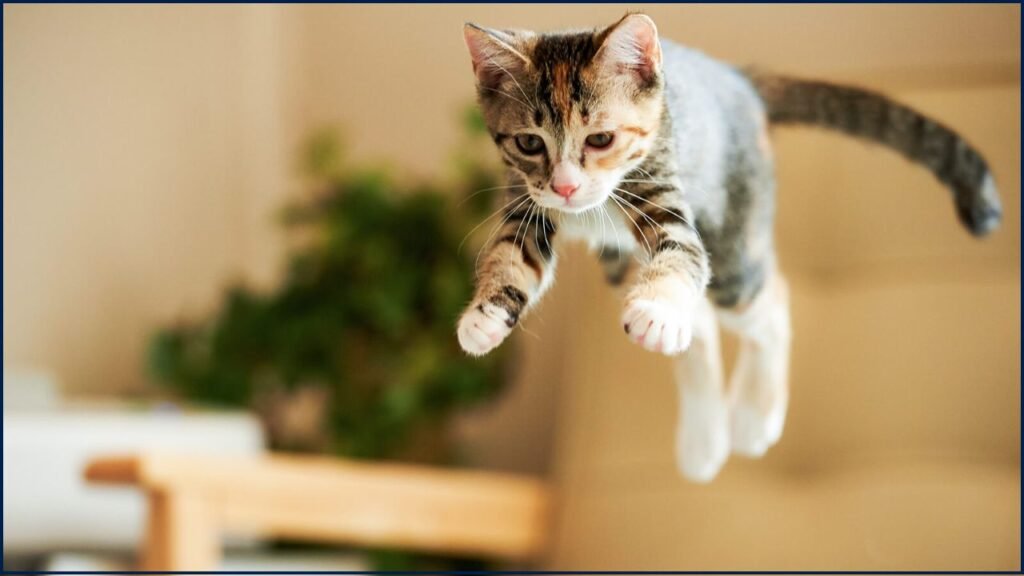
The falling cat phenomenon refers to the remarkable ability of cats to twist their bodies during a fall and land on their feet. This behavior, which scientists call the cat righting reflex, relies on a combination of flexible anatomy, rapid sensory processing, and precise muscular coordination. Researchers studying animal biomechanics say the cat’s highly flexible spine and specialized balance system allow it to reorient itself in mid-air within fractions of a second.
For more than a century, the phenomenon has intrigued physicists, biologists, and engineers. What first appeared to defy the laws of physics has since become a classic example of how living organisms adapt complex mechanical principles to survive in their environment.
Table of Contents
Famous Falling Cat Phenomenon
| Key Fact | Detail |
|---|---|
| Core mechanism | The righting reflex allows cats to rotate their bodies mid-air and land feet-down. |
| Anatomy advantage | Flexible spine and loose shoulder joints enable independent rotation of body segments. |
| Balance detection | The inner ear vestibular system helps cats determine orientation while falling. |
| Scientific significance | The falling cat phenomenon is studied in physics, biomechanics, and robotics. |
The falling cat phenomenon offers a striking example of how biology and physics intersect in the natural world. What once seemed like a mystery now illustrates the remarkable adaptability of living systems. As scientists continue studying feline motion, the insights gained may influence fields ranging from robotics to aerospace engineering—showing how even an everyday animal can inspire scientific discovery.
The Physics Behind the Falling Cat Phenomenon
At first glance, the falling cat phenomenon appears to contradict the law of conservation of angular momentum, a fundamental rule in physics stating that an object cannot begin rotating without an external force.
If a rigid object is dropped without spin, it cannot suddenly start rotating. Yet cats clearly rotate while falling.
Scientists eventually discovered that cats overcome this limitation because their bodies are not rigid. Instead, they can change their shape while in the air. By bending their spine and moving their limbs, cats redistribute their body mass and rotate different sections of their body independently.
Physicists often describe this motion using a two-segment body model. In this model, the cat’s front and rear halves act as separate rotating units connected by the flexible spine.
The maneuver typically follows several steps:
- The cat turns its head to locate the ground.
- The front half of the body rotates while the back half rotates in the opposite direction.
- The cat adjusts its legs to control rotational speed.
- The rear half completes the rotation until the entire body aligns feet-down.
This coordinated motion allows the cat to reorient itself without violating physical laws.
The Role of the Flexible Cat Spine
A key element in the falling cat phenomenon is the cat’s extraordinary spinal flexibility.
Cats have between 53 and 60 vertebrae, more than humans, whose spines contain about 33 vertebrae. This increased number of joints gives cats a much greater range of motion.
The feline spine can bend and twist in multiple directions, allowing cats to reshape their bodies during a fall. This flexibility enables the front and rear halves of the body to rotate independently.
Cats also lack a rigid collarbone. Instead, their shoulder bones are attached primarily by muscles rather than fixed joints. This feature increases the range of movement in the forelimbs and helps cats maneuver their bodies while airborne.
Together, these anatomical traits make the feline body extremely adaptable during sudden movements.
How Cats Know Which Way Is Up
Another important factor is the vestibular system located in the inner ear.
This sensory system detects changes in orientation and motion relative to gravity. Inside the ear are three semicircular canals filled with fluid. When the head moves, the fluid shifts, sending signals to the brain about the body’s position.
When a cat begins to fall, this system quickly detects the change in orientation. The brain then triggers the righting reflex.
The head rotates first, followed by the shoulders, spine, and hind legs. This sequence allows the entire body to align with the ground before impact.
The reflex begins developing in kittens at about three to four weeks of age and becomes fully developed by around seven weeks.
A Discovery Captured by Early Photography
The falling cat phenomenon became widely studied in the late nineteenth century.
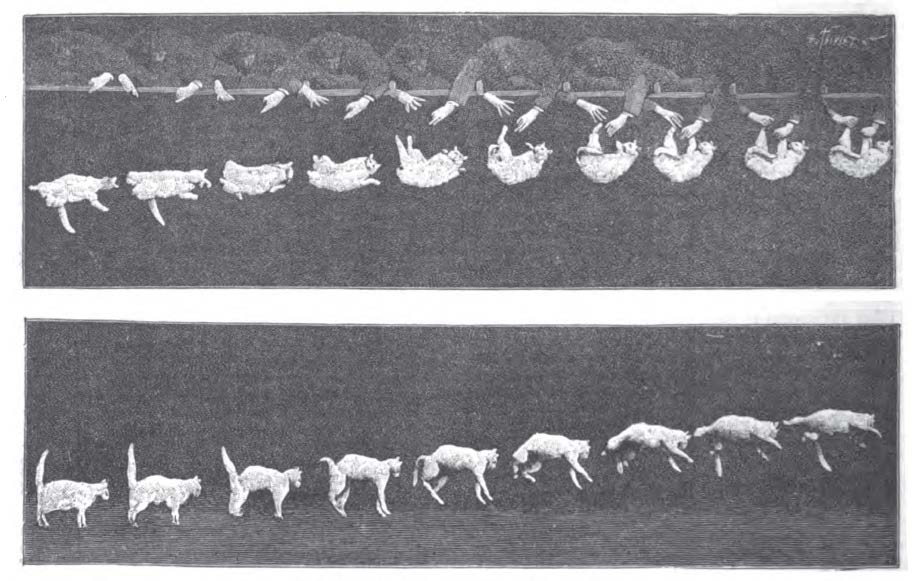
French physiologist Étienne-Jules Marey used early high-speed photography to analyze how cats move during a fall. His photographic sequences captured the precise stages of the cat’s rotation, revealing that the animal twists its body rather than spinning as a rigid object.
These experiments helped resolve a long-standing debate among scientists about whether cats truly violated physical laws during a fall.
Marey’s images remain an important milestone in the history of motion analysis and scientific photography.
Evolutionary Advantages of Feline Agility
The falling cat phenomenon is not merely a scientific curiosity. It reflects evolutionary adaptations that helped cats survive in the wild.
Wild cats often climb trees, rocks, and elevated terrain while hunting or escaping predators. Falling from heights is therefore a common risk.
Over millions of years, natural selection favored individuals that could recover from falls safely. Flexible bodies, strong muscles, and quick reflexes increased survival rates.
This evolutionary pressure likely contributed to the development of the righting reflex and the highly agile feline body structure seen in domestic cats today.
High-Rise Syndrome and Veterinary Research
Veterinarians have studied the falling cat phenomenon in relation to injuries caused by falls from tall buildings. This condition is sometimes called high-rise syndrome.
Studies of veterinary hospital records have shown that cats falling from very high buildings sometimes suffer fewer injuries than those falling from moderate heights.
Researchers believe this occurs because cats falling from greater heights have more time to fully right themselves and spread their limbs outward. This posture increases air resistance and slows the rate of descent, functioning somewhat like a parachute.
However, veterinarians emphasize that falls from any height can be dangerous and should not be underestimated.
Mathematical Models of the Falling Cat Problem
The physics behind the falling cat phenomenon has also inspired mathematical models.
Scientists have used geometry and rotational dynamics to describe the motion of flexible bodies in free fall. One well-known model treats the cat as two connected cylinders that rotate relative to each other.
This model demonstrates how changing body shape can allow rotation without external torque.
The falling cat problem has become a classic teaching example in physics courses because it illustrates how internal motion can produce overall reorientation.
Applications in Robotics and Engineering
The lessons learned from the falling cat phenomenon extend beyond biology.
Engineers developing robotic systems have studied feline motion to improve machines that must stabilize themselves during falls. Robots designed for exploration or disaster response may need to reorient their bodies quickly in unpredictable environments.
Some robotic designs now incorporate flexible joints and balance sensors inspired by animal locomotion.
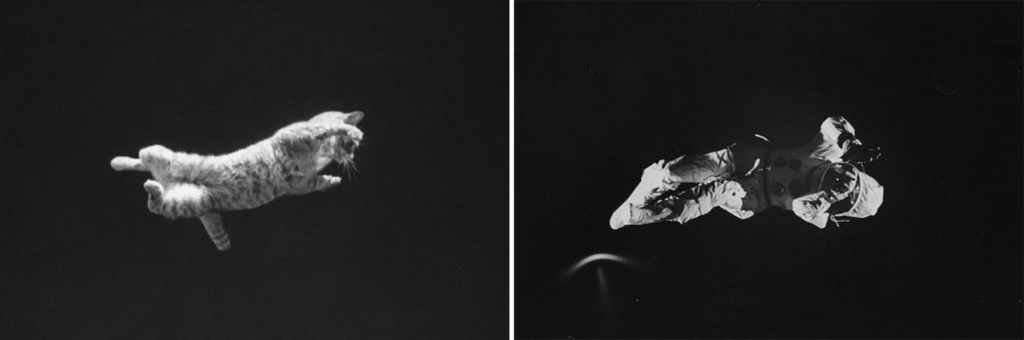
Researchers in aerospace engineering have also explored how similar principles could help spacecraft or satellites adjust orientation in microgravity environments.
Comparison With Other Animals
While cats are famous for their aerial agility, they are not the only animals capable of mid-air reorientation.
Squirrels, for example, can twist their bodies during falls and use their tails to stabilize their descent. Some primates also exhibit limited righting abilities.
However, cats are particularly efficient at the maneuver due to the unique combination of spinal flexibility, balance sensing, and rapid reflexes.
This combination makes them among the most agile mammals relative to body size.
Debunking a Common Myth
A popular saying claims that cats always land on their feet.
In reality, the falling cat phenomenon increases the chances of a safe landing but does not guarantee it. Factors such as fall height, surface conditions, and obstacles can affect the outcome.
Young kittens, injured animals, or cats caught in confined spaces may not be able to complete the righting reflex.
Understanding these limitations helps explain why veterinarians caution pet owners about open windows, balconies, and other potential fall hazards.
Why Scientists Continue Studying the Phenomenon
More than a century after it was first documented, the falling cat phenomenon continues to attract scientific interest.
Researchers studying biomechanics, neuroscience, and robotics see it as a model for understanding how flexible bodies interact with physical laws.
The phenomenon demonstrates that biological systems can solve complex mechanical problems through simple but highly coordinated movements.
For engineers and scientists alike, the falling cat remains a powerful reminder that nature often provides elegant solutions to challenges that technology is still learning to master.
FAQs About Famous Falling Cat Phenomenon
What is the falling cat phenomenon?
It is the ability of cats to rotate their bodies mid-air during a fall and land on their feet using the righting reflex.
Why can cats twist in mid-air?
Cats have highly flexible spines and can rotate different parts of their bodies independently.
How fast does the righting reflex work?
Cats can complete the maneuver in less than a second.
Do cats always land safely?
No. While the reflex improves their chances of landing safely, injuries can still occur.