
Andromeda Is on a Collision Course With the Milky Way: The topic “Scientists Discover Why Andromeda Is on a Collision Course With the Milky Way” has captured the imagination of astronomers, space fans, and everyday stargazers across the United States and beyond. Scientists have long known that the Andromeda Galaxy is moving toward our own Milky Way Galaxy, but new research is helping experts better understand why this cosmic meeting is happening. While it may sound like a dramatic crash straight out of a Hollywood sci-fi movie, the reality is far more fascinating—and a whole lot slower.
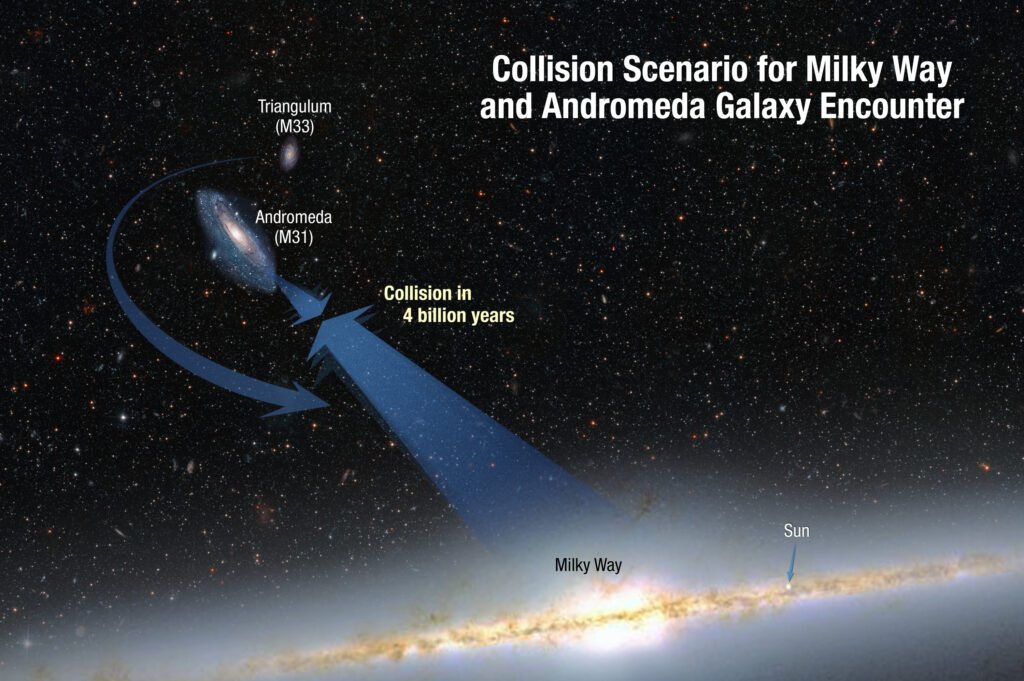
Here’s the deal: our galaxy and Andromeda are part of a neighborhood called the Local Group, a cluster of about 80 galaxies bound together by gravity. Scientists now believe that gravitational forces from massive dark-matter halos and nearby galaxies are slowly pulling the two galaxies toward each other. The expected encounter is estimated to happen about 4 to 5 billion years from now, which means Earth will be a very different place long before the cosmic dance begins.
Table of Contents
Andromeda Is on a Collision Course With the Milky Way
The discovery explaining why Andromeda is on a collision course with the Milky Way gives scientists deeper insight into the gravitational forces shaping our cosmic neighborhood. Through observations from telescopes like Hubble and Gaia, researchers now understand that dark matter halos and the gravity of the Local Group are gradually pulling the two galaxies together. Even though the collision won’t happen for billions of years, studying this future event helps astronomers understand galaxy formation, dark matter, and the evolution of the universe itself. In the grand scheme of the cosmos, the Milky Way and Andromeda are simply partners in a slow-motion gravitational dance across space.
| Topic | Key Information |
|---|---|
| Main Discovery | Scientists discovered that gravity and dark matter are pulling the Milky Way and Andromeda together |
| Current Distance | About 2.5 million light-years apart |
| Speed of Approach | Roughly 110 km/s (250,000 mph) |
| Estimated Collision Time | Around 4–5 billion years |
| Galaxy Group | Both belong to the Local Group of galaxies |
| Possible Outcome | A merged galaxy sometimes called “Milkomeda” |
| Key Research Sources | NASA, ESA, Hubble Telescope data |
| Official Reference | https://www.nasa.gov |
Understanding the Milky Way and Andromeda Galaxies
Before diving into the science, let’s set the stage.
What Is the Milky Way?
The Milky Way Galaxy is the cosmic home of our solar system. It contains an estimated 100–400 billion stars, along with planets, gas clouds, and dark matter.
Key facts:
- Diameter: About 100,000 light-years
- Age: Around 13.6 billion years
- Stars: Hundreds of billions
- Central feature: A supermassive black hole called Sagittarius A*
What Is the Andromeda Galaxy?
The Andromeda Galaxy (M31) is the closest major galaxy to ours and is actually larger than the Milky Way.
Important facts:
- Distance from Earth: 2.5 million light-years
- Stars: Around 1 trillion
- Type: Spiral galaxy
- Visible with the naked eye under dark skies
Why Scientists Say Andromeda Is on a Collision Course With the Milky Way?
For years, astronomers have been tracking Andromeda’s motion. Using powerful observatories like the Hubble Space Telescope, scientists discovered that Andromeda’s light shows a blueshift.
What Does Blueshift Mean?
When light shifts toward the blue end of the spectrum, it means an object is moving toward us.
In simple terms:
- Redshift = moving away
- Blueshift = moving closer
This measurement confirmed that Andromeda is approaching our galaxy at about 110 kilometers per second.
Andromeda Is on a Collision Course With the Milky Way: The Role of Gravity and Dark Matter
Now here’s where the science gets really interesting.
Dark Matter’s Hidden Influence
Scientists believe galaxies sit inside enormous dark-matter halos. Dark matter cannot be seen directly, but its gravitational pull influences how galaxies move.
According to researchers:
- Dark matter makes up about 85% of the universe’s total matter.
- Both galaxies are embedded in massive dark-matter halos.
- These halos create a gravitational pull that draws the galaxies together.
The Local Group’s Gravitational Dance
The Milky Way and Andromeda are not floating alone.
They are part of a cosmic family called the Local Group, which includes galaxies like:
- Triangulum Galaxy (M33)
- Large Magellanic Cloud
- Small Magellanic Cloud
These nearby galaxies influence each other through gravity, creating what scientists call a gravitational dance.
Sometimes smaller galaxies can slightly change the path of the bigger ones, which means scientists are still refining predictions.
Will the Milky Way and Andromeda Actually Collide?
Here’s the good news for anyone worried about cosmic doom.
Even if the galaxies merge, stars almost never collide directly.
Why?
Because the distance between stars is enormous.
Imagine this example:
If our Sun were the size of a basketball, the nearest star would be thousands of miles away.
That means when galaxies merge:
- Stars usually pass right by each other
- Gas clouds interact and form new stars
- Black holes eventually merge
The entire process could take several billion years.
Andromeda Is on a Collision Course With the Milky Way: What the Night Sky Might Look Like?
Astronomers believe that, if humanity were still around billions of years from now, the sky would look incredible.
Over millions of years:
- Andromeda would grow larger in the sky
- Spiral arms would stretch and distort
- Bright star formations would appear
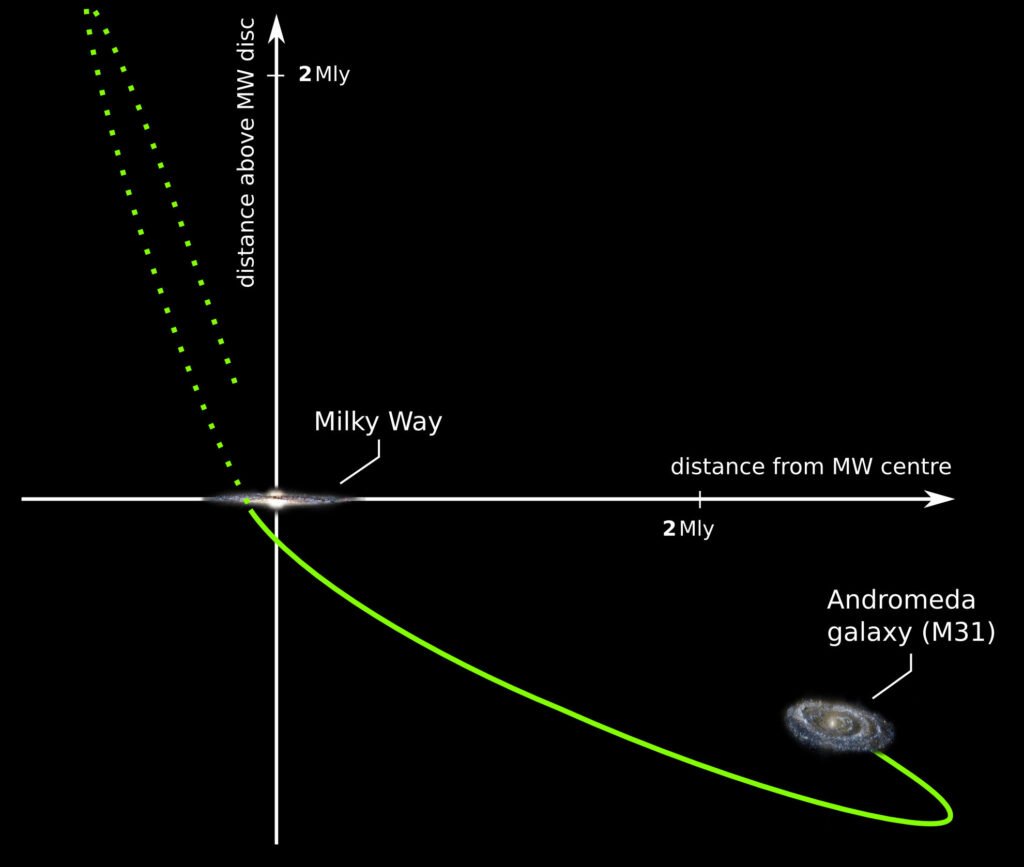
NASA simulations show the two galaxies slowly blending into a single elliptical galaxy.
Scientists sometimes call the result:
“Milkomeda.”
New Research Changing the Predictions
Recent studies using data from Gaia and Hubble space telescopes suggest the future might not be completely certain.
Some simulations show:
- A direct collision probability around 50% within 10 billion years
- A possibility that galaxies could pass by each other first
- Gravitational effects from Triangulum Galaxy influencing the path
Why Andromeda Is on a Collision Course With the Milky Way Discovery Matters for Science?
Understanding galaxy movement helps scientists answer big questions about the universe.
1. How Galaxies Form
Studying galaxy collisions teaches researchers how:
- New stars are created
- Galaxies evolve
- Black holes grow
2. Dark Matter Research
The Milky Way–Andromeda interaction helps scientists measure the effects of dark matter, one of the biggest mysteries in astrophysics.
3. Predicting Cosmic Evolution
By studying nearby galaxies, astronomers can estimate what might happen to other galaxies across the universe.
A Simple Guide to Understanding Galaxy Collisions
Let’s break it down step-by-step so anyone—even a 10-year-old—can follow along.
Step 1: Galaxies Move Through Space
Galaxies are not fixed in place. They travel through the universe because of gravity and cosmic expansion.
Step 2: Gravity Pulls Them Together
Massive objects attract each other. Because the Milky Way and Andromeda are huge, gravity pulls them closer over billions of years.
Step 3: Their Dark Matter Halos Interact
Invisible dark matter halos around galaxies increase gravitational attraction.
Step 4: They Begin a Slow Merger
When galaxies get close enough, they start stretching and forming new stars.
Step 5: A New Galaxy Forms
Eventually the two galaxies combine into a single larger galaxy.
What Happens to Earth During the Event?
Here’s a reassuring thought.
By the time the galaxies merge:
- The Sun will likely become a red giant star
- Earth may no longer be habitable
But even if our solar system still existed:
- The chance of Earth colliding with another star is extremely tiny
So there’s no cosmic disaster headed our way anytime soon.
Space Rocket Debris Is Becoming a New Risk for Commercial Aircraft
Meteorite Hunters Are Turning Falling Space Rocks into High-Value Finds
James Webb Telescope Observations Reveal Unusual Cosmic Patterns Under Study