
For generations, the Atlantis debate returns every time a strange discovery surfaces from the ocean floor. A sonar image, a newly mapped coastline, or a forgotten translation of ancient Greek texts is enough to reopen the conversation.
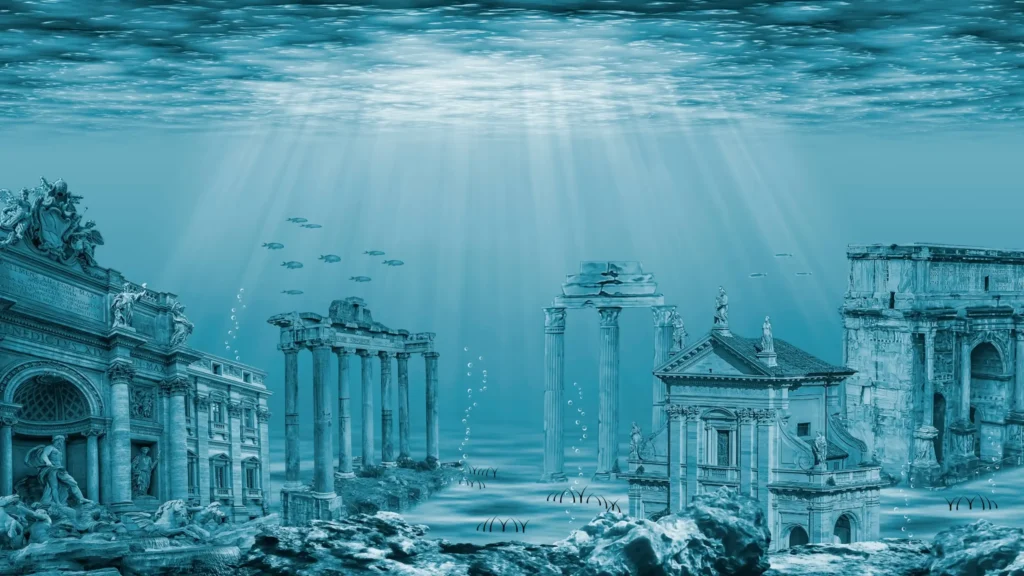
The Atlantis debate returns not because people are chasing fantasy, but because modern science now has the tools to test stories that were once impossible to verify. Instead of dismissing the legend outright, researchers are beginning to ask a different question: could ancient people have preserved a real disaster in the form of a story? What makes the discussion different today is the seriousness behind it. Archaeologists are no longer hunting for crystal cities or mythical technologies. The modern approach is cautious and grounded. Historians, geologists, and oceanographers now compare Plato’s writings with volcanic eruptions, earthquake zones, and evidence of drowned coastlines. The story is being treated less like a fairy tale and more like a historical clue. In that sense, the mystery has matured.
As the Atlantis debate returns to serious academic discussion, researchers are focusing on understanding memory rather than chasing treasure. Plato described canals, harbors, and a powerful naval empire destroyed suddenly by nature. When scientists compare that description with the archaeological record, they find something interesting: ancient civilizations were repeatedly struck by catastrophic events. Tsunamis, earthquakes, and rising sea levels wiped out entire communities long before written history became reliable. Recent underwater surveys around the Mediterranean and Atlantic have discovered dozens of submerged settlements, proving that large populations did once live where oceans now exist. These discoveries do not confirm Atlantis directly, but they make the idea of a drowned civilization far less impossible than it once seemed.
Table of Contents
Atlantis Debate Returns
| Source Or Claim | Proposed Location | Supporting Evidence | Counterpoints | Current Scholarly View |
|---|---|---|---|---|
| Plato’s Timaeus And Critias | Beyond Strait Of Gibraltar | Detailed political and geographic description | Written as philosophical dialogue | Possible allegory inspired by real events |
| Minoan Civilization Theory | Santorini And Crete | Massive volcanic eruption and tsunami | Location differs from Atlantic setting | Most studied academic theory |
| Spanish Marshland Theory | Southern Spain | Circular satellite patterns | No confirmed ruins | Speculative |
| Mid Atlantic Ridge Theory | Deep Atlantic Ocean | Geological activity | No human remains | Rejected by mainstream science |
| Caribbean Bimini Road | Bahamas | Rock formations resembling walls | Natural geology | Not supported by archaeologists |
Plato’s Original Account
- The Atlantis debate returns again and again because Plato did not write the story casually. Around 360 BCE, he described a wealthy island power located beyond the Pillars of Hercules, known today as the Strait of Gibraltar. According to his dialogue, Atlantis had a structured government, advanced engineering, and strong naval dominance. He claimed the Atlanteans attempted to conquer Athens but were destroyed when earthquakes and floods sank their island in a single day and night.
- Many classic historians believe Plato created the narrative to illustrate a political message about moral decline and arrogance. Yet the level of detail he included remains unusual. He described ringed canals, harbors, and planned architecture, which feels closer to observation than imagination. Even more intriguing, he said the information came from Egyptian priests whose records were older than Greek civilization. That detail keeps historians curious and is one reason the story refuses to fade away.
The Santorini Eruption Connection
- One of the strongest reasons the Atlantis debate returns to academic interest is the eruption of the Santorini volcano roughly 3,600 years ago. Geological evidence shows it was one of the most violent eruptions in human history. Ash clouds spread across the eastern Mediterranean, and tsunamis struck coastal settlements across nearby islands.
- Excavations at the buried city of Akrotiri revealed paved roads, multi story buildings, drainage systems, and detailed wall paintings. The city was sophisticated and prosperous, then suddenly abandoned. Many scholars believe survivors carried stories of destruction to other cultures. Over generations, those accounts may have traveled to Egypt and eventually to Greece, where Plato heard them.
- The geography does not perfectly match Plato’s description of an Atlantic location, but oral tradition changes details over time. Memories stretch, distances shift, and dramatic events grow larger in storytelling.
Geological Explanations
- Another reason the Atlantis debate returns is modern climate science. After the last Ice Age ended, melting glaciers caused global sea levels to rise dramatically. Coastlines that once supported villages now lie underwater. Marine archaeologists have discovered submerged settlements in the Mediterranean, the Black Sea, and even the North Sea near Europe.
- This suggests Atlantis may not have been a single empire at all. Instead, it may represent a collective memory of multiple coastal societies lost to water. Imagine generations watching the sea swallow farmland and homes. Stories would naturally form, and those stories would survive far longer than physical evidence.
- Ancient people did not write scientific reports. They preserved knowledge through myth, legend, and oral tradition. A catastrophic flood could easily become a powerful narrative about a vanished civilization.
Modern Technology and Ocean Mapping
- The Atlantis debate returns strongly today because technology finally allows testing of long standing claims. Advanced sonar, underwater drones, and satellite mapping can now reveal structures beneath sediment and shallow seas.
- Several locations once promoted as Atlantis have already been investigated. Underwater formations near the Bahamas once looked like stone roads, but geological analysis showed they formed naturally through coastal processes. Marshlands in southern Spain revealed circular patterns from above, yet excavation showed later settlements built over natural features.
- These findings did not end the discussion. Instead, they improved it. The search moved from speculation to careful verification. Scientists now follow evidence rather than imagination.
Why The Myth Endures
- The Atlantis debate returns partly because the story speaks to human nature. Every society fears sudden collapse. A thriving civilization destroyed overnight feels believable even today. Earthquakes, tsunamis, and climate change remind us that stability is fragile.
- Atlantis also survives because it sits between fiction and reality. It is not anonymous folklore. It comes from a known philosopher and a specific historical period. That gives it credibility, even without proof.
- People are drawn to mysteries with a possibility of truth. Atlantis provides just enough uncertainty to remain fascinating.
Skepticism And Scientific Standards
- Most archaeologists remain cautious. No tools, inscriptions, or confirmed structures tied directly to Atlantis have been found. Scientific research requires physical evidence. A written story alone cannot confirm a civilization.
- Still, the Atlantis debate returns in academic circles because myths sometimes hide history. For centuries the city of Troy was considered fictional until excavations uncovered real ruins matching ancient descriptions. Researchers are not claiming Atlantis existed exactly as Plato described, but they are investigating whether a real catastrophe inspired his narrative. Curiosity does not equal belief. It means the question is worth studying.
What Future Research May Bring
Oceans still hold many secrets. Large portions of the seafloor remain unmapped. As underwater exploration expands, archaeologists will likely discover more ancient ports, drowned trade routes, and coastal communities. The Atlantis debate returns each time a new underwater settlement is found because every discovery helps reconstruct ancient human experience. The search today is no longer about finding golden temples or mythical technology. It is about understanding how early civilizations remembered disasters and preserved them in storytelling. Atlantis may never be discovered as a single lost city. Yet its importance remains. The legend teaches historians how memory works and how societies process trauma. Whether the island existed or not, the story carries meaning. It reminds us that even powerful cultures can vanish, leaving only stories behind.
FAQs on Atlantis Debate Returns
Did Atlantis actually exist?
There is no confirmed archaeological proof of a civilization exactly matching Plato’s description. Most scholars believe it was a philosophical story possibly inspired by real disasters.
Where do researchers think Atlantis could be?
Popular theories include Santorini in Greece, coastal Spain, and submerged Mediterranean settlements, though none are proven.
Why are scientists still studying Atlantis?
Researchers study it to understand how ancient cultures recorded catastrophic events and how myths preserve historical memory.
What is the most accepted explanation today?
The destruction of the Minoan civilization after the Santorini eruption is widely considered the most realistic inspiration for the story.