
For decades, scientists believed they had mapped out a fairly solid outline of our evolutionary story. We came from Africa. Different early human species appeared, overlapped, and eventually one lineage survived while the others vanished. It seemed structured, almost orderly. Then discoveries like the Dmanisi fossil forced researchers to slow down and reconsider. Could One Skull Disprove Everything We Thought About Human Origins? It may sound exaggerated, but in paleoanthropology a single well-preserved skull can force experts to rethink entire evolutionary models. Could One Skull Disprove Everything We Thought About Human Origins? When fossil evidence contradicts neat classifications, the debate becomes serious. Human evolution is not a straight ladder leading to modern humans. It is more like a tangled network of populations spreading, adapting, and sometimes blending. In 2026, scientists are still debating how many early Homo species truly existed. New imaging technologies and digital fossil reconstructions have sharpened comparisons between specimens found thousands of miles apart. The big question remains relevant today. Could One Skull Disprove Everything We Thought About Human Origins? To understand why that question matters, we need to look closely at one remarkable fossil discovery.
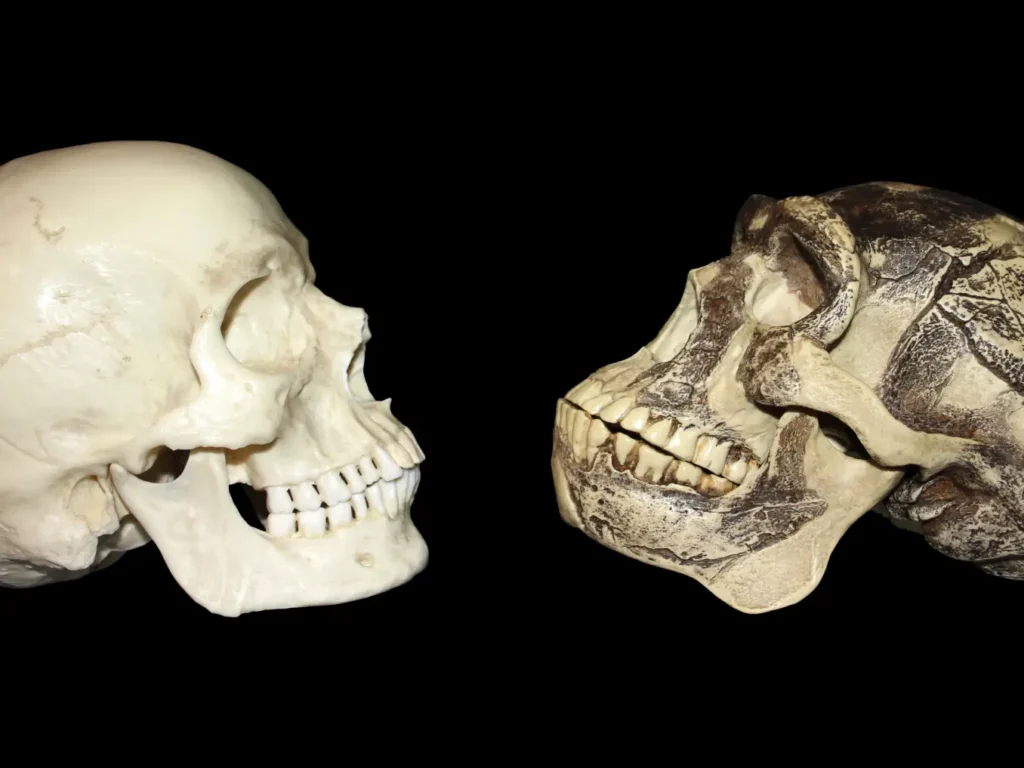
The question Could One Skull Disprove Everything We Thought About Human Origins? sits at the center of one of the most intense debates in evolutionary science. The discovery of a nearly complete 1.8-million-year-old skull at Dmanisi in Georgia shook the foundations of early human classification. The fossil, often called Skull 5, displayed a surprising combination of features that did not neatly match existing species categories. For years, researchers separated early Homo fossils into distinct species such as Homo habilis and Homo erectus based largely on skull shape and brain size. Skull 5 blurred those boundaries. Its small braincase resembled fossils attributed to Homo habilis, yet its facial structure looked more like early Homo erectus. That mix led scientists to reconsider whether these fossils truly represented different species or simply natural variation within a single evolving population.
Table of Contents
Could One Skull Disprove Everything We Thought About Human Origins?
| Key Information | Details |
|---|---|
| Discovery Location | Dmanisi, Georgia |
| Estimated Age | About 1.8 million years |
| Fossil Name | Skull 5 |
| Cranial Capacity | Around 546 cc |
| Lead Researcher | David Lordkipanidze |
| Published In | Science |
| Scientific Debate | Single species variation vs multiple early Homo species |
| Broader Impact | Rethinking migration and classification models |
A Fossil That Didn’t Fit The Mold
- When Skull 5 was carefully reconstructed and analyzed, the reaction in the scientific community was immediate. It simply did not fit the mold. For decades, paleoanthropologists relied heavily on cranial measurements to distinguish species. Brain size, facial projection, jaw thickness, and brow ridge prominence were treated as key dividing lines.
- This fossil challenged that approach. Its brain volume was relatively small compared to classic Homo erectus specimens. At the same time, its facial proportions were long and robust. Previously, those features would have been sorted into separate species boxes.
- Could One Skull Disprove Everything We Thought About Human Origins? It might not erase decades of research, but it does force a serious reconsideration of how species are defined in the fossil record. Modern humans vary widely in skull size and facial structure. No one would classify present day populations into different species based on those differences. The Dmanisi skull suggests early humans may have shown similar levels of diversity.
Rethinking Early Homo Species
- For many years, textbooks presented a lineup of early Homo species coexisting roughly two million years ago. Homo habilis was often described as more primitive, with a smaller brain. Homo erectus was seen as more advanced, with a larger brain and a body adapted for long distance travel. The Dmanisi evidence complicates that tidy progression. Fossils from the same site show notable variation in skull shape and size, yet they appear to belong to one interconnected population. If that interpretation holds, some of the early species distinctions may represent over splitting rather than genuine evolutionary branches.
- Could One Skull Disprove Everything We Thought About Human Origins? It may not disprove the overall framework of human evolution, but it strongly suggests that early Homo diversity was more fluid than once believed. In 2026, digital morphometric analysis allows researchers to compare fossil shapes in far greater detail. These comparisons increasingly show overlapping features between specimens once labeled as separate species. Not all scientists agree with collapsing species categories. Some argue that distinct evolutionary lineages still existed. The debate continues, and that ongoing discussion is a healthy part of scientific progress.
What Skull Shape Reveals About Evolution
- A skull carries remarkable information. It reveals brain size, chewing adaptations, and aspects of posture. It can even hint at social complexity. For decades, researchers assumed that significant brain expansion happened before early humans left Africa. The Dmanisi fossils challenge that assumption. These individuals appear to have migrated out of Africa with relatively modest brain sizes. That forces a reevaluation of what traits were essential for early human dispersal.
- Could One Skull Disprove Everything We Thought About Human Origins? In terms of migration theory, it certainly reshaped the timeline. It suggests that adaptability, cooperation, and basic tool use may have mattered more than large brains alone. That insight shifts attention toward behavioral flexibility rather than purely anatomical milestones. This has major implications for understanding early human survival strategies. It also highlights how one well preserved skull can affect multiple areas of research at once.
A Pattern in Paleoanthropology
- The Dmanisi skull is not an isolated example of a single fossil altering scientific thinking. Throughout the history of paleoanthropology, major discoveries have repeatedly forced revisions of accepted models. Each time a nearly complete skull is uncovered, it provides a clearer picture than fragmented remains.
- Many early species were named based on limited evidence. A jaw here, a partial cranium there. When a full skull surfaces, it allows researchers to evaluate multiple traits together. That broader context can reveal that previous classifications were built on incomplete information.
- Could One Skull Disprove Everything We Thought About Human Origins? History suggests that while no single fossil erases an entire field of study, it can dramatically redirect the conversation. Scientific understanding grows through these moments of disruption.
The Limits Of The Fossil Record
- It is important to remember that the fossil record is far from complete. Millions of years of human evolution are represented by a relatively small number of well preserved remains. Environmental conditions rarely allow bones to fossilize. Many regions have yet to be explored thoroughly.
- Because of this, each new skull discovery carries weight. It fills gaps and sometimes exposes weaknesses in earlier assumptions. Could One Skull Disprove Everything We Thought About Human Origins? It can certainly highlight how provisional some classifications are.
- Modern technologies are improving accuracy. High resolution scanning, advanced dating techniques, and 3D modeling are refining timelines and anatomical comparisons. Still, the story remains incomplete. Future discoveries may confirm the Dmanisi interpretation or complicate it further.
Could One Skull Disprove Everything
- At its core, the question Could One Skull Disprove Everything We Thought About Human Origins? captures the dynamic nature of science. The answer is nuanced. One skull cannot dismantle the entire theory of evolution. The evidence for human evolution comes from fossils, genetics, archaeology, and comparative anatomy. However, a single skull can challenge specific interpretations. It can expose flaws in classification systems. It can shift timelines and influence migration theories. Skull 5 did exactly that.
- Rather than disproving everything, it refined our understanding. It reminded researchers that evolution rarely follows neat categories. Variation within populations can be broader than expected. Species boundaries in deep time may not align with modern definitions. In many ways, that is the beauty of evolutionary science. It is self-correcting. When new evidence appears, theories adapt. That flexibility ensures that our understanding of human origins grows more accurate over time.
- As excavations continue across Africa, Eurasia, and beyond, more discoveries are inevitable. Perhaps another skull will emerge that reshapes the narrative once again. Until then, the Dmanisi fossil stands as a powerful example of how one piece of ancient bone can spark global debate. Human evolution remains one of the most fascinating scientific stories ever told. It is not static. It evolves just as the species it studies once did. And sometimes, all it takes is one skull to remind us how much there is still to learn.
FAQs on Could One Skull Disprove Everything We Thought About Human Origins?
1. What Is the Dmanisi Skull and Why Is It Important?
The Dmanisi skull, often referred to as Skull 5, is a 1.8-million-year-old fossil discovered at Dmanisi. It is one of the most complete early Homo skulls ever found.
2. Could One Skull Disprove Everything We Thought About Human Origins?
Not entirely. One skull cannot overturn the entire theory of human evolution, which is supported by fossil, genetic, and archaeological evidence.
3. How Old Is the Skull and What Does Its Age Tell Us?
The skull is approximately 1.8 million years old. Its age suggests that early humans had already migrated out of Africa much earlier than once believed.
4. Why Is Brain Size Such a Big Part of the Debate?
Brain size has traditionally been used to distinguish between early human species. Larger brains were often linked to more advanced species like Homo erectus.