

Scientists say they have clarified the physics behind Desert Singing Sands, a rare natural phenomenon in which sand dunes emit a deep, resonant hum during avalanches. The findings, published in peer-reviewed geophysics research and supported by field experiments in North Africa and Asia, explain why only certain dunes produce sustained sound and why the tones resemble musical notes.
Researchers report that synchronized grain movement and dune-layer resonance are key to the acoustic effect.
Table of Contents
What Are Desert Singing Sands?
Desert Singing Sands refer to large sand dunes that produce a low-frequency sound when sand flows down their slopes. The sound can last several minutes and reach volumes comparable to a low-flying aircraft at close range.
The phenomenon has been documented for centuries. Travelers along trade routes in the Sahara Desert described dunes that “boomed” or “sang,” according to historical accounts cited by geologists. Similar reports have emerged from dunes in China, the Middle East, and parts of the southwestern United States.
Modern acoustic measurements show that the tones typically fall between 70 and 110 hertz. That range aligns with the frequency of a low musical note.
How Scientists Solved the Mystery
Synchronized Grain Motion Drives the Sound
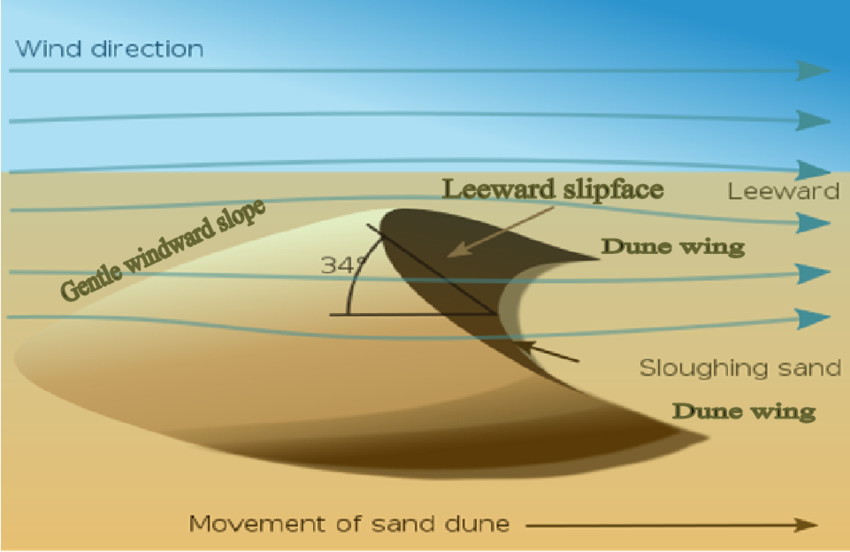
Researchers studying granular physics have determined that the sound begins when a thin layer of dry sand avalanches down a steep dune face. As millions of grains collide, they begin to move in a coordinated pattern.
“When the grains are nearly identical in size and shape, they can synchronize,” said Dr. Stéphane Douady, a physicist at the University of Paris who has conducted field research on booming dunes. “That synchronization allows the collisions to amplify each other rather than cancel out.”
According to published findings in geophysical journals, the moving surface layer vibrates at a specific frequency. A compact layer beneath acts as a natural resonator, reflecting and strengthening the sound waves. The dune, in effect, becomes a large acoustic instrument.
The Role of Uniform Sand and Dry Conditions
Scientists say only a small fraction of the world’s dunes produce sustained sound because the conditions must be precise.
Grains must be well-rounded, polished, and similar in size. Even slight moisture can disrupt the effect by causing particles to stick together. Wind patterns and slope angles must also be optimal to trigger a steady avalanche.
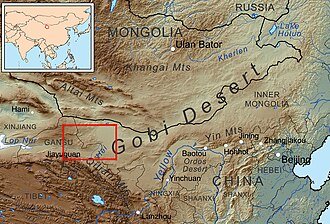
Field studies conducted in Morocco’s Sahara Desert and China’s Badain Jaran Desert show that humidity levels above a narrow threshold can silence dunes entirely, according to researchers.
Why the Discovery Matters
The study of Desert Singing Sands extends beyond curiosity. Experts say the findings deepen understanding of granular materials, which include sand, grains, powders, and industrial particles.
“Granular flow is central to many natural hazards and industrial processes,” said Dr. Nathalie Vriend, a physicist at the University of Cambridge who has researched booming dunes. “Understanding how grains coordinate under motion can inform landslide modeling and material transport systems.”
Granular physics plays a role in predicting avalanches, managing soil erosion, and improving bulk material handling in manufacturing.
Where Desert Singing Sands Occur
Documented locations of singing dunes include:
- The Sahara Desert in North Africa
- The Badain Jaran Desert in China
- Dunes near Al-Askharah in Oman
- Sand Mountain in Nevada, United States
Researchers note that even within these regions, only certain dunes produce consistent tones.
A Rare Natural Instrument
Acoustic recordings show that each dune produces a characteristic pitch determined by grain size and dune structure. Larger grains tend to produce lower tones.
The sound can travel several miles under calm conditions. Observers often describe it as a hum, drone, or distant engine noise.
Despite centuries of folklore attributing the sound to spirits or hidden forces, scientists now attribute the phenomenon entirely to measurable physical principles.
Ongoing Questions
While researchers agree on the general mechanism, questions remain about how dunes maintain the precise layering required for resonance over time.
Environmental changes, including increased humidity linked to climate variability, may influence the frequency of active singing dunes. Scientists continue to conduct field measurements to understand long-term stability.
“The physics is clearer now than it was 20 years ago,” Douady said in a recorded lecture. “But dunes remain dynamic systems. They are always changing.”
FAQ
What causes Desert Singing Sands?
A synchronized avalanche of dry, uniform sand grains creates vibrations that resonate within the dune structure.
How loud are singing dunes?
Measurements indicate sounds can reach up to 100 decibels at close range.
Why don’t all dunes sing?
Most lack the precise grain uniformity, dryness, and structural layering required for resonance.
Are Desert Singing Sands dangerous?
The sound itself poses no known danger, though dune avalanches can be unstable for climbers.
Looking Ahead
Researchers continue to examine how shifting climate conditions and human activity affect the stability of dunes known for Desert Singing Sands. While the mystery of their sound may be largely solved, scientists say these natural acoustic systems remain valuable laboratories for studying granular physics in extreme environments.