
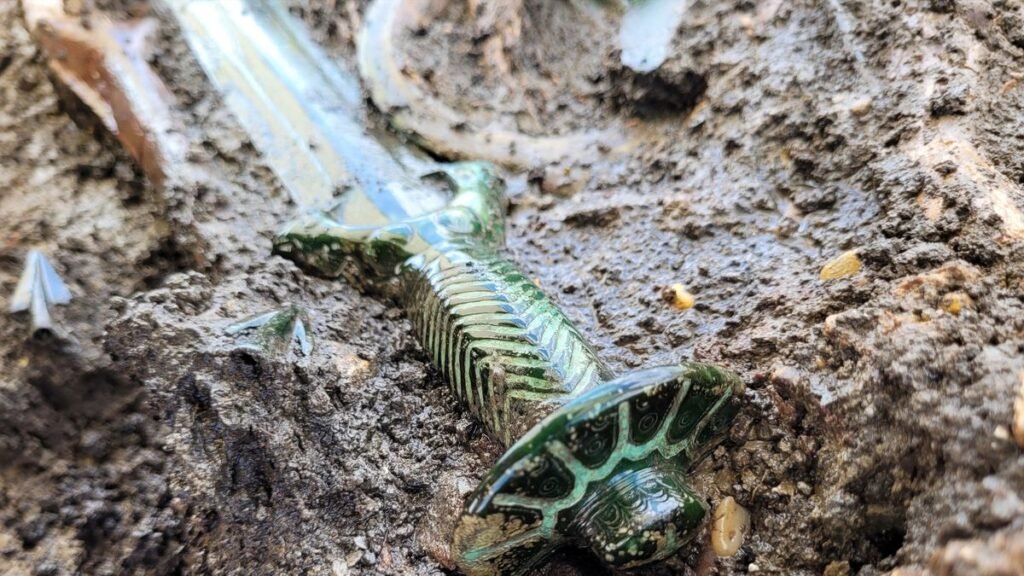
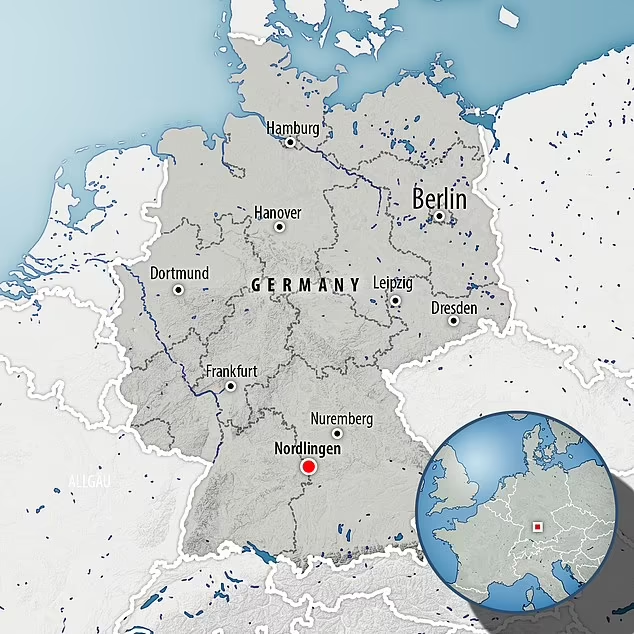
A Flawless Bronze Age Sword uncovered in southern Germany is reshaping historians’ understanding of prehistoric engineering after archaeologists recovered a remarkably preserved weapon dating to roughly 1400 BCE. Found inside a burial near Nördlingen, Bavaria, the blade’s pristine condition and complex construction suggest advanced metalworking knowledge far earlier than scholars once believed.
Table of Contents
Flawless Bronze Age Sword
| Key Fact | Detail/Statistic |
|---|---|
| Age | Approx. 3,000–3,400 years old |
| Location | Nördlingen, Bavaria, Germany |
| Condition | Minimal corrosion; blade intact |
| Construction | Octagonal hilt cast over blade |
Researchers plan further regional surveys to identify the workshop that produced the sword and to locate additional burials nearby. Archaeologists say future discoveries could reveal how early European societies shared knowledge, organized trade, and passed specialized skills across generations.
Burial Site Reveals Family Grave and Elite Status
Archaeologists from the Bavarian State Office for Monument Protection (BLfD) excavated the Flawless Bronze Age Sword during a 2023 investigation of a burial mound near Nördlingen in Bavaria.
The grave contained three individuals — a man, woman, and child — indicating a family burial rather than a battlefield interment. Researchers believe the weapon belonged to the adult male, whose burial placement and grave goods suggest elevated social standing.
Weapons in Bronze Age graves often symbolized leadership or warrior identity. The sword was positioned carefully beside the body, a practice associated with high-status burials across prehistoric Europe.
Officials noted the preservation was remarkable. Bronze weapons typically suffer heavy corrosion over millennia, yet this artifact retained its form and decorative detailing.
Engineering Behind the Flawless Bronze Age Sword
Complex Casting Method
One of the most significant features of the Flawless Bronze Age Sword is its octagonal hilt. Unlike many ancient weapons, the handle was not riveted onto the blade. Instead, molten bronze was poured around the base of the blade during production.
This required precise temperature management and careful mold preparation.
Archaeometallurgy specialists say this technique demonstrates specialized craftsmanship.
“It demanded careful control of heat and cooling,” researchers explained in excavation findings. “The maker had to anticipate how metal contracts while solidifying.”
The design corresponds to a rare group of swords associated with metalworking centers in southern Germany and northern Italy, suggesting organized workshops rather than isolated smiths.
Alloy Composition Shows Deliberate Engineering
Scientific testing revealed a carefully balanced mixture of copper and tin — the defining components of bronze.
The ratio appears intentional:
- Higher tin concentration at the cutting edge
- Slightly softer core for flexibility
This structure allowed the sword to absorb shock while retaining a sharp edge. Modern metallurgists describe the method as early “materials optimization,” similar to layered blades used centuries later.
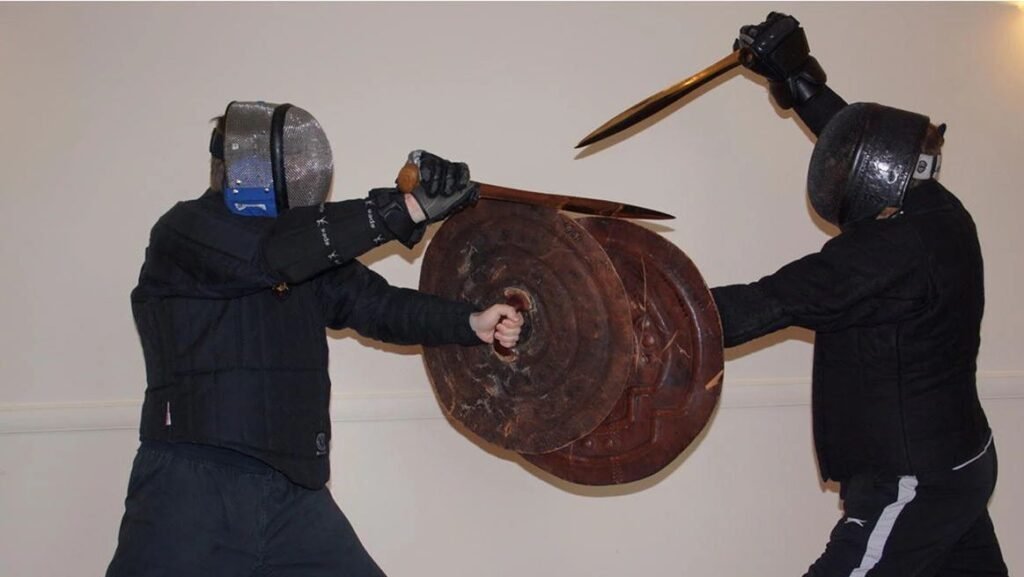
Evidence the Weapon Was Used in Combat
At first, the nearly perfect appearance suggested a ceremonial object. However, microscopic examination changed that assumption.
Under magnification, researchers identified:
- fine edge wear
- polishing patterns from repeated motion
- slight impact deformation
These characteristics are consistent with actual use in combat or training.
Bronze swords were primarily slashing weapons. Because bronze bends more easily than iron, fighters used sweeping cuts rather than thrusts.
The evidence indicates the Flawless Bronze Age Sword was both functional and prestigious.
How Bronze Age Smiths Made the Sword
The production process likely involved several specialized stages.
Step 1: Ore Acquisition
Copper and tin ores were mined separately. Tin sources were rare and often distant from settlements.
Step 2: Smelting
Ore was heated in clay furnaces reaching temperatures above 1,000°C. Charcoal acted as fuel and reducing agent.
Step 3: Alloying
Metals were melted together in a crucible. The tin percentage had to be carefully controlled — too much caused brittleness, too little produced softness.
Step 4: Casting
Liquid bronze was poured into a stone or clay mold shaped like a sword blade.
Step 5: Finishing
After cooling, the weapon was:
- ground smooth with stone abrasives
- polished with sand or fine mineral powder
- sharpened along the edges
The octagonal hilt required an additional casting phase, showing multi-stage manufacturing.
What the Discovery Says About Bronze Age Society
The Flawless Bronze Age Sword indicates a structured society with occupational specialization.
Evidence suggests:
- professional metalworkers existed
- weapons signified authority
- trade networks were established
Tin was scarce in central Europe. Scholars believe it traveled through long-distance exchange routes from mining regions such as Cornwall in Britain or the Erzgebirge mountains.
This implies early economic networks operating centuries before written records in the region.
The burial itself reflects social hierarchy. The careful placement of a weapon alongside family members suggests hereditary status or clan leadership.
Trade Networks and the Early European Economy
The sword also offers insight into prehistoric globalization.
Bronze production required two metals rarely found together geographically. Communities had to cooperate across regions to obtain resources.
Archaeologists believe trade routes connected:
- Alpine settlements
- Central European river systems
- Mediterranean coastal cultures
Such networks likely transported not only metals but also knowledge and craftsmanship techniques.
Why the Sword Survived 3,000 Years
Iron rusts rapidly when exposed to oxygen and moisture. Bronze behaves differently.
The alloy forms a stable protective patina called copper oxide. This layer slows corrosion instead of accelerating it.
Additional preservation factors:
- low oxygen burial environment
- stable soil chemistry
- minimal disturbance
Conservation specialists reported the artifact required limited stabilization after excavation.
Comparison With Other Ancient Weapons
The discovery is frequently compared to other famous ancient swords, including royal Chinese bronze blades and later Iron Age weapons.
Key differences:
| Bronze Sword | Iron Sword |
|---|---|
| Flexible | Rigid |
| Resistant to rust | Prone to corrosion |
| Slashing design | Thrusting capable |
| Earlier metallurgy | Later technological phase |
The Flawless Bronze Age Sword shows that technological sophistication existed well before ironworking spread across Europe around 800 BCE.
Scientific Analysis and Conservation
After excavation, the sword was transported to a conservation laboratory. Specialists used:
- X-ray imaging
- metallographic microscopy
- chemical composition analysis
The tests allowed scientists to examine the internal structure without damaging the artifact.
Conservators cleaned the surface carefully and stabilized minor corrosion using controlled humidity environments.
They avoided heavy restoration to preserve original material.
Broader Historical Significance
Historians say the discovery supports a growing reassessment of prehistoric Europe. The period was not technologically primitive but instead marked by experimentation and skilled craftsmanship.
The Flawless Bronze Age Sword demonstrates that ancient societies:
- understood metallurgy
- organized labor
- maintained trade economies
It narrows the technological gap between the Bronze Age and later historical civilizations.
FAQs About Flawless Bronze Age Sword
Why is the Flawless Bronze Age Sword important?
It proves advanced metal engineering existed in Europe more than 3,000 years ago.
Was the sword decorative?
No. Microscopic wear indicates real combat use.
How rare is such preservation?
Extremely rare. Most Bronze Age weapons survive only as fragments.
Who owned it?
Likely a high-status warrior or local leader.