
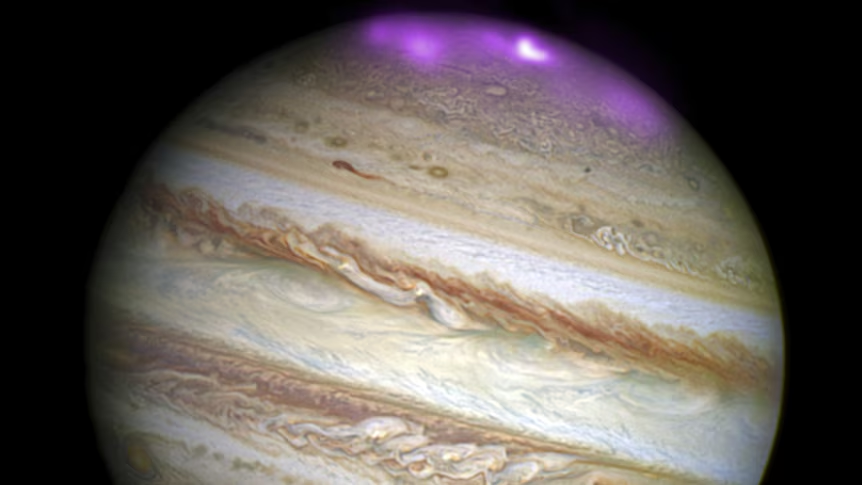
A Blue Aurora On Jupiter observed by NASA spacecraft and telescopes is reshaping scientific understanding of the solar system’s largest planet. Data collected by the National Aeronautics and Space Administration (NASA) Juno spacecraft and the James Webb Space Telescope show that Jupiter’s atmosphere is strongly influenced by charged particles, magnetic forces, and interactions with its moons, rather than weather alone.
Table of Contents
NASA Spots Unusual Blue Aurora On Jupiter
| Key Fact | Detail |
|---|---|
| Continuous aurora | Jupiter’s auroras occur nearly constantly |
| Energy source | Volcanic moon Io supplies charged particles |
| Atmospheric effect | Auroras heat and chemically change upper atmosphere |
Researchers say the Blue Aurora On Jupiter marks a turning point in planetary science. The discovery suggests gas giants are not passive worlds dominated only by weather. Instead, they are active environments shaped by magnetism, plasma, and interactions with nearby moons. Continued observations may reveal similar processes across distant planetary systems.
What Scientists Observed
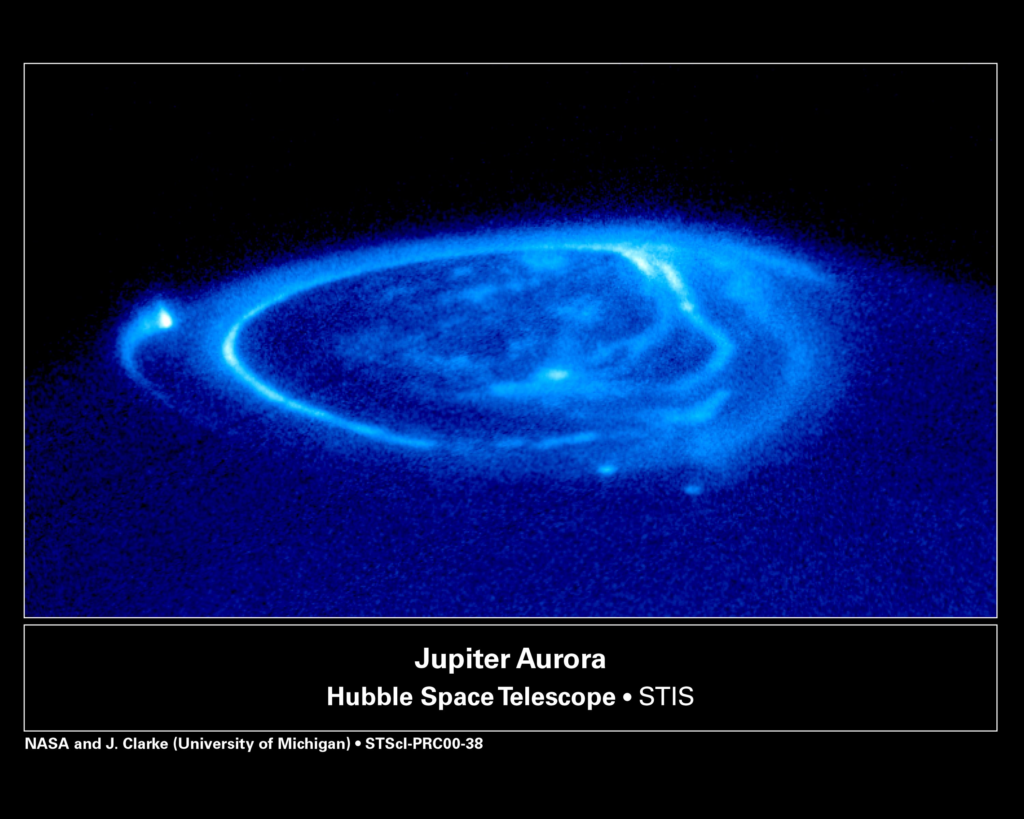
Astronomers detected intense glowing rings around Jupiter’s poles across ultraviolet and infrared wavelengths. When converted into visible-light color, these emissions appear blue.
The color comes from energetic electrons colliding with hydrogen molecules in the upper atmosphere. The collisions excite the atoms, which release light as they return to a stable state.
“These auroras release vastly more power than Earth’s northern lights,” said Dr. Jonathan Nichols, a planetary scientist at the University of Leicester. “They represent an extreme version of a process we only see in a much weaker form on our planet.”
Unlike Earth’s auroras, which occur mainly after solar storms, Jupiter’s auroras are persistent and almost never disappear.
Why the Blue Aurora On Jupiter Matters
A Planet That Powers Its Own Aurora
Jupiter is not dependent on the Sun to create its auroras. Instead, scientists say the planet runs a self-contained space-weather system.
The key factor is the moon Io, the most volcanically active body in the solar system. Continuous eruptions send clouds of sulfur and oxygen particles into space. Jupiter’s enormous magnetic field traps these particles and accelerates them toward its poles.
The particles travel along magnetic field lines and strike the atmosphere, generating the Blue Aurora On Jupiter.
Dr. Scott Bolton, principal investigator of NASA’s Juno mission, described the process as “a planetary electrical circuit,” with currents far exceeding those found on Earth.
A Giant Magnetic Environment
Jupiter’s magnetosphere is so large it could fit the Sun inside it if visible. Scientists estimate it extends several million kilometers into space and rotates with the planet.
As Jupiter spins once every 10 hours, the magnetic field drags charged particles with it. This rapid rotation produces powerful electrical currents that feed the aurora.
How the Aurora Changes Jupiter’s Atmosphere
For decades, researchers believed Jupiter’s atmosphere was shaped mainly by internal heat rising from the planet’s interior. Massive storms and jet streams were considered the dominant forces.
New observations indicate the aurora plays a major role.
Heating the Upper Atmosphere
Measurements show temperatures in the upper atmosphere are much higher than predicted. Scientists now attribute much of this heat to energetic particles from the aurora.
Chemical Changes
The Blue Aurora On Jupiter triggers chemical reactions that create new compounds and high-altitude hazes. These changes affect how sunlight is absorbed and reflected.
Atmospheric Circulation
Energy deposited near the poles appears to drive winds that influence weather patterns far from the auroral regions. Researchers believe the aurora may help shape large-scale atmospheric circulation.
What Juno and Webb Revealed
New Plasma Waves
Juno instruments detected unusual plasma waves that accelerate electrons before they enter the atmosphere. This mechanism had never been directly measured around a planet before.
Rapid Brightness Changes
The James Webb Space Telescope recorded sudden brightening events in the aurora. Some regions intensified within minutes, showing the system is highly dynamic.
Scientists say this challenges older models that assumed the aurora changed slowly.
Comparison With Earth’s Northern Lights
Earth’s auroras occur when solar wind particles interact with Earth’s magnetic field. They usually appear after solar flares and coronal mass ejections.
Jupiter’s auroras differ in several key ways:
| Feature | Earth | Jupiter |
|---|---|---|
| Main energy source | Solar storms | Internal magnetic activity + Io |
| Frequency | Occasional | Continuous |
| Energy level | Moderate | Hundreds of times stronger |
| Visibility | Visible to naked eye | Mostly ultraviolet/infrared |
Because most of Jupiter’s aurora emits outside visible wavelengths, humans cannot see it directly even through ordinary telescopes.
Implications for Spacecraft and Future Missions
The Blue Aurora On Jupiter also has practical importance for exploration.
Radiation around Jupiter is extremely intense. Energetic particles trapped in the magnetic field can damage electronics. NASA engineers designed Juno with a titanium radiation vault to protect instruments.
Future spacecraft must also plan around the radiation belts.
NASA’s upcoming Europa Clipper mission, which will study Jupiter’s icy moon Europa, will carefully choose flight paths to reduce exposure.
Broader Implications for Other Planets
Astronomers study Jupiter because it serves as a model for giant planets throughout the universe.
Many known exoplanets are “hot Jupiters,” massive gas giants orbiting very close to their stars. They likely experience even stronger magnetic and atmospheric interactions.
Understanding the Blue Aurora On Jupiter helps scientists answer major questions:
- How do planets keep their atmospheres?
- How does radiation affect habitability?
- Can magnetic fields protect life?
Nichols explained that Jupiter offers “a nearby example of processes that probably occur across the galaxy.”
Historical Context: Earlier Observations
Jupiter’s auroras were first detected in ultraviolet light in 1979 by the Voyager spacecraft. Later missions, including Galileo and the Hubble Space Telescope, confirmed the phenomenon.
However, earlier instruments lacked the sensitivity of modern observatories. Only with Juno’s polar orbit and Webb’s infrared imaging could scientists track energy flow in detail.
The new discovery is therefore not just a confirmation but a shift in interpretation.
The Role of the Sun
Although Jupiter powers much of its own aurora, the Sun still influences it.
Solar wind pressure can compress Jupiter’s magnetosphere. When that happens, auroral brightness increases temporarily.
Scientists now believe Jupiter’s aurora is produced by a combination of internal and solar processes, though internal sources dominate.
What Happens Next
NASA will continue Juno flybys through at least the late 2020s. Researchers also plan coordinated observations using Webb, Hubble, and ground-based telescopes.
Scientists want to determine:
- whether the aurora varies with Io’s volcanic activity
- how it responds to solar cycles
- how deeply its effects reach into the atmosphere
FAQs About NASA Spots Unusual Blue Aurora On Jupiter
Why is it blue?
High-energy electrons excite hydrogen molecules, which emit blue-tinted light in visible wavelengths.
Can we see it from Earth?
No. Most emissions occur in ultraviolet and infrared light invisible to human eyes.
Is Jupiter unique?
No, Saturn and other planets have auroras, but Jupiter’s are the most powerful in the solar system.