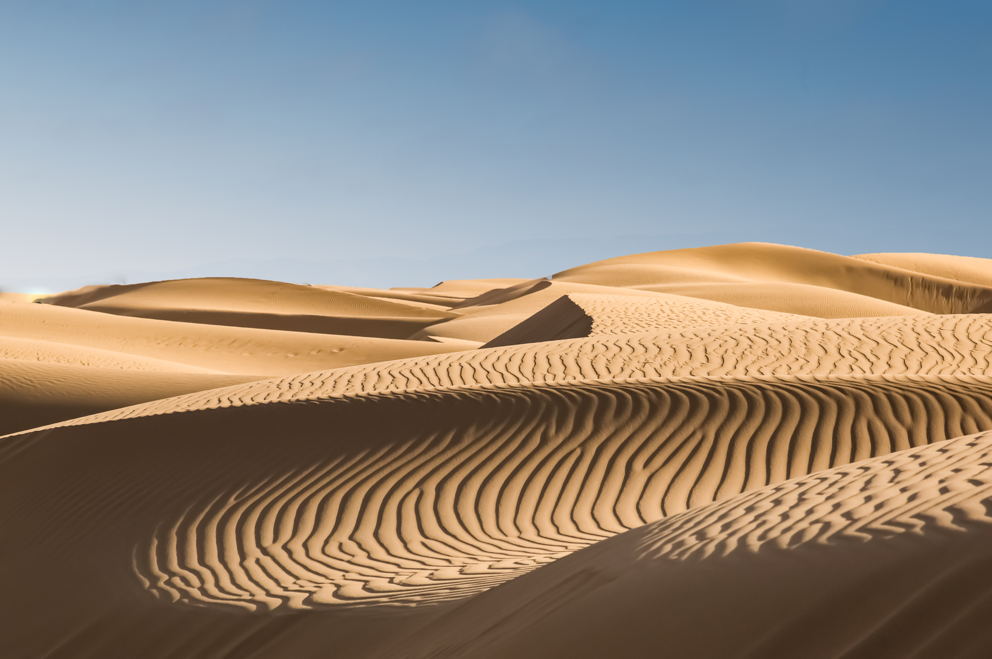

Imagine standing on a quiet desert dune just before sunset. The sky glows orange, the air feels completely still, and then without warning the ground beneath your feet begins to hum. Not a faint rustle, not the sound of wind, but a deep, steady vibration that you can actually feel in your chest.
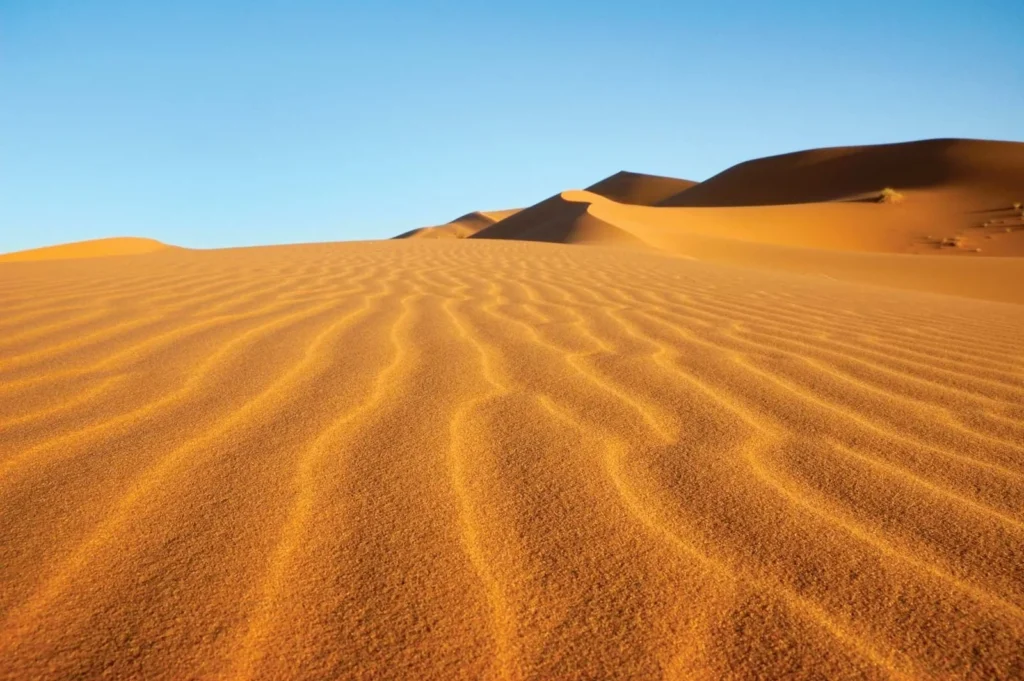
This is what people experience when they encounter booming sand dunes, and nearly everyone who hears it reacts the same way: confusion first, then amazement. The mystery of booming sand dunes has been recorded by travelers for centuries, long before science had any tools to explain it. Today we finally know that the sound isn’t caused by spirits, hidden caves, or underground movement. It comes from the sand itself. Under very specific conditions, an ordinary-looking dune transforms into something extraordinary a natural sound instrument built by wind and time. Once scientists started studying the phenomenon carefully, they discovered the desert wasn’t just making noise. It was producing a precise, physical vibration created by millions of moving grains working together.
In simple terms, booming sand dunes are dunes that emit a deep, musical humming sound when sand slides down their steep surface. The noise can continue for several minutes and is loud enough to be heard from far away. Researchers have measured some dunes producing sounds above 100 decibels, roughly similar to standing near a running motorcycle. The remarkable part is that booming sand dunes only occur when extremely dry and uniform sand grains move together in a flowing layer. Each grain bumps into its neighbors at nearly the same rhythm, creating vibrations that travel through the dune and become audible sound waves. Because the sand must be unusually smooth, rounded, and evenly sized, only a small number of deserts on Earth can produce booming sand dunes at all.
Table of Contents
Desert Sands Produce a Strange Deep Sound
| Feature | Details |
|---|---|
| Sound Type | Deep humming or droning |
| Frequency | Around 70–110 Hz |
| Trigger | Sand avalanche down dune face |
| Required Conditions | Extremely dry, uniform sand grains |
| Grain Size | Approximately 0.1–0.5 mm |
| Locations | Sahara, Gobi Desert, Death Valley, China deserts |
| Duration | A few seconds to several minutes |
| Loudness | Around 100+ dB |
The deep humming sound of certain desert dunes once frightened travelers because it seemed impossible. Now we know the explanation is grounded in physics. When extremely dry, smooth, and similarly sized sand grains slide together down a steep dune face, they collide in synchronized rhythm. Those tiny collisions combine into vibrations, and the dune amplifies them into a powerful sound. Booming sand dunes are rare not because deserts are rare, but because the conditions required are incredibly precise. Change the humidity, grain size, or surface texture, and the sound disappears. The phenomenon reminds us that nature often creates complex effects from simple elements. What sounds like a mysterious voice in the desert is actually millions of grains moving in perfect harmony.
What Are Singing or Booming Dunes
- Singing dunes, often called booming sand dunes, are rare natural formations where moving sand creates a continuous tone rather than a simple rustling noise. Most dunes shift quietly when sand moves, but certain steep dunes have a smooth slope called a slip face. When enough sand starts sliding down that slope at once, a thin sheet of grains begins flowing downhill together.
- Instead of sounding chaotic, the movement becomes organized. The grains behave almost like a fluid, and the sound comes from inside the moving sand, not from wind passing over the surface. Many people describe booming sand dunes as sounding like distant thunder, an airplane engine, or the low note of a giant musical instrument hidden beneath the ground.
Early Observations And Historical Confusion
- Long before scientists studied deserts, travelers already knew about the sound. Ancient trade caravans crossing Asia and North Africa wrote about dunes that roared without storms. Some guides even avoided certain dunes at night because animals panicked when the sound started.
- For a long time, explanations were mostly guesses. Some believed the dunes were hollow. Others thought underground air pockets were collapsing. A few suggested magnetic forces. The reason the mystery lasted so long is simple. The sound stops immediately when the sand stops moving, so observers had no clear way to trace the source.
- It took modern field equipment and careful measurements to realize the noise was coming directly from the moving sand grains themselves.
The Key Discovery A Moving Layer Not Individual Grains
- One of the most important discoveries researchers made was that the sound does not come from random collisions. Individual grains hitting each other would create only a faint noise. The real secret is synchronization.
- When sand slides down a steep dune, a thin layer forms that moves together. Inside that layer, each grain repeatedly bumps neighboring grains at almost the same timing. Imagine a crowd clapping randomly versus clapping in perfect rhythm. Random claps sound messy, but synchronized clapping becomes loud and powerful. Booming sand dunes work in exactly the same way.
- The entire sliding layer acts like one vibrating sheet, turning tiny impacts into a strong vibration.
How The Sound Is Actually Produced
- The process happens step by step. First, sand at the top of the dune becomes unstable and begins sliding. As it accelerates, a flowing layer forms. The grains begin bouncing and rubbing against each other in a repeating pattern. This creates vibrations that travel downward into the dune body.
- The dune then amplifies the vibration and releases it into the air as sound. The pitch of the sound depends mainly on grain size. Slightly larger grains produce deeper tones, while smaller grains produce higher notes. That is why each location with booming sand dunes has its own unique sound signature.
Why Only Certain Dunes Can Sing
- One of the most surprising discoveries is that dune size is not the deciding factor. A massive dune may stay silent, while a smaller one can produce a strong hum.
- The key factor is the sand itself. For booming sand dunes to occur, the grains must be very smooth and rounded. They must also be nearly identical in size. Even small amounts of dust or clay coating prevent the grains from moving freely enough to synchronize.
- If grains are rough or mixed in size, they interrupt each other’s rhythm and the sound never forms. This explains why only specific deserts around the world produce the effect.
The Role of Dryness and Humidity
- Moisture plays a major role in whether a dune sings or stays silent. When humidity increases, tiny films of water form between sand grains. These films cause grains to stick slightly together. Instead of bouncing cleanly, they slide slowly and absorb vibrations.
- After rainfall or fog, booming sand dunes often stop producing sound entirely. Only after long periods of heat and dryness do the grains separate enough for vibration to occur again. In extremely dry conditions, grains move freely and the sound returns.
Field Experiments That Solved the Mystery
- To confirm their theories, scientists took sand samples from sounding dunes and tested them in laboratories. They placed the sand inside rotating drums that simulated a dune avalanche. The same deep hum appeared indoors.
- Then they washed the sand and removed dust. The sound became clearer. When fine powder was added, the sound disappeared. These experiments proved the noise depends on grain characteristics, not just the dune’s shape.
- This was the moment the mystery was effectively solved.
Why The Sound Has A Single Musical Note
- People often notice the sound is not random. It holds one steady pitch like a musical tone. This happens because of resonance. The moving sand layer vibrates at a natural frequency, and the dune body amplifies that frequency.
- Just like a guitar body strengthens the sound of its strings, the dune strengthens the vibration produced by the grains. Because the thickness of the moving layer stays fairly consistent, the sound remains stable rather than chaotic.
Feeling The Sound
Another unusual feature is that people can feel the sound as much as they hear it. Low frequency vibrations travel efficiently through sand. Standing barefoot on an active dune allows the vibration to pass directly through the ground into your body. Observers sometimes feel a rumbling sensation in their legs before they even notice the noise. This makes the experience especially memorable.
Modern Understanding
Scientists now describe booming sand dunes as a granular acoustic phenomenon. Moving particles self-organize into synchronized motion, producing vibration powered entirely by gravity. The dune acts as a natural amplifier. The desert, in this case, becomes a carefully tuned instrument shaped by wind erosion over thousands of years. A precise balance of grain size, dryness, and slope angle must all exist together.
FAQs on Desert Sands Produce A Strange Deep Sound
1 Where Can I Hear Booming Sand Dunes
You can experience them in the Sahara Desert in Morocco, the Gobi Desert, China’s Badain Jaran Desert, and Death Valley National Park in the United States.
2 Are Booming Dunes Dangerous
No, the sound itself is harmless. Visitors only need to be cautious while climbing steep slopes to avoid slipping.
3 Why Do Most Deserts Stay Silent
Most desert sand contains mixed grain sizes and dust particles. Without uniform grains, synchronized vibration cannot occur.
4 Can Scientists Predict When A Dune Will Sound
Yes. Dry weather, low humidity, and freshly disturbed sand greatly increase the chances of hearing the sound.