
For decades, scientists have tried to answer a deceptively simple question: how did life actually begin? Before cells, before DNA, and long before animals or plants, Earth was a chemical world. Oceans were warm, volcanoes were active, and lightning regularly struck the atmosphere.
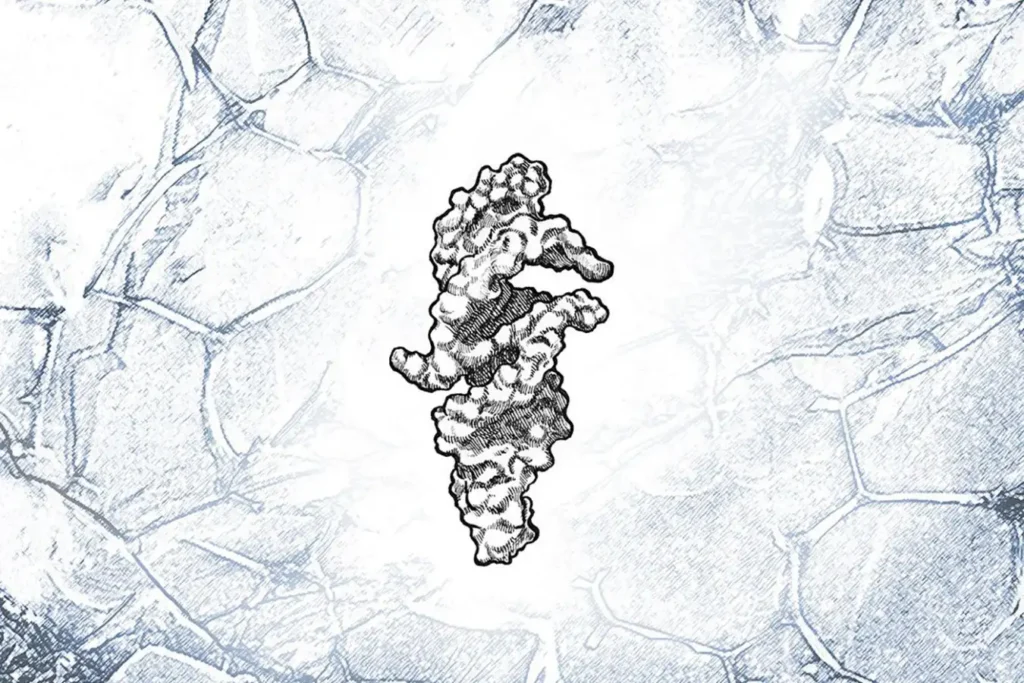
In that chaotic environment, researchers believe a very small but powerful actor appeared the self-replicating RNA molecule. The idea is gaining serious support because new laboratory evidence now shows that a self-replicating RNA molecule could copy genetic information in a primitive way. This discovery does not create life in a lab, but it shows how nature may have taken the first step from chemistry to biology. The fascinating part is not just that molecules can copy information. It is that they can do it well enough for change to accumulate over time. Imagine a recipe copied by hand again and again. Small mistakes appear. Some improve the recipe. Others ruin it.
Over many copies, only the useful versions survive. Scientists now think something very similar may have happened billions of years ago. Instead of cooks and recipes, there were chemicals and sequences. That possibility makes the origin of life feel less mysterious and far more understandable. A self-replicating RNA molecule is essentially a tiny strand of RNA capable of guiding the formation of new RNA strands. Unlike DNA, RNA is incredibly versatile. It can store information and perform chemical reactions at the same time. That dual ability is what makes scientists believe early Earth may have relied on RNA before cells existed. In controlled experiments, researchers observed small catalytic RNA sequences assembling matching strands from basic chemical building blocks. The copying process is imperfect, but it preserves information well enough for natural selection to occur. This means evolution could have started at the molecular level long before the first living organism appeared. Researchers describe this as chemistry learning how to remember.
Table of Contents
Tiny Self Copying RNA Discovery
| Aspect | Key Information |
|---|---|
| Type of molecule | Catalytic RNA (ribozyme) |
| Size | Very small compared to modern genes |
| Function | Helps assemble copies of RNA templates |
| Environment | Controlled laboratory chemical conditions |
| Accuracy | Imperfect but information-preserving |
| Importance | Supports the RNA World hypothesis |
| Limitation | Cannot yet operate freely outside controlled systems |
What Scientists Actually Found
- Researchers identified a ribozyme, a special RNA that acts like an enzyme, capable of copying RNA strands longer than itself. Earlier experiments could only extend short fragments before reactions stopped. This time, the system continued long enough to maintain recognizable sequences.
- Why is that important? Because heredity depends on information survival. If every copy changes completely, evolution cannot happen. The molecules must keep a recognizable pattern. The newly observed system did exactly that. Copies were not perfect, yet they were similar enough to their templates to pass along instructions. In simple terms, the molecules began to behave like ancestors and descendants.
- Scientists were particularly excited because the ribozyme was small. Early Earth likely did not support complex molecular machines. Simpler systems are more realistic. The discovery suggests life did not require a dramatic chemical miracle. It may have required only persistence and time.
How The Copying Process Works
- The RNA strand folds into a complex three dimensional structure. Certain folds create a chemical pocket that holds nucleotides, the building blocks of RNA. When a template strand sits beside it, matching nucleotides attach one at a time. Chemical bonds form and a complementary strand appears.
- Picture it like a zipper slowly closing. Each tooth connects only to its matching partner. The ribozyme does not force the reaction. It simply positions the pieces so chemistry can happen naturally. That small guidance is enough to create ordered sequences instead of random chains.
- This is slow compared with modern cellular biology. A living cell copies DNA in minutes. These reactions take much longer. But speed is not the point. Possibility is. The experiment demonstrates that genetic inheritance can exist without DNA, proteins, or even a cell membrane.
Why The RNA World Hypothesis Matters
- The RNA World hypothesis proposes that early life depended entirely on RNA before DNA and proteins evolved. DNA is excellent at storing information but chemically inactive. Proteins are powerful catalysts but cannot store genetic instructions. RNA sits in the middle, able to do both imperfectly.
- The new evidence strengthens this theory. If RNA copies itself with small mistakes, some versions become more stable or efficient. Those variants naturally dominate. Over thousands of cycles, improvements accumulate. Eventually new functions appear.
- This also explains a long standing mystery. Every organism on Earth uses the same genetic code. That shared system makes sense if all life descended from a common RNA based beginning. The code was established early and never replaced because it already worked well enough.
From Chemistry To Evolution
- One of the greatest scientific mysteries is how non living chemistry turned into biology. Evolution needs three things: information, reproduction, and variation. The new molecular system provides all three.
- It stores sequence information. It produces copies. And occasional copying errors create variation. With repetition, natural selection could operate without cells. Molecules that copied faster or lasted longer would gradually dominate their environment.
- This changes how we think about the origin of life. Life may not have started with a complete organism. Instead, evolution may have begun first. Organisms came later.
Why Size Is Important
Early Earth was harsh. Ultraviolet radiation, meteor impacts, and extreme heat constantly destroyed complex chemicals. Large fragile molecules would not survive long. Small molecules had a better chance. The studied ribozyme is compact, which makes the scenario realistic. Scientists believe environments such as shallow ponds, wet mineral surfaces, or volcanic hot springs could have supported these reactions naturally. Water cycles would concentrate chemicals. Evaporation would bring molecules together. Repetition would allow copying reactions to occur again and again. Early Earth may have been a natural laboratory running millions of experiments simultaneously.
What This Means For DNA And Proteins
- Modern organisms rely on DNA for information and proteins for chemistry. However, they may be evolutionary upgrades. RNA likely came first. Some RNA strands probably began forming short peptides which stabilized reactions. Eventually DNA evolved as a safer long term archive while proteins took over catalysis.
- This gradual transition explains why biology looks layered. Cells still carry RNA in essential roles today. Ribosomes, the structures that build proteins, are largely made of RNA. They may be living fossils from that early era.
Skepticism And Scientific Caution
- Scientists emphasize an important point: the system is not alive. Researchers prepare the environment and supply chemical ingredients. The molecules cannot gather resources or survive changing conditions.
- Origin of life research is about plausible steps, not instant organisms. Each discovery removes a gap. Instead of a sudden spark of life, we see a chain of understandable events. Chemistry becomes self-organizing. Self-organization becomes heredity. Heredity becomes evolution.
Implications Beyond Earth
- This research also changes how scientists search for alien life. If simple molecular evolution is possible, life may not be extremely rare. Any world with liquid water, organic molecules, and energy sources could potentially host similar chemistry.
- Moons with subsurface oceans and ancient Martian lakebeds are now key targets. Scientists are not only looking for fossils or microbes. They are also searching for chemical patterns that suggest molecular evolution.
- Even a primitive system would be revolutionary because it would show life is a natural outcome of planetary chemistry rather than a unique accident.
A New Perspective On Life’s Beginning
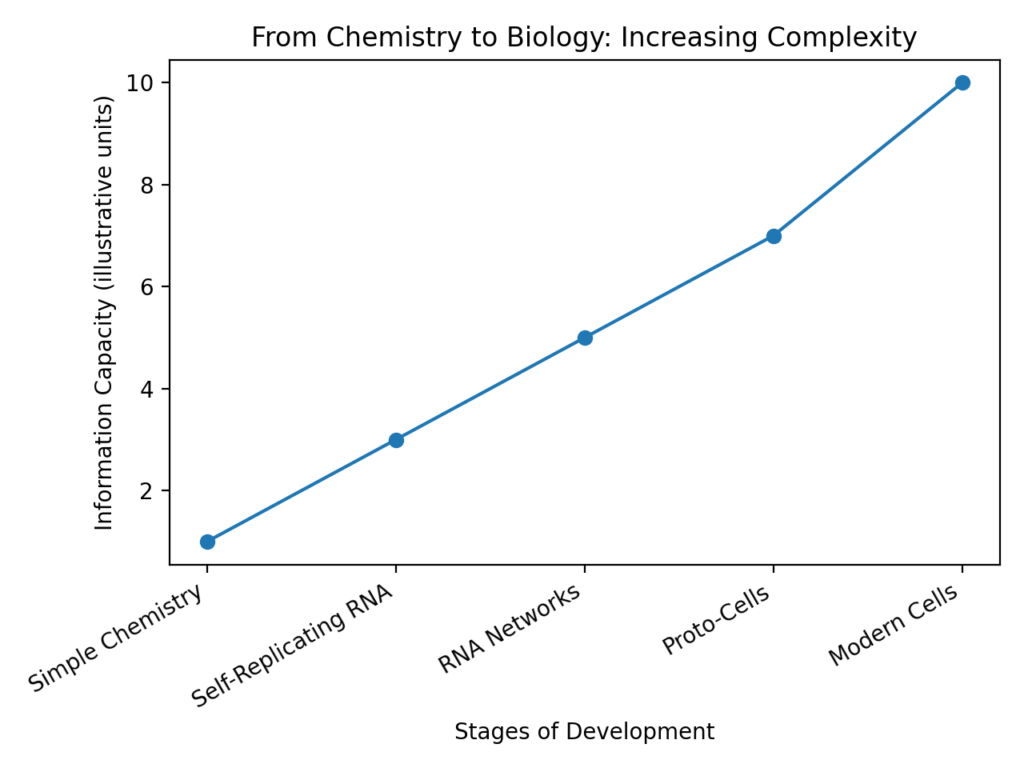
The discovery does not pinpoint the exact moment life began. Instead, it reshapes the narrative. Life likely did not appear in a sudden event. It emerged gradually from ordinary chemistry following physical rules. Tiny copying molecules accumulated complexity over millions of years. Membranes formed. Metabolism appeared. DNA replaced RNA as a stable archive. Eventually cells evolved, followed by complex organisms and ecosystems. The profound idea is simple. The foundation of biology may rest on fragile molecular strands only a few units long. The earliest ancestor of every living thing may have been nothing more than a copying molecule drifting in ancient water.
FAQs on Tiny Self Copying RNA Discovery
1. What is a self-replicating RNA molecule?
It is a small RNA strand capable of helping assemble copies of RNA sequences. It does not form a living cell but performs a primitive version of genetic replication.
2. Does this discovery mean scientists created life?
No. The molecules still require controlled conditions and supplied chemicals. The experiment only demonstrates a plausible step toward how life could naturally arise.
3. Why is RNA important in origin of life studies?
RNA can store genetic information and catalyze chemical reactions. This makes it a strong candidate for the earliest genetic system before DNA and proteins evolved.
4. Could life exist on other planets because of this finding?
Possibly. If simple molecular evolution is common, worlds with water and organic chemistry could support early pre cellular evolution even without complex organisms.