
Stand outside on a quiet night and you’ll notice something interesting. Even when daily life feels chaotic, the sky above follows precise patterns. The human subconscious and the solar system might sound like a poetic idea at first, but scientists have started examining it seriously.
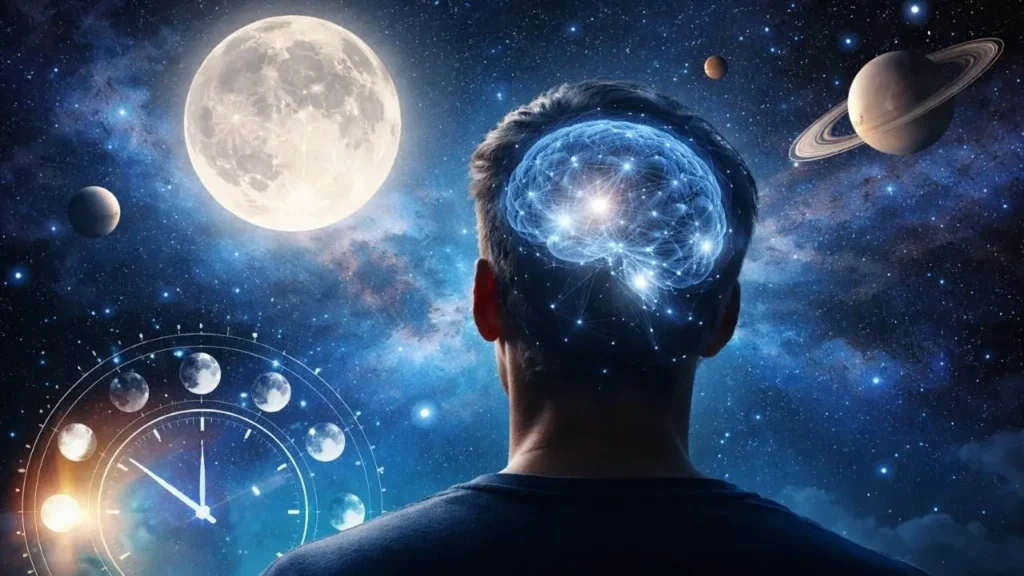
The human subconscious and the solar system connection is not about horoscopes or mystical thinking. Instead, it is about biology responding to environmental rhythms we rarely notice. Human brains evolved under sunlight, darkness, seasons, and magnetic fields, and new research suggests those forces may still be influencing our thoughts, sleep, and emotions beneath conscious awareness. In recent years, neuroscientists, psychologists, and chronobiologists have begun comparing solar activity with human behavior patterns. They are discovering small but repeated correlations. Some people experience sleep disturbance during solar storms. Others report subtle mood changes during seasonal light variation. The effects are modest, but they appear consistently in large data sets. Researchers are not claiming that space controls personality. They are suggesting that environmental signals coming from the Sun and Earth’s magnetic field might quietly influence the subconscious mind.
Understanding this may help explain insomnia, fatigue, and emotional fluctuations that many people experience without clear cause. The idea of the human subconscious and the solar system focus on how natural cosmic cycles affect brain activity without us realizing it. Scientists studying circadian rhythm regulation have discovered that the brain depends heavily on environmental timing signals. The Sun acts as the body’s master clock regulator. Light exposure controls melatonin release, hormone balance, and alertness levels. Because the brain communicates using electrical signals, researchers are now examining whether electromagnetic fluctuations from solar activity can influence neural timing systems. Early findings show links with sleep quality, dream intensity, and mood regulation. This is not astrology. It is environmental neuroscience. The subconscious mind constantly monitors surroundings, and Earth’s position within an active solar environment may quietly shape our internal mental rhythms.
Table of Contents
Curious Link Between the Human Subconscious and the Solar System
| Key Factor | Field Of Study | What Scientists Measure | Possible Human Effect | Evidence Level |
|---|---|---|---|---|
| Sunlight exposure | Chronobiology | Hormones and sleep cycles | Sleep timing changes | Strong |
| Geomagnetic storms | Neurophysics | Brainwave patterns | Relaxation and alertness shifts | Moderate |
| Seasonal daylight | Psychiatry | Serotonin activity | Mood variation | Strong |
| Moonlight brightness | Sleep research | REM sleep duration | Vivid dreaming | Early |
| Solar flare activity | Space medicine | Fatigue and headaches | Possible correlation | Emerging |
Natural Rhythms Beyond Conscious Awareness
- The human body follows a biological clock known as the circadian rhythm. This system controls sleep, hunger, focus, and body temperature. The brain’s timing center reacts to light entering the eyes. Morning sunlight triggers wakefulness. Darkness signals rest.
- However, sunlight is not identical every day. Solar radiation fluctuates based on solar activity. During periods of increased solar output, researchers have noticed slightly higher rates of sleep disturbances and headaches in medical records. These changes are small but repeatable across populations.
- This supports the concept that the human subconscious and the solar system interaction works through physiology. You do not feel solar variation directly. Your body simply adapts automatically, and your conscious mind never notices.
The Influence Of Geomagnetic Activity
- Earth is surrounded by a protective magnetic field. When charged particles from the Sun reach Earth, they disturb this field. These disturbances are called geomagnetic storms. Neuroscientists wondered whether magnetic fluctuations could influence the brain. Since brain cells send electrical signals, even slight magnetic variation might affect communication between neurons.
- In controlled experiments, volunteers were monitored using EEG brain scans. During simulated magnetic fluctuations, researchers observed changes in alpha brainwaves. These waves are associated with calmness, daydreaming, and subconscious processing.
- Participants did not feel anything unusual. Yet their brain activity changed. This is important because subconscious processes such as emotional processing and memory sorting occur in these same brain states. The human subconscious and the solar system connection become scientifically relevant here because the subconscious brain appears sensitive to environmental physics.
Dreams, Memory, And The Night Sky
Sleep is the time when the subconscious mind is most active. During sleep, the brain organizes memories, filters experiences, and processes emotional events. Researchers studying sleep patterns noticed a curious trend. During brighter moon phases, many people fall asleep slightly later and report more vivid dreams. The Moon does not affect decisions or personality, but its light changes nighttime brightness. Before artificial lighting existed, moonlight influenced human sleep schedules. Even today, subtle light differences can change REM sleep timing. REM sleep plays a major role in emotional balance. When REM cycles shift, emotional processing shifts as well. This suggests that the human subconscious and the solar system connection operates through environmental conditions rather than direct control.
Seasonal Psychology And The Solar Connection
- The strongest scientific evidence comes from Seasonal Affective Disorder. During winter, shorter daylight hours reduce serotonin production and disrupt melatonin timing. Many people feel tired, unmotivated, or emotionally low.
- Doctors treat this condition using bright light therapy. Patients sit near a specialized lamp that mimics sunrise. Within weeks, mood and energy often improve.
- This demonstrates a direct biological pathway. Sunlight affects hormones. Hormones affect mood. Mood affects behavior. The human subconscious and the solar system relationship is clear in this case because emotional experience changes without conscious intention.
Patterns In Planetary Cycles
Researchers are also studying long solar cycles, especially the eleven-year sunspot cycle. Solar activity increases and decreases over this period. Some statistical studies suggest that during peak solar activity, people may report slightly more fatigue and concentration difficulty. The results remain debated, but modern wearable devices now provide millions of sleep records worldwide. Scientists compare these records with space weather data in real time. This allows a new type of research called environmental neurobiology. The hypothesis is modest. The human subconscious and the solar system interaction may act like background environmental influence, similar to how cloudy weather can affect mood.
Skepticism And Scientific Limits
Scientists remain cautious. The brain is extremely complex, and many factors influence behavior. Diet, stress, screen exposure, and lifestyle play much larger roles than cosmic activity. There is no scientific proof that planets determine personality or life events. The research focuses only on measurable environmental conditions such as light exposure and magnetic fluctuations. Researchers emphasize that correlation does not equal causation. Still, ignoring environmental variables may leave part of the psychological puzzle incomplete. The human subconscious and the solar system concept is best understood as environmental influence, not cosmic destiny.
Why The Subconscious Matters
The subconscious mind processes information constantly. It controls breathing, hormone balance, instinctive reactions, and emotional responses. Many decisions actually begin subconsciously before becoming conscious thoughts. If environmental cycles influence biological timing, they indirectly influence behavior. Energy levels, alertness, emotional resilience, and sleep quality all depend on internal regulation systems. This is why scientists increasingly study the human subconscious and the solar system relationship. It may explain why some days feel unusually tiring or mentally foggy even when life circumstances have not changed.
What Comes Next
- Researchers are now combining satellite solar monitoring with wearable health technology. Sleep trackers, heart rate monitors, and mood logs are compared with solar and geomagnetic data. Large global datasets may reveal patterns previously impossible to detect.
- Future applications could include improved insomnia treatment, better work scheduling, and personalized mental health recommendations based on environmental conditions.
- We may discover that humans are more connected to natural cycles than modern indoor lifestyles suggest. The human subconscious and the solar system connection may eventually become part of mainstream psychology and preventive healthcare.
FAQs on Human Subconscious and the Solar System
1. Does the solar system control human behavior
No. Current evidence shows subtle environmental influence, mainly through light exposure and biological timing, not personality control.
2. Why do I sometimes feel tired without reason
Changes in sleep cycles, daylight exposure, and possibly geomagnetic conditions can influence circadian rhythm and energy levels.
3. Is this related to astrology
No. Astrology is based on symbolic interpretation. This research studies measurable biological responses to environmental physics.
4. Can sunlight really improve mood
Yes. Light therapy is widely used to treat seasonal depression and circadian rhythm disorders. Exposure to morning light helps regulate hormones.