

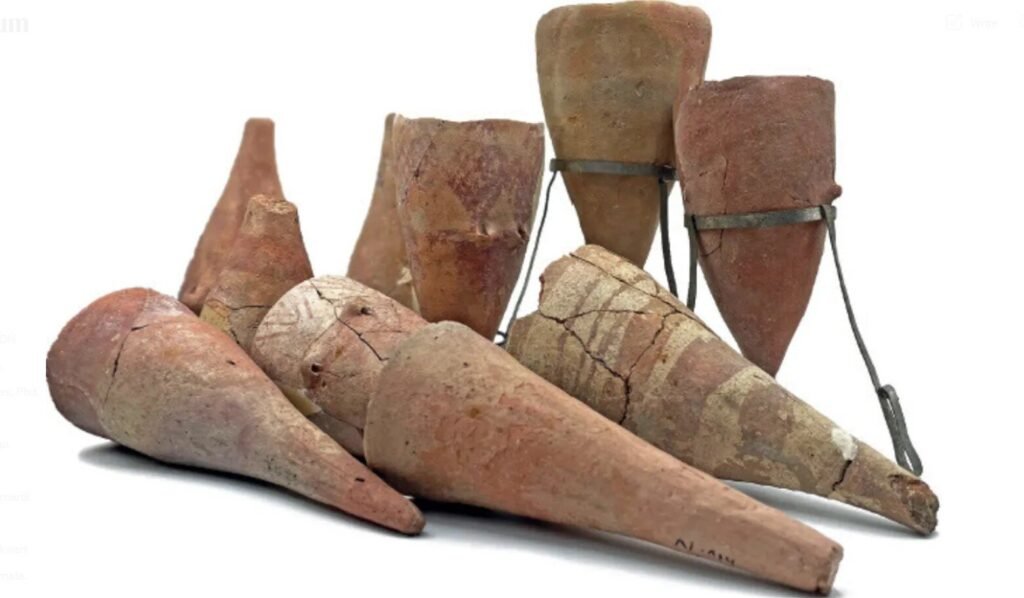
A long-standing archaeological puzzle may be nearing resolution. Researchers studying prehistoric pottery known as cone-shaped vessels have concluded the objects were probably beeswax lamps used in ceremonial rituals about 7,000 years ago. The findings come from new residue testing and reconstruction experiments on artifacts recovered across the southern Levant, including sites in modern-day Jordan and Israel.
Table of Contents
Cone-Shaped Vessels
| Key Fact | Detail/Statistic |
|---|---|
| Age of artifacts | Approximately 5000–3300 BCE |
| Study sample | 35 complete vessels and ~550 fragments |
| Burn duration | Up to about 9 hours in experiments |
Further laboratory testing and new excavations may clarify how widely the lighting practice spread. Each analyzed fragment could help explain how early societies combined technology, symbolism, and communal ritual in ways only now becoming visible to modern researchers.
A Century-Old Archaeological Puzzle
For more than a century, archaeologists have debated the purpose of small conical pottery containers found across Chalcolithic settlements. The artifacts, often called “cornets” in academic literature, appear in large quantities at ritual complexes but rarely inside ordinary dwellings.
The vessels have pointed bases, preventing them from standing upright on flat surfaces. That feature made them unlikely to function as standard storage containers for grain, oil, or water.
Researchers say the distribution pattern also raised questions. Excavations at Teleilat Ghassul in the Jordan Valley revealed hundreds of the objects clustered in specific buildings decorated with wall paintings and ceremonial imagery.
“These objects appear where people gathered for symbolic activity rather than daily life,” one excavation researcher explained in published archaeological analysis. “Their context was always unusual.”
Another curiosity was uniformity. Many vessels were nearly identical in size and shape, suggesting mass production rather than casual household pottery. Archaeologists believe specialized craftspeople may have produced them for communal use.
Testing the Cone-Shaped Vessels Theory
Residue and Soot Evidence
Scientists examined the interior surfaces of several vessels using microscopic and chemical analysis. They identified combustion traces and residue consistent with organic wax rather than food remains or metalworking byproducts.
In some samples, soot accumulated along the rim and upper interior, suggesting a sustained open flame rather than heating or cooking.
Chemical signatures pointed to beeswax, a material known to burn cleanly while producing steady light.
Experimental Archaeology
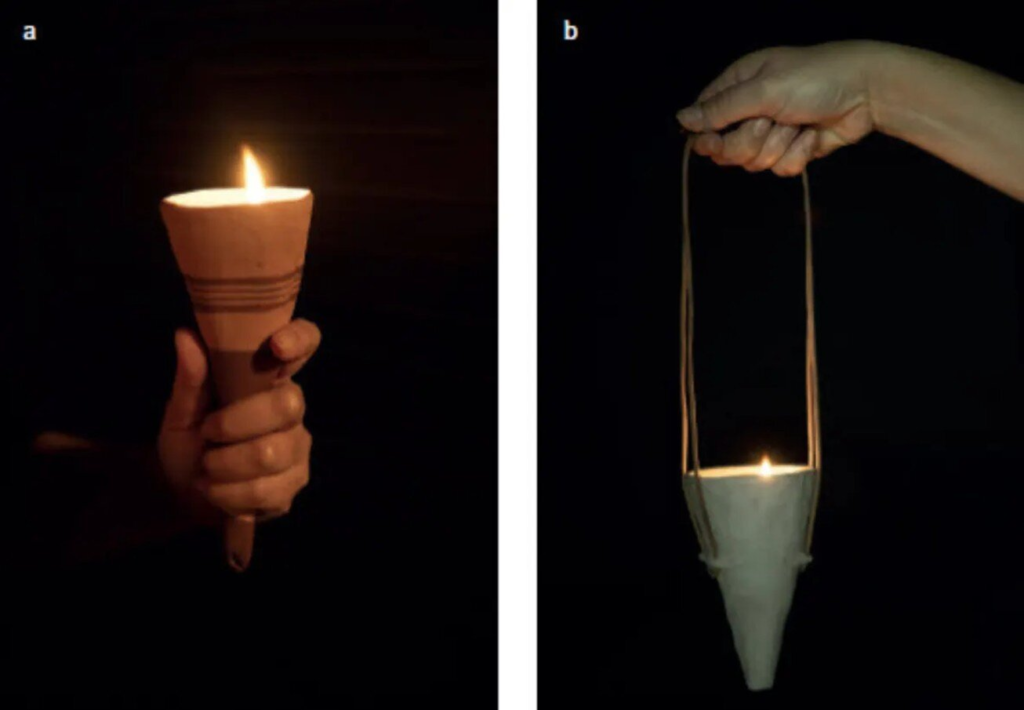
To test the hypothesis, researchers recreated the vessels using local clay similar to prehistoric materials. They filled the replicas with beeswax and inserted plant-fiber wicks.
The lamps burned steadily for hours, providing controlled illumination with limited smoke. Experiments showed the flame could last most of a night, supporting the idea that the objects functioned as portable lighting.
Ceremonial Lighting and Social Meaning (Ritual Lighting)
Archaeologists believe the objects played a role in nighttime ceremonies or processions. Wall paintings discovered at Teleilat Ghassul depict masked figures, geometric designs, and gatherings that may represent ritual events.
The placement of large numbers of vessels in certain rooms suggests coordinated activity rather than individual household use.
Light would have dramatically changed these spaces after sunset. In a world without artificial illumination, controlled lighting could create powerful visual effects — moving shadows, glowing walls, and illuminated figures.
Anthropologists note that fire and light frequently hold sacred meaning across cultures. Ritual light often symbolizes purification, divine presence, or protection from darkness.
Some researchers also point to the deliberate breaking of the vessels after use. The fragments were frequently found together, indicating intentional smashing, a practice known as ritual deposition.

Why Beeswax Matters (prehistoric technology)
Beeswax was not easy to obtain in prehistoric societies. Producing enough wax required organized honey collection or early beekeeping.
That effort implies cooperation, planning, and possibly leadership. Researchers suggest specialized groups may have prepared the lamps for ceremonies.
The use of beeswax also shows technological knowledge. Wax burns slower and cleaner than animal fat, producing less smoke. That quality would have been important inside enclosed ceremonial buildings.
Archaeologists believe such knowledge indicates advanced experimentation. Early farmers were not only cultivating crops but also manipulating natural materials to create controlled environments.
The discovery changes assumptions about prehistoric communities. They were not solely focused on survival. Instead, they invested labor into symbolic and cultural practices.
Daily Life in Chalcolithic Communities (ancient religion)
The Chalcolithic period, often called the Copper Age, marked a transition between the Stone Age and the Bronze Age. People farmed wheat and barley, herded goats and sheep, and lived in permanent villages.
They also began using copper tools, though stone implements remained common. Trade networks expanded across regions, bringing shells, minerals, and pigments from distant locations.
Archaeologists now believe religion played a central role in community organization. Ceremonial gatherings likely reinforced social bonds and collective identity.
Lighting devices such as cone-shaped vessels could have helped stage important events — initiations, seasonal festivals, or funerary rites.
Competing Theories Reconsidered
Earlier explanations proposed the vessels were used for:
- Cheese or dairy processing
- Metal casting molds
- Measuring containers
The dairy theory emerged because some prehistoric pottery held milk residues. However, chemical testing did not detect consistent dairy traces in these vessels.
The metallurgy theory suggested they were molds for copper objects. Yet metallurgical analysis failed to show significant copper residue or heat exposure required for casting.
The measuring-cup theory also weakened because the pointed base made stable measurement difficult.
Experts emphasize the interpretation remains under study. Archaeology rarely offers certainty, but the combined residue, context, and experimental results make the lighting hypothesis the most convincing.
Broader Historical Implications
If confirmed, the vessels could represent some of the earliest dedicated lighting devices known. Comparable lamps appear later in Mesopotamia and Egypt, usually made for oil rather than wax.
The discovery suggests ceremonial performance existed earlier than previously believed. Communities may have intentionally staged nighttime rituals using controlled illumination.
Anthropologists say lighting technology often shapes religious experience. Darkness intensifies attention, while selective illumination directs focus toward symbols or leaders.
Researchers think the lamps may also have signaled authority. Individuals holding light in a dark gathering would immediately command attention.
Comparative Archaeology
Similar ritual lighting traditions appear in later civilizations. Ancient Egyptians used oil lamps in temple ceremonies. Greeks carried torches in processions honoring deities. Roman religious festivals also involved controlled lighting.
The difference is time. Those practices date thousands of years after the Chalcolithic Levant.
The new evidence suggests structured ceremonial lighting existed far earlier in human history.
What Comes Next
Researchers plan chemical analysis of additional fragments and residue sampling from other sites. If similar wax traces appear across the Levant, the interpretation could become widely accepted.
Future discoveries may also determine whether the lighting was seasonal, funerary, or linked to agricultural cycles.
One archaeologist involved in the study summarized cautious optimism: the objects “are no longer mysterious everyday tools, but part of an experience people intentionally created.”
FAQs About What Were These Cone-Shaped Vessels Really For
What are cone-shaped vessels?
They are prehistoric pottery artifacts discovered at Chalcolithic sites in the Middle East.
How old are they?
About 7,000 years old.
Why do scientists think they were lamps?
Residue analysis, soot patterns, and experimental reconstructions show they can burn beeswax for hours.
Are archaeologists certain?
Not completely. The theory is the strongest explanation so far but still under investigation.