

Walk past any modern construction site and you’ll almost always see the same materials stacked everywhere: concrete blocks, steel rods, and sheets of glass. These materials shaped our cities and skylines, but they also created one of the construction industry’s biggest environmental challenges.

Cement manufacturing releases huge amounts of carbon dioxide, and steel production requires extreme heat and massive energy consumption. Because of this, engineers and architects are searching for smarter, cleaner alternatives. That is exactly why Superwood construction is attracting serious attention across the world. The promise behind Superwood construction is simple but powerful use a natural resource and upgrade it so it performs like a high-performance building material. Instead of inventing a synthetic replacement, scientists are improving wood itself. Through advanced processing, the internal fibers of wood are reorganized, making it dramatically stronger and more durable. The result is not fake wood or plastic lumber. It is still real timber but enhanced in a way that allows it to carry heavy loads, resist damage, and last much longer in structural use.
The growing interest in Superwood construction comes from a long-standing dilemma in architecture. Builders want environmentally friendly materials, yet they cannot compromise safety, strength, or reliability. Traditional wood is sustainable but limited in large structural roles. Steel is strong but carbon intensive. This new engineered timber sits right between the two. It combines the renewable benefits of forestry with the performance builders expect from structural materials. As green building certifications become stricter in 2025 and 2026, developers are seriously exploring Superwood construction for housing projects, offices, and public buildings. Many industry experts believe it could soon become a standard option rather than a niche experiment.
Table of Contents
Engineered Superwood
| Feature | Key Details |
|---|---|
| Base Material | Fast growing natural wood species |
| Treatment | Chemical softening, compression, and heat stabilization |
| Strength | Several times stronger than regular lumber |
| Weight | Much lighter than steel components |
| Fire Behavior | Protective char layer slows burning |
| Environmental Benefit | Stores carbon and lowers emissions |
| Potential Uses | Structural beams, façades, bridges, flooring |
| Current Challenge | Scaling production and building code approval |
We may be witnessing the early stage of a building revolution. For centuries, wood was limited by its natural properties. Today, science enhances those properties rather than replacing them. By reorganizing microscopic fibers, researchers transformed a familiar material into a structural contender. Steel and concrete will remain important, but their dominance could shrink as sustainable options grow. Builders now face stricter environmental expectations, and they need materials that meet both performance and ecological standards. Superwood construction answers that need by combining strength, durability, and sustainability in one resource. Future cities may still rise high into the sky, but the materials holding them up could come from forests instead of factories. If that happens, construction will not only become more efficient but also more responsible toward the planet.
How The Material Is Made
- To understand why this material matters, you first need to know what wood looks like inside. Wood is made of long cellulose fibers held together by a natural polymer called lignin. Lignin provides stiffness to trees but also leaves microscopic spaces between fibers. Those gaps make ordinary lumber weaker and prone to cracking.
- Researchers begin by treating the wood with a mild chemical solution. This partially removes the lignin and softens the structure. Next comes compression. The wood is pressed under very high pressure, collapsing the empty spaces and pushing the fibers tightly together. Finally, controlled heat stabilizes the new shape so the material remains dense permanently.
- This transformation is what allows Superwood construction to work. Instead of cutting larger beams for strength, builders can use compact components that perform far better than conventional boards.
Strength And Load Performance
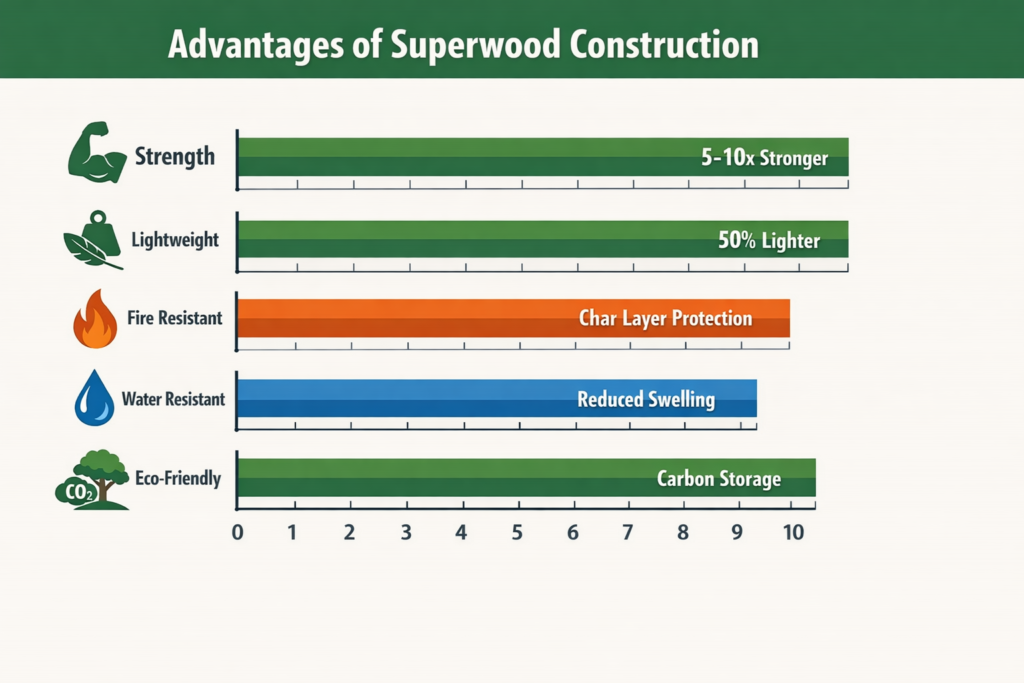
Traditional timber performs well along the grain but poorly across it. That is why most tall buildings rely heavily on steel frameworks. However, densified wood changes this limitation. Because the fibers are tightly packed and aligned, the material distributes forces evenly. It handles compression, bending, and impact much better than untreated wood. In terms of strength relative to weight, the enhanced timber can rival some metal components used in mid-rise construction. For contractors, Superwood construction offers clear advantages. Lighter materials mean easier transportation and faster installation. Workers can handle structural pieces without heavy machinery in some cases. Foundations may also require less material because the building itself weighs less.
Fire And Weather Resistance
- The biggest concern people usually raise about wood buildings is fire safety. It seems logical to assume wood would burn quickly. In reality, dense timber behaves differently from thin lumber.
- When exposed to flame, the outer surface forms a char layer. This layer acts like insulation, slowing heat from reaching the inner core. The interior remains structurally sound longer than many people expect. Heavy timber buildings already rely on this behavior, and the engineered version improves it further because fewer air pockets exist inside.
- Moisture resistance also improves significantly. Ordinary lumber expands, contracts, and warps when humidity changes. The densification process reduces water absorption, which makes Superwood construction suitable for outdoor panels, cladding, and decking when properly sealed.
Sustainability And Carbon Storage
- Construction contributes a large share of global carbon emissions. Governments and city planners are now setting strict environmental targets, pushing builders to adopt greener materials.
- Trees naturally absorb carbon dioxide during growth. When the wood becomes part of a building, that carbon remains locked away for decades. This makes Superwood construction especially appealing for sustainable architecture. Instead of producing emissions like cement and steel, it stores carbon captured from the atmosphere.
- In recent years, low-carbon building incentives have expanded. Developers aiming for green certifications increasingly consider engineered timber because it helps meet environmental goals while maintaining structural reliability.
Applications In Future Buildings
Structural Beams And Columns
Residential buildings and mid-rise apartments are likely early adopters. Enhanced beams can support floors and roofs while reducing overall building weight.
Exterior Cladding
Architects value materials that perform well and look natural. Treated wood panels provide durability and insulation along with a warm appearance that many clients prefer.
Bridges And Infrastructure
Lightweight bridge components can be transported more easily to remote areas. In certain projects, Superwood construction could reduce the need for heavy cranes and complex logistics.
Interior Design And Flooring
Because the material is dense and hard, it resists dents and wear. It can handle heavy foot traffic in commercial spaces while maintaining the visual appeal of real wood.
Challenges And Limitations
- Despite the excitement, the material still faces real hurdles. The biggest challenge is manufacturing scale. Laboratory production works well, but global construction requires large industrial facilities capable of consistent output.
- Cost is another factor. Early versions are more expensive than conventional lumber. However, history shows that once production expands, prices typically drop. Solar panels and engineered glass followed similar paths.
- Building regulations also move slowly. Safety testing must prove durability over decades of weather exposure and load cycles. As certifications progress, Superwood construction is expected to move from pilot projects to widespread adoption.
What It Means For The Construction Industry
If widely adopted, construction methods may change significantly. Buildings could be manufactured in sections at factories and assembled quickly on site. Faster assembly reduces labor costs and project timelines. Urban planners are also interested. Cities need housing and infrastructure while lowering emissions. Superwood construction offers a practical path because it allows growth without dramatically increasing environmental impact. Architecturally, the change could be noticeable. Instead of cold industrial materials dominating interiors, buildings may feature natural textures without sacrificing performance or safety.
FAQs About Engineered Superwood
1. What Is Superwood Construction
It is a building approach that uses densified, engineered wood strengthened through chemical treatment and compression to replace certain steel or concrete elements.
2. Is Engineered Superwood Stronger Than Regular Wood
Yes. The treatment compresses and aligns fibers, making it multiple times stronger and more durable than natural lumber.
3. Is It Safe in Fire Situations
Dense treated wood forms a protective char layer that slows burning and protects the inner structure for a longer period than expected.
4. Is Superwood Environmentally Friendly
Yes. It stores carbon captured by trees and reduces reliance on high-emission materials such as cement and steel.