
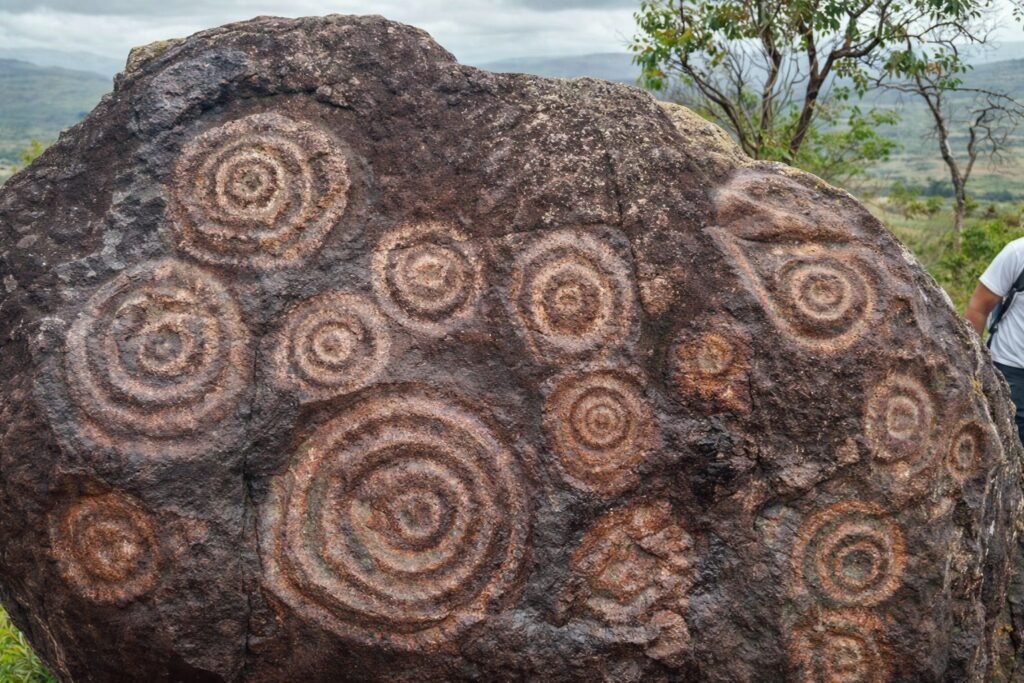
Archaeologists in eastern Venezuela say a newly documented group of prehistoric carvings may date back as far as 8000 years, potentially shifting the known timeline of symbolic culture in northern South America. The petroglyphs were recorded in Monagas state in early 2026 and are now being analyzed to determine their age, cultural meaning, and relationship to early Indigenous societies.
Table of Contents
8000-Year-Old Petroglyphs
| Key Fact | Detail |
|---|---|
| Estimated age | 4,000–8,000 years |
| Location | Monagas state, eastern Venezuela |
| Type of art | Stone engravings (petroglyphs) |
| Cultural interpretation | Ritual, cosmology, territorial markers |
What Scientists Found at the 8000-Year-Old Petroglyphs Site
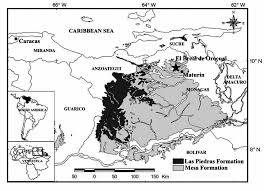
The carvings appear across exposed rock formations near the rural community of Cedeño in Venezuela’s Monagas state, a region bordering the Orinoco River basin. The location is remote, forested, and historically difficult for archaeologists to access.
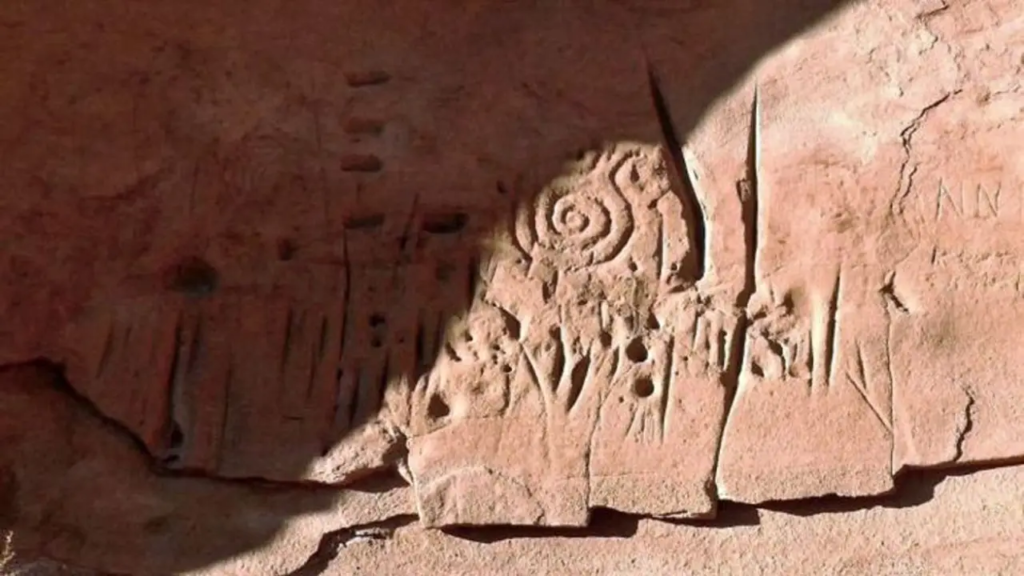
Researchers documented spirals, concentric circles, stylized human figures, and repeated geometric patterns etched into the stone surface.
Petroglyphs differ from cave paintings because they are cut into rock rather than painted. Archaeologists believe carving required stone tools and repeated hammering over long periods, suggesting intentional planning and cultural importance.
“These markings were created deliberately and repeatedly,” said regional heritage researcher María Rojas, part of the field documentation team. “Communities returned to the same rock surfaces. That behavior usually indicates ritual use rather than decoration.”
Scholars say the visual style resembles symbolic traditions found across parts of the Amazon basin and northern South America.
The site currently shows no permanent ancient settlement structures. That absence may actually be significant.
According to archaeologists, ritual locations were often separated from everyday living areas, functioning as gathering or ceremonial places.
Dating the Carvings: Why the Age Estimate Matters
Dating rock art presents a major scientific challenge. Unlike bones, wood, or charcoal, stone carvings themselves cannot be carbon-dated.
Instead, scientists rely on indirect methods:
- mineral buildup inside carved grooves
- weathering rates
- microscopic lichen growth
- nearby organic remains in sediment
Preliminary geological analysis suggests the carvings could be between 4,000 and 8,000 years old, placing them in the early Holocene epoch — shortly after the end of the last Ice Age.
That period is important in human history. Many regions were transitioning from nomadic hunting to semi-settled communities.
Archaeologist Luis Delgado, who studies prehistoric settlement patterns in the Orinoco basin, explained the implications:
“Rock art may be the only surviving evidence of thought, belief, and identity from societies that left few tools or buildings. It shows how early people understood the universe around them.”
Until recently, most Venezuelan rock art sites dated to about 2,000–4,000 years ago. If confirmed, the new findings would push symbolic behavior in the region back thousands of years.
What the Symbols Might Represent
Researchers emphasize the 8000-Year-Old Petroglyphs are not a written language and cannot be translated word-for-word. However, archaeologists compare similar imagery worldwide to interpret possible meaning.
Many of the patterns align with common symbolic themes:
| Symbol | Possible Interpretation |
|---|---|
| Spirals | cycles of time, life, or the sun |
| Concentric circles | water sources or sacred springs |
| Human figures | ancestors, spirits, or shamans |
| Geometric grids | territory markers or mythic maps |
Anthropologists studying early Indigenous cosmology believe rock art often served as a communication system across generations. Instead of recording events, it expressed shared beliefs.
Ritual specialists, sometimes described as early shamans, may have used such sites during ceremonies tied to seasons, hunting success, or weather cycles.
Indigenous Cultural Context
The region historically has been inhabited by Indigenous groups including the Kariña and Chaima peoples. Cultural historians believe their ancestors likely occupied nearby territories for thousands of years.
While archaeologists cannot directly link modern communities to the creators of the carvings, they note continuity in oral traditions and sacred landscape concepts.
“These places often remain meaningful long after the original makers are gone,” said anthropologist Ana Villalobos, who studies Indigenous cosmology in northern South America. “Rivers, hills, and rock formations frequently become spiritual landmarks across generations.”
Venezuela’s Institute of Cultural Heritage has begun documenting the site and restricting public access to prevent vandalism, erosion, and artifact removal.
Comparison With Other Ancient Rock Art Worldwide
The discovery gains significance when placed in global context.
Rock art has been found on every inhabited continent. Some famous examples include:
- Australia’s Aboriginal rock art (over 20,000 years old)
- European cave art in France and Spain (around 17,000–30,000 years old)
- North American petroglyphs in the U.S. Southwest
- Brazilian Serra da Capivara paintings (12,000+ years old)
What makes the Venezuelan site notable is geographic coverage. Northern South America has far fewer well-dated prehistoric sites than the Andes region.
This gap has long limited researchers’ understanding of early migration patterns across the Americas.
Implications for Early Human Migration
Archaeologists believe humans first entered the Americas at least 15,000 years ago, possibly earlier, traveling from Asia via the Bering land bridge during the Ice Age.
Over time, groups spread southward through different ecological zones: mountains, grasslands, and tropical forests.
The 8000-Year-Old Petroglyphs may provide evidence that organized cultural traditions existed in tropical regions much earlier than previously documented.
Delgado noted:
“The Amazon and Orinoco regions were once thought to be sparsely populated in prehistory. Increasing discoveries are showing they hosted complex social networks.”
This supports a growing theory that the Americas were populated by multiple migration waves rather than a single movement.
Why Headlines Say It Could “Rewrite History”
Scientists caution the phrase is often misunderstood.
The discovery does not suggest a lost civilization or advanced ancient technology. Instead, it challenges assumptions about cultural development timelines.
For decades, early complex societies were mainly associated with farming and permanent settlements. However, archaeological evidence increasingly shows mobile hunter-gatherer groups also created symbolic traditions, social networks, and ceremonial spaces.
Rock art is considered one of the clearest indicators of abstract thinking — a hallmark of modern human cognition.
In simple terms: early humans in this region were forming belief systems long before cities or agriculture appeared.
Preservation and Risks
Experts warn that rock art sites are extremely vulnerable.
Threats include:
- weather erosion
- plant root growth
- flooding
- human vandalism
- illegal artifact collection
Even touching carvings can cause damage because oils from human skin accelerate mineral breakdown.
Authorities are considering protected status and long-term monitoring using drone photography and 3D scanning technology. Digital preservation may allow study without physical contact.
What Happens Next
Researchers will continue surveying the surrounding area for tools, charcoal, or habitation remains that could allow direct dating.
Laboratory mineral analysis may narrow the age range within the next few years.
The site remains closed to the public while documentation continues.
“Once damaged, information from rock art is permanently lost,” Rojas said. “Preserving it is as important as studying it.”
FAQ
How old are the 8000-Year-Old Petroglyphs?
Estimates range from 4,000 to 8,000 years while laboratory testing continues.
Who made them?
Likely early Indigenous hunter-gatherer societies living in the Orinoco region.
Are they writing?
No. They are symbolic images representing beliefs, rituals, or territory.
Why are archaeologists interested?
They may change understanding of early human cultural development in South America.
Will the site open to tourists?
Not currently. Authorities are prioritizing preservation.