

A new scientific technique using Dinosaur Eggshells is enabling researchers to determine the age of prehistoric fossils with unprecedented accuracy. By measuring radioactive elements trapped inside fossilized eggshells, scientists can directly date dinosaur nesting sites and nearby bones, helping resolve long-standing gaps in Earth’s fossil chronology and improving understanding of dinosaur evolution and extinction.
Table of Contents
Dinosaur Eggshells
| Key Fact | Detail |
|---|---|
| What changed | Eggshell crystals trap uranium that decays into lead |
| Why it matters | Fossils can be dated without volcanic ash layers |
| Accuracy | Comparable to high-precision radiometric dating of volcanic rocks |
Researchers say the method is still expanding as more samples are tested globally. As museum collections and new excavations are analyzed, scientists expect a clearer picture of the final era of dinosaurs. More precise fossil chronology may ultimately determine how quickly ecosystems changed before and after the asteroid impact.
What Dinosaur Eggshells Mean for Paleontology Research
For more than a century, paleontologists have struggled with a basic question: How old are dinosaur fossils really?
Most dinosaur bones cannot be dated directly. Over millions of years, minerals seep into bone and replace its original material. That process preserves shape but destroys the chemical signals needed for precise measurement.
Dinosaur Eggshells behave differently.
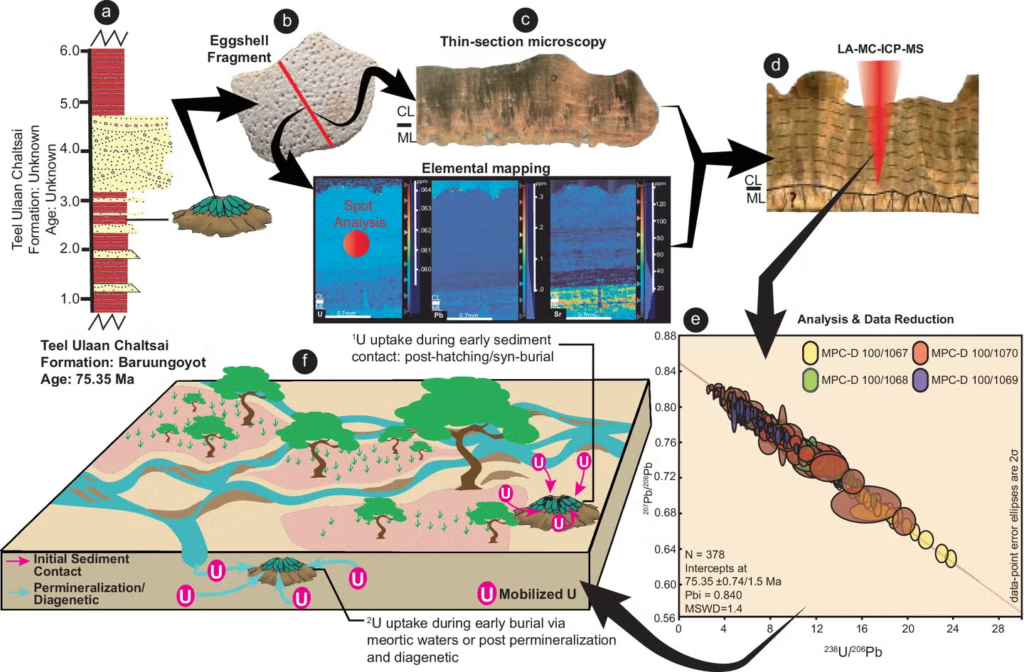
The shells are made of calcite crystals formed when a dinosaur laid an egg. Soon after burial, uranium from groundwater becomes locked into those crystals. Uranium decays into lead at a steady, measurable rate, a fundamental principle of radiometric dating.
By measuring the ratio of uranium to lead, scientists can determine when the egg was buried — essentially the moment dinosaurs nested at that site.
“This is an extraordinary archive of biological activity,” said Dr. Gregory Erickson, a paleobiologist at Florida State University. “We are not dating the rock. We are dating the behavior of a living animal.”
That difference marks a turning point in paleontology research.
Why Previous Fossil Dating Was Difficult
Traditionally, scientists dated fossils by examining volcanic ash layers above or below fossil beds. When volcanoes erupt, ash contains minerals such as zircon crystals that preserve radioactive isotopes.
Researchers measure those isotopes to determine when the ash cooled.
But many fossil sites lack volcanic material.
Sedimentary rocks — sandstones and mudstones — dominate dinosaur fossil environments in Mongolia, China, Argentina, and the western United States. These rocks form from slowly deposited sediments and contain few radioactive minerals.
Scientists therefore relied on fossil chronology comparisons — matching fossils to similar species elsewhere — which could be off by millions of years.
“Without reliable ages, we cannot confidently compare ecosystems,” said Dr. Koen Stein, a paleontologist at the University of Bonn. “We might think two species coexisted when they actually lived far apart in time.”
The new Dinosaur Eggshells method removes much of that uncertainty.
How the New Method Works
Step-by-Step Process
- Scientists collect a tiny eggshell fragment.
- A laser removes microscopic material.
- A mass spectrometer measures uranium and lead isotopes.
- The isotope ratio calculates the burial age.
The equipment measures atoms smaller than a billionth of a meter. Because uranium decays at a predictable rate, the method functions as a natural geological clock.
Researchers say some eggshell samples preserved accurate signals for more than 80 million years.
Scientific Implications
Improved Evolutionary Timelines
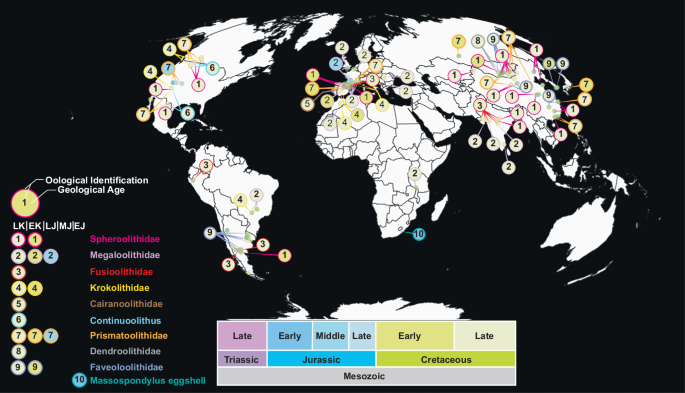
Precise dating allows scientists to synchronize fossil records worldwide. This is crucial because dinosaurs lived across multiple continents that were drifting apart.
If two species appear similar but lived millions of years apart, they were not interacting populations. Accurate ages clarify migration patterns and evolutionary relationships.
Researchers can now test how climate changes influenced dinosaur diversity.
Understanding the Extinction Event
Dinosaurs disappeared about 66 million years ago. Most scientists attribute the extinction to the Chicxulub asteroid impact. However, large volcanic eruptions in India — the Deccan Traps — were also altering global climate.
Dinosaur Eggshells dating may reveal whether species declined gradually before the impact or vanished suddenly afterward.
“Chronology controls every extinction theory,” said Dr. Darla Zelenitsky of the University of Calgary. “If the timeline shifts even slightly, our interpretation changes.”
Historical Context: Why This Took So Long
Dinosaur eggs were first discovered in Mongolia in the 1920s during expeditions led by the American Museum of Natural History. At the time, scientists did not know whether dinosaurs laid eggs at all.
Those discoveries confirmed dinosaur reproduction but offered little information about age.
The missing piece was technology.
Mass spectrometers capable of measuring microscopic isotope ratios have only recently become sensitive enough to analyze delicate fossil material without destroying it. Advances in laser ablation and geochemistry made the new method possible.
In other words, the eggshells always contained the answer. Scientists simply lacked the tools to read it.
Broader Impact on Museums and Education
Natural history museums worldwide hold thousands of unstudied eggshell fragments collected over decades. Many were cataloged but never chemically analyzed.
Researchers now plan to reexamine these collections.
The findings could lead to:
- revised exhibit timelines
- updated textbooks
- new evolutionary family trees
Museum curators say public displays may change as fossil ages become more precise.
“We expect some dinosaurs will move on the timeline,” said a curator at a North American natural history museum. “School charts showing ‘millions of years ago’ ranges may soon become much narrower.”
Applications Beyond Dinosaurs
Scientists believe the same approach could apply to other ancient egg-laying animals, including:
- early birds
- crocodilians
- reptiles
That would extend the method across major evolutionary groups and help trace how modern animals emerged after the dinosaur extinction.
Researchers are also investigating whether eggshell isotopes preserve environmental information, such as ancient temperature and rainfall patterns.
If confirmed, Dinosaur Eggshells could become climate archives as well as timekeepers.
Limits and Remaining Questions
The technique is not universal. Eggshells must remain chemically stable and uncontaminated by later mineral changes.
Some fossils occur in environments where shells dissolved or were destroyed before fossilization. In those cases, traditional dating remains necessary.
Scientists also caution that precise dates do not immediately solve all evolutionary questions. They simply provide a reliable timeline on which other evidence can be interpreted.
Why the Discovery Matters
The innovation links geology and biology more directly than any previous method in dinosaur science. Instead of dating surrounding rocks, researchers can now date a reproductive event — the moment a dinosaur nested.
That level of precision may reveal:
- migration patterns
- breeding seasons
- ecosystem collapse rates
It also strengthens scientific comparisons across continents, improving understanding of global environmental change in deep time.
Many paleontologists say this could be one of the most important technical advances in fossil research in decades.
FAQs Above Dinosaur Eggshells
What are Dinosaur Eggshells used for scientifically?
Scientists analyze them to determine the age of fossil sites through uranium-lead radiometric dating.
Why not just date the bones?
Fossil bones chemically change during fossilization and usually lose the radioactive signals required for accurate measurement.
Does this replace older dating methods?
No. It complements volcanic ash dating and improves accuracy where ash layers are absent.
Can this explain dinosaur extinction?
Not directly, but it provides the precise timeline needed to test competing extinction theories.