
Archaeologists say the Ancient Chimú Pathway and temple site identified in coastal Peru offers rare insight into how a powerful pre-Inca civilization organized religious ceremonies more than 600 years ago. The discovery along Peru’s northern Pacific desert connects a ceremonial road directly to a sacred structure, suggesting large public processions linked to seasonal beliefs, political authority, and environmental cycles.
Table of Contents
Ancient Chimú Pathway
| Key Fact | Detail |
|---|---|
| Civilization | Chimú culture flourished roughly AD 800–1470 |
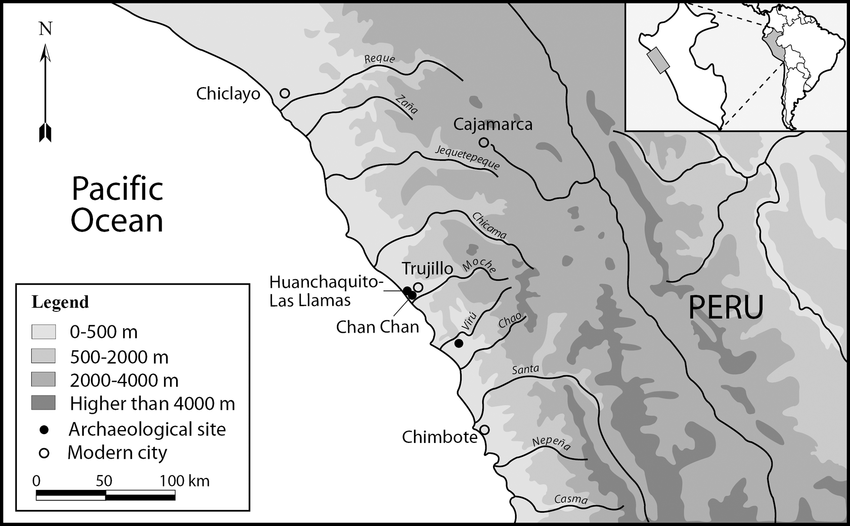
| Location | Northern coastal desert near Trujillo region |
| Significance | Pathway likely used for ritual procession toward temple |
Further research may determine whether the pathway hosted seasonal pilgrimages or rare state ceremonies. Archaeologists say the discovery continues to reshape understanding of pre-Inca religion, showing that ritual life extended across entire landscapes rather than remaining inside temples alone.
What Archaeologists Found
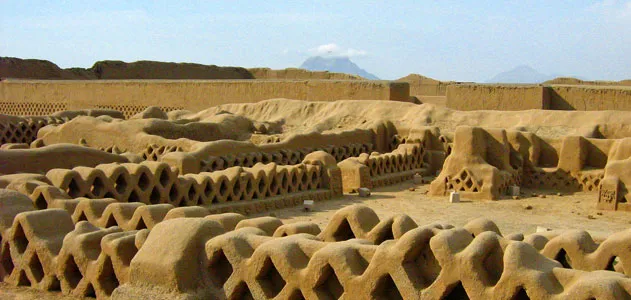
Researchers documented a long, carefully aligned pathway crossing a sandy coastal plain toward a ceremonial mound, known in Andean archaeology as a “huaca.” The route appears intentionally constructed rather than a trade or transport road.
“The architecture suggests controlled access to sacred space,” a project archaeologist said in a statement released by Peru’s Ministry of Culture. “People likely walked this route during organized ceremonies.”
The pathway’s width and orientation indicate large groups moving together toward the temple. The structure contains restricted entry corridors and elevated viewing platforms, architectural elements associated with ritual leadership.
Investigators also identified compacted soil layers along the route. These layers may have formed from repeated foot traffic over decades or centuries, strengthening the theory of organized ceremonial movement.
Understanding the Chimú Civilization
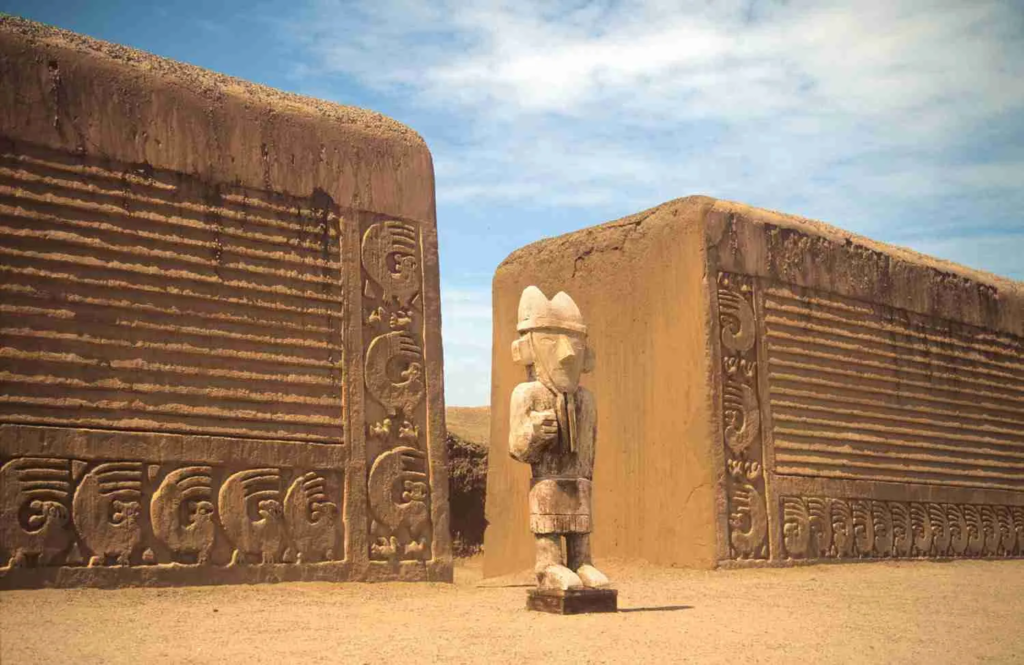
The Chimú civilization controlled a large coastal kingdom centuries before the rise of the Inca Empire. Their capital, the Chan Chan ruins, remain the largest adobe city in the Americas.
Archaeologists describe the society as highly organized. It relied on irrigation canals to transform desert valleys into farmland capable of sustaining large populations. Farmers cultivated maize, beans, squash, and cotton in otherwise arid terrain.
The state operated a hierarchical political system led by rulers often described as divine kings. Elite administrators supervised labor, craft production, and religious activity across coastal territories stretching hundreds of kilometers.
The Inca eventually conquered the Chimú in the late 1400s, incorporating their engineering and administrative methods into the expanding imperial structure.
Why the Ancient Chimú Pathway Matters
The Ancient Chimú Pathway provides a missing piece in understanding pre-Inca religion. Archaeologists often find temples but rarely identify how worshippers reached them.
This site preserves the entire ceremonial sequence — public movement, gathering space, and restricted ritual zone.
Processional Religion
Andean religions frequently involved pilgrimage. Movement itself carried symbolic meaning. Participants might have followed the route during planting or harvest seasons, lunar events, or environmental crises.
Specialists in Andean anthropology say ceremonies may have addressed unpredictable climate events such as flooding caused by El Niño.
“The journey toward the temple was likely part of the ritual,” said a university researcher specializing in Andean ceremonial landscapes. “Participation reinforced identity and belief.”
Environmental Beliefs and Climate
The coastal desert of northern Peru is one of the driest regions on Earth, yet ancient societies thrived there. Success depended on careful water management and spiritual interpretation of weather patterns.
Many scholars believe Chimú rituals sought to influence natural forces, especially ocean currents and rainfall. The Pacific Ocean provided fish and marine resources, making it central to survival.
Archaeological studies in nearby areas have revealed evidence of animal sacrifices, particularly marine animals and camelids. These offerings may have been placed to appeal to deities associated with water and fertility.
The Ancient Chimú Pathway could therefore represent a physical connection between people, rulers, and environmental forces.
Religion and Political Authority
Researchers say the discovery also clarifies governance within the Chimú state. Ritual ceremonies likely reinforced political power.
Elites probably stood inside the temple while the public gathered outside. This separation visually demonstrated hierarchy.
Participation in ceremonies may have functioned as a loyalty display. People walking the route collectively acknowledged leadership and shared belief systems.
The layout of the site supports this interpretation. Narrow entrances restrict access to a small number of individuals, while large open areas accommodate crowds.
Broader Archaeological Context
Northern Peru is one of the most important regions for a Peru archaeology discovery in the Americas. Over the past decades, archaeologists have uncovered royal tombs, sacrificial sites, and urban settlements from multiple ancient cultures.
The Chimú were not isolated. They followed earlier societies such as the Moche and preceded the Inca.
Each civilization inherited knowledge from the previous one. Irrigation systems, religious symbols, and artistic styles evolved across centuries rather than appearing suddenly.
Scholars now consider the Andes one of the world’s independent centers of civilization, alongside Mesopotamia, Egypt, China, and Mesoamerica.
Archaeological Methods Used
The research team combined traditional excavation with modern technology.
Drones created aerial images revealing the straight alignment of the route. Ground-penetrating radar detected buried architectural features beneath the sand. Soil chemistry analysis helped identify areas where people repeatedly gathered.
Carbon dating of organic material found near the site will help establish precise chronology.
“These technologies allow us to see human behavior patterns,” a field specialist explained. “We are studying movement, not just objects.”
Preservation Challenges
The site faces serious environmental threats. Coastal winds gradually erode exposed adobe structures. Climate change may intensify rainfall events in desert regions, accelerating damage.
Peru’s Ministry of Culture has begun protective measures including sand barriers and controlled access to prevent looting and accidental destruction.
International heritage organizations warn that many ancient sites worldwide face similar risks. Preservation requires both local protection and global awareness.
Cultural Significance Today
Modern communities near the excavation consider the discovery part of regional identity. Educational programs are planned to teach students about the Chimú civilization.
Tourism officials say responsible cultural tourism could support conservation funding. However, authorities stress that public access must be carefully managed.
Archaeologists emphasize that the Ancient Chimú Pathway is not merely a ruin but evidence of human experience.
“It shows how people gathered, believed, and cooperated,” one researcher said. “We are seeing social life preserved in the landscape.”
What Happens Next
Excavation teams will continue mapping the area and searching for offerings such as pottery, shells, and food remains. These materials could clarify the timing and purpose of ceremonies.
Researchers will also compare the site with other Andean ritual pathways to determine whether similar processional routes were widespread.
Officials say preservation will remain the priority while research continues.
FAQs About Ancient Chimú Pathway
What is the Ancient Chimú Pathway?
A ceremonial route leading to a temple used for religious gatherings by the Chimú civilization.
How old is it?
Approximately 600–700 years old, dating to the late pre-Inca period.
Why is it important?
It reveals how religious ceremonies involved movement and public participation, not only temple worship.
Is it open to visitors?
Currently access is restricted to protect the site during excavation.