


Deep-Earth Energy Source: and this isn’t just lab-coat theory or something cooking in a Silicon Valley pitch deck. This is happening right here in the United States, from the wide-open spaces of Nevada to research fields in Utah and exploratory wells in Kansas. Scientists, engineers, tribal leaders, and policymakers are taking a serious look at what lies beneath our boots — and how it might power America’s future. When we talk about a deep-Earth energy source, we’re talking about energy created by natural heat, pressure, and chemical reactions happening miles below the surface. The two big players right now are geologic (natural) hydrogen and enhanced geothermal systems (EGS). These technologies could deliver steady, low-carbon energy and help the U.S. reduce dependence on fossil fuels while strengthening grid reliability. From a professional standpoint — working in sustainability planning and energy policy — I can say this: deep-Earth energy isn’t hype. It’s a serious contender in America’s long-term power strategy.
Table of Contents
Deep-Earth Energy Source
Researchers exploring a deep-Earth energy source beneath the surface are advancing one of the most promising frontiers in clean power. Through geologic hydrogen and enhanced geothermal systems, America has the opportunity to unlock reliable, low-emission energy from domestic resources. With growing federal support, improving technology, and strong economic incentives, deep-Earth energy could become a major pillar of U.S. energy independence and grid stability for decades to come.
| Topic | Key Data & Insights |
|---|---|
| Geologic Hydrogen | USGS reports hydrogen occurs naturally in rock formations worldwide; exploration accelerating in the U.S. |
| U.S. Geothermal Capacity | ~3.7 GW installed capacity (2023), mainly in CA & NV |
| EGS Potential | DOE estimates 90+ GW possible by 2050 |
| Capacity Factor | Geothermal operates at 70–90% capacity factor |
| Clean Energy Jobs | 3.4+ million U.S. jobs in clean energy (2023) |
| Regulatory Oversight | Underground injection regulated under Safe Drinking Water Act |
Understanding Deep-Earth Energy Source in Plain Terms
Let’s break it down so it makes sense whether you’re 10 years old or a seasoned energy executive.
Deep underground, the Earth is hot. Really hot. That heat comes from leftover energy from when the planet formed and from radioactive elements slowly decaying over billions of years. In some places, temperatures rise enough that water turns into steam naturally. In others, the rocks are hot but dry — and that’s where new technology steps in.
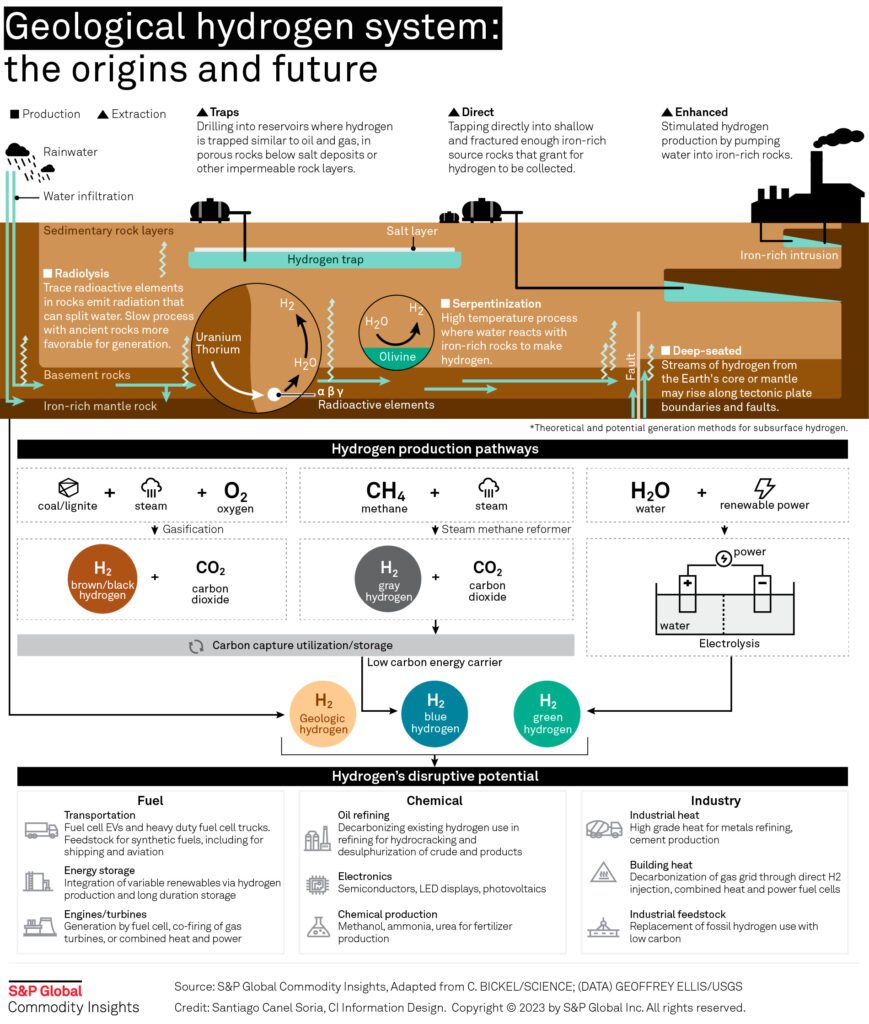
At the same time, certain underground rocks react chemically with water to produce hydrogen gas. This is called serpentinization, a natural reaction that splits water molecules and releases hydrogen.
In simple words:
- Hot rocks = usable heat.
- Reactive rocks + water = natural hydrogen gas.
- Both can be tapped carefully to produce energy.
According to the U.S. Geological Survey (USGS), hydrogen has been detected in multiple geological formations across the world, and U.S. mapping efforts are expanding to identify viable reservoirs.
Geologic Hydrogen: America’s Underground Fuel Opportunity
Hydrogen isn’t new. NASA has used it for rockets for decades. The difference here is naturally occurring hydrogen — sometimes called “white hydrogen.”
Most hydrogen today is made from natural gas, a process that releases carbon dioxide. But geologic hydrogen forms naturally without industrial processing.
Here’s how it works in more detail:
- Iron-rich rocks deep underground react with water.
- The chemical reaction releases hydrogen gas.
- Gas accumulates in pockets underground.
- Wells can potentially capture the hydrogen.
Small-scale examples already exist. In Mali, West Africa, a naturally occurring hydrogen well has powered a village for over a decade. That success story has inspired U.S. exploration.
In states like Nebraska and Kansas, exploratory drilling is underway. Researchers are studying:
- Whether hydrogen reservoirs replenish naturally.
- How to prevent leakage.
- The economic viability of extraction.
Right now, it’s early-stage — but promising. The DOE’s Hydrogen Program is investing heavily in clean hydrogen research.
Enhanced Geothermal Systems: Turning Hot Rock into Power
Traditional geothermal works best in volcanic areas like Northern California. But Enhanced Geothermal Systems (EGS) expand the map.
Here’s the process step-by-step:
- Drill several miles into hot, dry rock.
- Inject water into fractures.
- Water absorbs heat from rock.
- Hot water or steam returns to the surface.
- Steam spins turbines.
- Turbines generate electricity.
It’s basically recycling water underground to collect Earth’s heat.
The U.S. Department of Energy’s FORGE site in Utah is a major research center for EGS. Their goal? Make geothermal viable in more states, not just the West Coast.
Why does this matter?
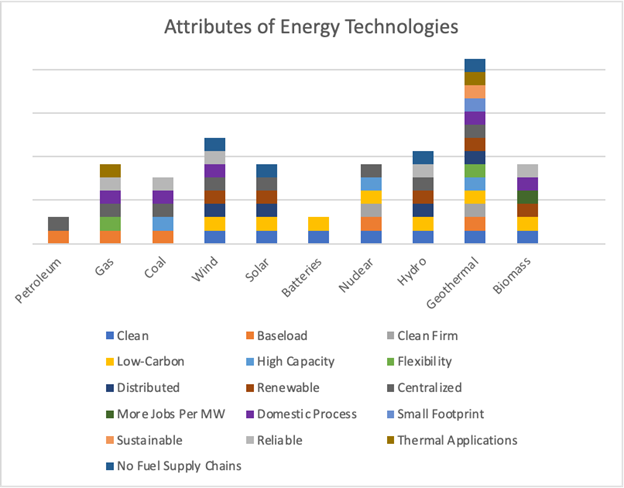
Because geothermal operates at high reliability levels. The Energy Information Administration (EIA) reports geothermal plants can reach capacity factors above 70%, sometimes near 90%. Compare that to solar (~25%) and wind (~35%), and you see why utilities value it for baseload power.
That means geothermal can run day and night — steady as a heartbeat.
Environmental Impact and Responsible Development
Let’s be real. Every energy source has trade-offs.
For Geothermal:
- Small induced earthquakes can occur during drilling.
- Water use must be managed carefully.
- Land disturbance happens during construction.
However, lifecycle emissions are extremely low compared to fossil fuels. The National Renewable Energy Laboratory (NREL) confirms geothermal’s greenhouse gas footprint is minimal.
For Geologic Hydrogen:
- Long-term reservoir sustainability remains under study.
- Infrastructure is limited.
- Monitoring for leaks is critical.
Regulation matters. Underground injection wells fall under EPA oversight through the Safe Drinking Water Act.
The key is careful planning, community engagement, and transparent monitoring.
Economic Potential and Energy Security
Energy independence isn’t just a slogan. It’s an economic stabilizer.
When we rely less on imported fuels, we buffer ourselves from global disruptions. Deep-Earth energy sources are domestic resources. That’s powerful.
According to DOE projections, achieving 90 GW of geothermal capacity by 2050 could power more than 65 million U.S. homes.
And jobs? Clean energy employment hit over 3.4 million in 2023. Geothermal and hydrogen sectors are expected to grow as tax credits from the Inflation Reduction Act incentivize development.
Investors are paying attention. Venture capital is flowing into geothermal startups focused on advanced drilling technologies, many borrowing techniques from the oil and gas industry.
In other words, American know-how is adapting — not disappearing.
Tribal Lands and Community Partnerships of Deep-Earth Energy Source
Many geothermal resources lie near or on tribal lands. That means collaboration is essential.
Some tribes are exploring geothermal as a pathway to:
- Energy sovereignty
- Local job creation
- Revenue diversification
Respect for land stewardship and cultural heritage must be central to development. Done right, deep-Earth energy can align with Indigenous principles of long-term resource balance.
Practical Advice for Communities and Professionals
If you’re a policymaker:
- Study geothermal resource maps from USGS.
- Review state-level incentives.
- Engage early with local communities.
If you’re an engineer:
- Develop skills in subsurface modeling.
- Learn advanced drilling and reservoir management techniques.
If you’re a student:
- Consider degrees in geology, petroleum engineering, environmental science, or energy systems.
- Look into internships through DOE national labs.
If you’re a landowner:
- Understand mineral rights.
- Consult legal and environmental experts before signing exploration agreements.
Knowledge is power — literally in this case.
Technical Challenges Still Ahead
Let’s not sugarcoat it.
Drilling deep is expensive. Wells can cost millions each. Materials must withstand extreme heat and pressure. Long-term reservoir behavior is still being modeled.
Hydrogen storage and transport infrastructure also require expansion. Pipelines, compression systems, and safety protocols must scale.
But here’s the thing: we’ve tackled tough energy challenges before. Horizontal drilling and hydraulic fracturing transformed oil and gas production in the 2000s. Similar innovation cycles could unlock geothermal and hydrogen.
Researchers Work to Restore the American Chestnut Tree
Researchers Revisit the Possible Substance Used in the Eleusinian Mysteries
A Bold Theory Suggests Earth Might Show Signs of Ancient “Terraforming”
The Road Ahead
The United States has the geological potential, the engineering talent, and the policy momentum to lead in deep-Earth clean energy.
What we need now:
- Continued federal research funding.
- Streamlined permitting without sacrificing environmental review.
- Public-private partnerships.
- Workforce development.
Energy transitions don’t happen overnight. They happen one drilling rig, one research breakthrough, and one community partnership at a time.
And if you ask me — tapping into the heat and chemistry beneath our feet feels about as American as it gets. Resourceful. Independent. Forward-looking.