
Step outside on a dark, clear night and the sky feels calm and permanent. The stars seem fixed, almost timeless. Yet in reality, everything above us is moving. Our Sun orbits the center of the galaxy, the galaxy itself travels through space, and one of the most fascinating discoveries in modern astronomy is now confirmed: another massive galaxy is coming toward us.
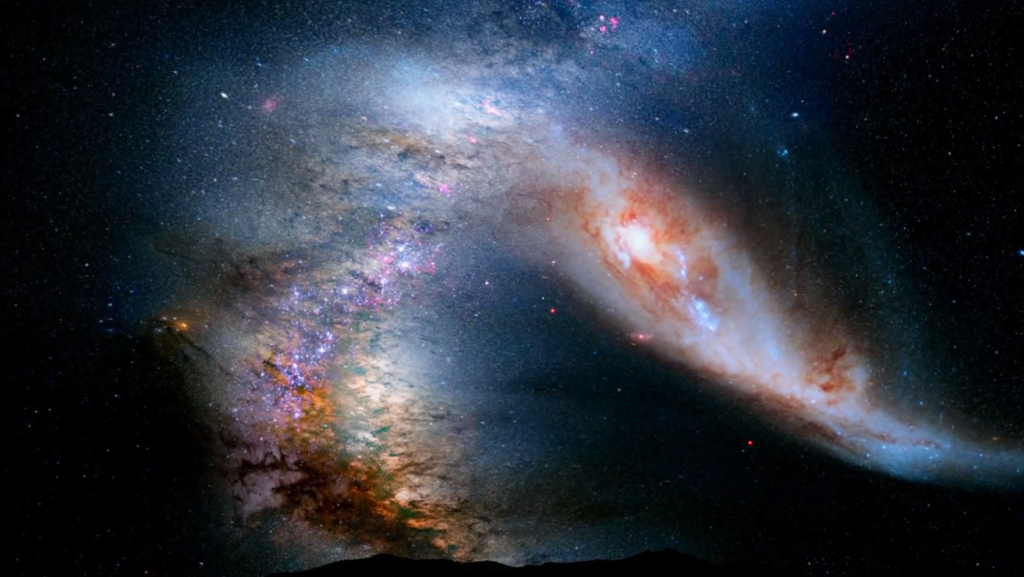
New research explains why Andromeda is headed toward the Milky Way, and the answer isn’t sudden or dramatic it’s the slow, inevitable effect of gravity acting over billions of years. What once sounded like a distant science-fiction scenario has become a predictable cosmic event backed by precise measurement. What makes this discovery especially important is how clearly scientists can now track it. New research explains why Andromeda is headed toward the Milky Way not just as a theory but as a measurable motion mapped star by star. Astronomers have spent years observing tiny shifts in position across the sky and comparing them with advanced simulations. The result is surprisingly simple: our galaxy and Andromeda are gravitationally bound. They separated early in the universe and are now slowly falling back together. Understanding this process helps researchers study dark matter, galaxy formation, and the future structure of our cosmic neighborhood.
The Andromeda Milky Way collision is now one of the best-understood future events in astronomy. For decades scientists knew Andromeda was approaching because its light appears slightly blue-shifted, meaning it is moving closer. What they did not know was whether it would pass by or collide. New observations tracking individual stars inside Andromeda showed extremely small sideways movement. That means the path is almost directly toward our galaxy. The two galaxies are about 2.5 million light-years apart, yet gravity already connects them. Both are massive spiral galaxies surrounded by invisible dark matter halos that extend far beyond their visible stars. These halos overlap across intergalactic space, forming a gravitational link. Over billions of years, that pull will reshape both galaxies into one. This is key reason new research explains why Andromeda is headed toward the Milky Way with much greater certainty than ever before.
Table of Contents
Andromeda Is Headed Toward the Milky Way
| Category | Details |
|---|---|
| Current Distance | Approximately 2.5 million light-years from Earth |
| Approach Speed | Around 110 kilometers per second |
| First Close Encounter | Roughly 4 billion years in the future |
| Final Merger | About 5–6 billion years |
| Driving Force | Mutual gravity and massive dark matter halos |
| Observation Method | Star tracking and motion measurements |
| Future Galaxy Form | One large elliptical galaxy often nicknamed Milkomeda |
How Astronomers Measured The Motion
- Earlier astronomers relied on a technique called the Doppler effect. When an object moves toward us, its light shifts slightly toward blue wavelengths. Andromeda showed a strong blue shift, confirming it was approaching.
- But that only revealed forward motion. To predict a collision, scientists needed to know sideways motion as well. Measuring that was extremely difficult because Andromeda is so far away. Even its entire galaxy shifts only a tiny fraction across the sky over many years.
- Using long-term observations, astronomers compared positions of specific stars over time. After years of data collection, they discovered something remarkable: Andromeda’s sideways motion is extremely small. It is essentially aimed at us. This precise measurement is a major reason new research explains why Andromeda is headed toward the Milky Way with confidence rather than estimation.
The Role Of Dark Matter Halos
- One of the most important parts of the story involves something we cannot see. Dark matter makes up most of a galaxy’s mass. While stars and gas are visible, they represent only a small portion of the total gravitational influence.
- Both the Milky Way and Andromeda are surrounded by enormous dark matter halos extending hundreds of thousands of light-years. These halos overlap long before the stars ever interact. The gravitational pull between them is what draws the galaxies together.
- Without dark matter, the galaxies might drift apart with cosmic expansion. Because of it, they remain bound. Observations supporting this behavior strongly reinforce the understanding that new research explains why Andromeda is headed toward the Milky Way through gravitational attraction amplified by unseen mass.
The Timing Argument Revisited
Astronomers use a method called the timing argument to understand galaxy motion. Shortly after the Big Bang, the universe expanded rapidly. Nearby galaxies moved apart as space itself stretched. However, gravity continued working. Massive galaxies slowed their outward movement. Eventually, their mutual attraction overcame expansion locally, and they began falling back toward each other. The Milky Way and Andromeda are the dominant galaxies in our Local Group. According to modern calculations, they separated billions of years ago and have been gradually approaching ever since. Updated models that include satellite galaxies and dark matter distribution match observed speeds closely. This agreement is another reason new research explains why Andromeda is headed toward the Milky Way as a natural cosmic process rather than a random event.
What The New Simulations Show
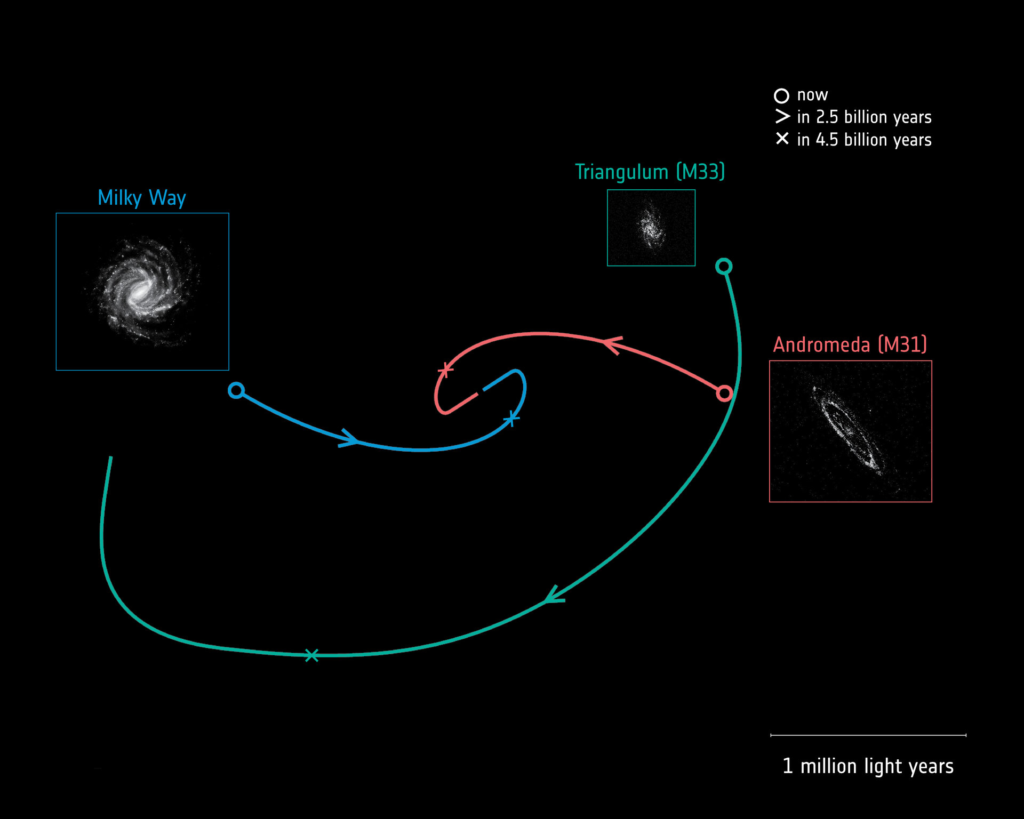
Supercomputer simulations allow astronomers to model billions of stars interacting through gravity. The results show the future merger will not be a single violent crash.
Instead, it will unfold slowly:
- First, the galaxies pass near each other and stretch into long streams of stars.
- Then they separate for hundreds of millions of years.
- Afterward, they return for another encounter.
- Finally, they merge into one larger galaxy.
Direct star collisions are extremely unlikely because distances between stars are vast. Instead, gravity changes orbits. Entire star systems shift position within the combined galaxy. Simulations confirm again that new research explains why Andromeda is headed toward the Milky Way as part of a gradual gravitational dance.
What Will Happen To The Solar System
Many people worry about planets colliding or the Earth being destroyed. The reality is far less dramatic.
- The Solar System will likely survive. However, its location within the galaxy could change. The Sun may move farther from the galactic center or enter a different orbital path. By the time the merger finishes, the Sun itself will be nearing the end of its life cycle.
- In roughly 5 billion years, the Sun will expand into a red giant star. Earth may become too hot to support life long before the galactic merger completes. From a distant future viewpoint, the most noticeable change would be visual. The sky would slowly transform as Andromeda grows larger over millions of years.
When Will It Happen
Astronomers now have consistent estimates:
- First close encounter occurs in about 4 billion years.
- Complete merger occurs around 5–6 billion years.
These predictions come from combining observational data with simulation models. The consistency across different methods strengthens the conclusion that new research explains why Andromeda is headed toward the Milky Way with reliable accuracy.
Why This Research Matters
Studying this event helps scientists understand much more than a future collision. It provides insight into how galaxies form, grow, and evolve.
Key questions it helps answer:
- How much dark matter galaxies contain
- How galaxy groups behave over time
- How spiral galaxies transform into elliptical ones
Because we can observe our own galaxy in detail, this merger serves as a real-world laboratory. By understanding it, astronomers can better interpret distant galaxies across the universe. In this way, new research explains why Andromeda is headed toward the Milky Way and improves models used throughout cosmology.
A Slow Cosmic Inevitability
- On human timescales, the universe seems unchanging. On cosmic timescales, it is constantly evolving. The approach of Andromeda is not a disaster rushing toward Earth. It is a slow gravitational process unfolding over billions of years.
- Gravity connects everything planets, stars, and entire galaxies. The Milky Way and Andromeda formed separately but remained linked by mass and motion since the early universe. Eventually they will become one system.
- The remarkable part is that modern astronomy can already predict this distant future. With improved measurements and simulations, new research explains why Andromeda is headed toward the Milky Way with clarity. The collision is not chaos; it is the natural outcome of cosmic physics working patiently over unimaginable time.
FAQs About Andromeda Is Headed Toward the Milky Way
1. Will humans be alive when the galaxies collide?
No. The event will occur billions of years in the future, far beyond human timescales.
2. Can we see Andromeda without a telescope?
Yes, under very dark skies it appears as a faint patch of light.
3. Will stars crash into each other?
Almost never. The distance between stars is enormous.
4. What type of galaxy will form after the merger?
Astronomers expect a large elliptical galaxy formed from both spirals.