
The Sacred Scarab was one of the most enduring religious symbols in ancient Egypt, representing rebirth, divine creation, and the cycle of life and death. For more than 3,000 years, Egyptians incorporated the scarab into art, burial rituals, royal propaganda, and daily life. Scholars say its power lay in how closely it mirrored the sun’s daily rebirth and the promise of life after death.
The symbol’s meaning evolved across dynasties, yet its central message remained consistent: life is cyclical, transformation is inevitable, and renewal follows darkness. From humble amulets worn by laborers to monumental temple carvings commissioned by pharaohs, The Sacred Scarab bridged social classes and historical eras.
Table of Contents
The Sacred Scarab and the Origins of Its Meaning
The scarab beetle, specifically Scarabaeus sacer, is a dung beetle native to North Africa. Ancient Egyptians observed how the insect rolled balls of dung across the desert sand, often containing its eggs.
Because young beetles seemed to emerge from these spheres without visible parents, early Egyptians believed the scarab generated itself spontaneously. According to Egyptologist Dr. Salima Ikram of the American University in Cairo, this observation “made the scarab a natural metaphor for self-creation and regeneration,” themes central to Egyptian cosmology.
The Egyptian word kheper means “to become” or “to come into being.” This linguistic connection helped elevate the beetle into a sacred emblem tied to transformation and rebirth.
Ancient Egyptian religious texts describe creation as an ongoing process rather than a singular event. In this worldview, existence unfolds through cycles. The daily sunrise, annual Nile flooding, and agricultural renewal all reinforced this pattern. The scarab’s life cycle appeared to echo the same principle.
Modern entomologists explain that dung beetles do not self-generate but reproduce through eggs deposited within dung balls. However, without that biological knowledge, ancient observers interpreted the phenomenon symbolically. The Sacred Scarab thus emerged from close study of the natural world, reflecting how observation shaped theology.
Khepri: The Morning Sun and Divine Renewal
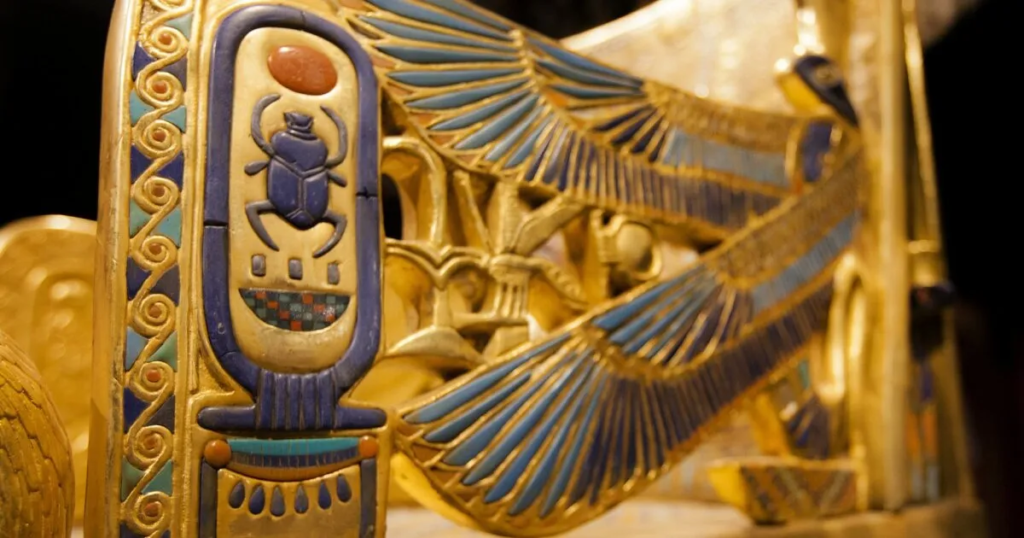
The Sacred Scarab became closely associated with Khepri, the Egyptian god of the rising sun. Khepri represented the dawn phase of the sun’s daily journey across the sky.
In Egyptian theology, the sun god manifested in three forms:
- Khepri at dawn
- Ra at midday
- Atum at sunset
This solar triad illustrated transformation across time. The sun’s rebirth each morning reinforced belief in resurrection after death. The British Museum notes that Khepri’s name derives from the same root as kheper, emphasizing becoming and emergence.
Temple inscriptions from the New Kingdom often depict Khepri pushing the solar disk upward from the horizon. The image paralleled the scarab rolling its sphere across the earth. In both cases, motion symbolized continuity and divine order.
Priests integrated this imagery into daily temple rituals. At dawn ceremonies, hymns praised Khepri’s renewal of the world. According to Egyptologists, these rites reaffirmed cosmic balance, known as ma’at, the principle of harmony and truth.
Scarab Amulets and Everyday Protection
Archaeological excavations have uncovered thousands of scarab amulets across Egypt and the broader Mediterranean. These objects were often carved from steatite and glazed in blue or green faience.
Blue symbolized the Nile and the heavens, while green signified growth and regeneration. Scarabs were affordable for many Egyptians, making them accessible spiritual tools rather than elite objects.
According to the University of Chicago’s Oriental Institute, scarabs served multiple functions. Some were personal amulets worn on necklaces or rings. Others acted as seals for documents and trade goods. Officials pressed inscribed scarabs into clay to authenticate shipments and legal agreements.
Craftsmanship and Production
Workshops specialized in producing scarabs during the Middle Kingdom and New Kingdom periods. Artisans shaped soft stone into beetle forms, carved inscriptions on the flat underside, and fired them with glaze.
Inscriptions ranged from royal cartouches to protective formulas and geometric patterns. Some scarabs even included prayers invoking deities such as Amun or Ptah.
Archaeologists have identified regional production centers, suggesting organized industry. Trade networks carried scarabs beyond Egypt’s borders into the Levant and Nubia. Their widespread presence reflects both commerce and cultural influence.
The Sacred Scarab in Burial Rituals
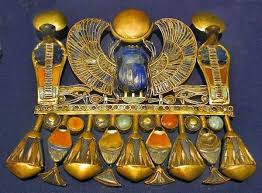
The Sacred Scarab played a critical role in funerary practices, particularly in the form of the “heart scarab.” These larger amulets were placed over the chest of the deceased during mummification.
Ancient Egyptian belief held that the heart was the seat of memory and morality. During the afterlife judgment, the heart would be weighed against the feather of Ma’at.
If the heart proved heavier than the feather, the soul would face annihilation. To prevent this outcome, heart scarabs were inscribed with Spell 30B from the Book of the Dead. The text implored the heart not to testify against its owner.
Egyptologists at the Metropolitan Museum of Art note that heart scarabs became especially common during the New Kingdom. Their inscriptions reveal personal anxiety about judgment and hope for rebirth.
Variations Across Dynasties
Earlier Old Kingdom burials did not always include scarabs. The practice expanded over time as religious texts became more accessible. By the Late Period, scarab imagery permeated coffins, papyri, and tomb walls.
This evolution reflects democratization of the afterlife. Belief in resurrection, once associated mainly with royalty, gradually extended to broader society.
Political Power and Royal Messaging
Scarabs were not limited to religion. Pharaohs used them as tools of political communication.
Large commemorative scarabs were issued during the reign of Amenhotep III in the 14th century BCE. These objects documented royal events, including lion hunts and diplomatic marriages.
Distributed across Egypt and neighboring regions, they functioned as state media. According to British Museum research, such scarabs reinforced the pharaoh’s divine legitimacy.
The Sacred Scarab thus bridged theology and governance. By aligning themselves with rebirth and cosmic order, rulers strengthened their authority.
Trade, Diplomacy, and International Influence
Scarabs have been discovered in archaeological sites in modern-day Israel, Jordan, and Sudan. Their presence highlights Egypt’s regional influence.
Scholars suggest that scarabs served diplomatic functions in gift exchanges. Their inscriptions sometimes included royal names, helping historians date foreign strata.
These finds also demonstrate cultural exchange. Neighboring societies adopted scarab forms and adapted them to local traditions. This cross-cultural spread enhanced Egypt’s symbolic reach.
Symbolism in Art and Architecture
Monumental scarab statues appear in temple complexes such as Karnak. Pilgrims sometimes circled these statues in ritual acts seeking renewal or fertility.
Temple ceilings also featured winged scarabs holding solar disks. These images reinforced the link between The Sacred Scarab and celestial protection.
Art historians note that the motif evolved stylistically over centuries but retained its symbolic core.
Enduring Legacy of The Sacred Scarab
The Sacred Scarab remains one of the most recognizable icons of ancient Egyptian civilization. Museums worldwide display scarab amulets, and the motif continues to appear in jewelry and contemporary design.
Modern Egyptology views the scarab as a window into how ancient societies understood existence. Researchers continue to study inscriptions to learn about literacy rates, trade routes, and political transitions.
Recent excavations in Luxor and Saqqara have uncovered additional scarab caches, providing new context for production techniques and burial customs.
Current Scholarly Perspective
Modern scholars emphasize that The Sacred Scarab illustrates how religion, governance, and natural observation intertwined in ancient Egypt.
Ongoing interdisciplinary research combines archaeology, linguistics, and materials science. Studies of glaze composition reveal trade patterns, while inscription analysis sheds light on literacy and administration.
The scarab also informs debates about ancient environmental awareness. By studying beetle ecology, researchers gain insight into Nile Valley ecosystems.
Final Note
The Sacred Scarab’s meaning evolved over centuries, but its core association with rebirth and continuity endured. As excavations continue and analytical techniques improve, scholars expect new discoveries to deepen understanding of this enduring symbol and its place within Egypt’s religious and political history.
FAQs About The Sacred Scarab Explained
What did The Sacred Scarab symbolize?
It symbolized rebirth, transformation, divine creation, and protection in both life and death.
Why was the beetle linked to the sun?
Its behavior of rolling dung balls resembled the sun’s movement across the sky, reinforcing themes of renewal.
Who was Khepri?
Khepri was the god of the rising sun and represented daily renewal in Egyptian belief.
Why were heart scarabs placed on mummies?
They were intended to protect the deceased during the afterlife judgment and ensure spiritual rebirth.