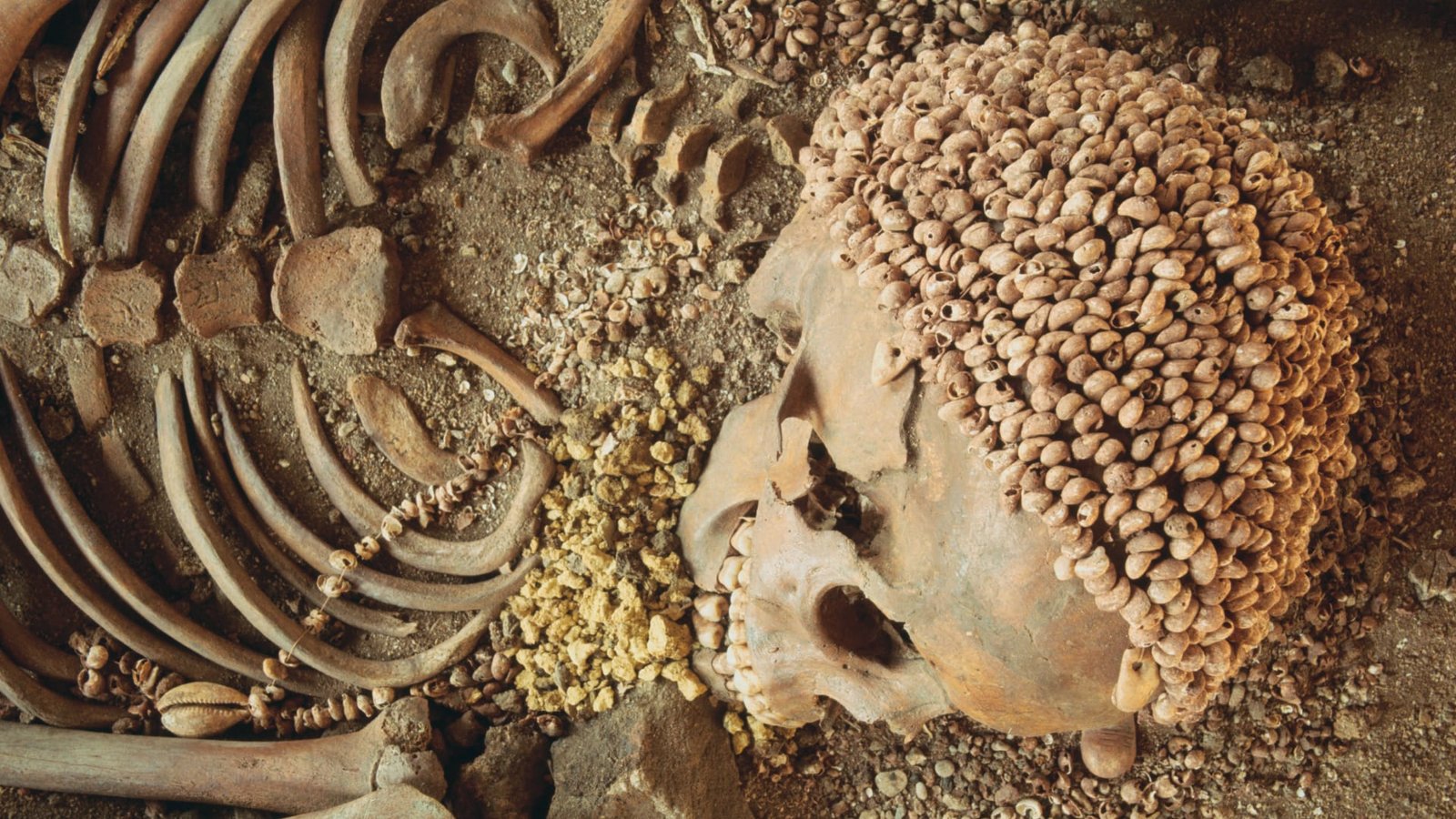

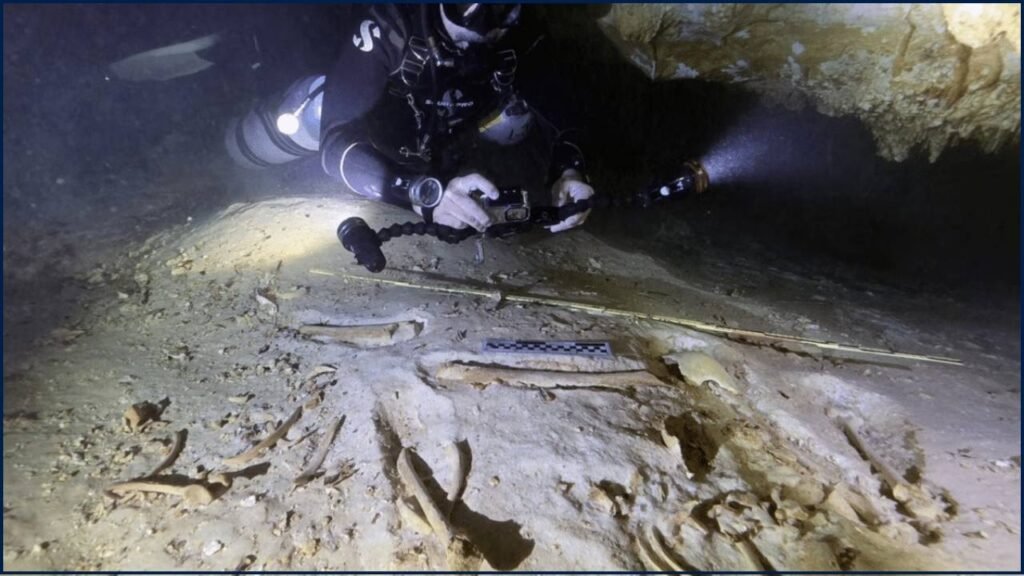
An 8000-Year-Old Skeleton discovered deep inside a submerged cave along Mexico’s Caribbean coast is providing new evidence about early settlement and ancient burial practices in the Americas. Archaeologists say the remains, found in late 2025 within a remote chamber of the Yucatán cave system, were likely placed there intentionally thousands of years before rising seas flooded the region.
Table of Contents
Discovery in a Submerged Cave System
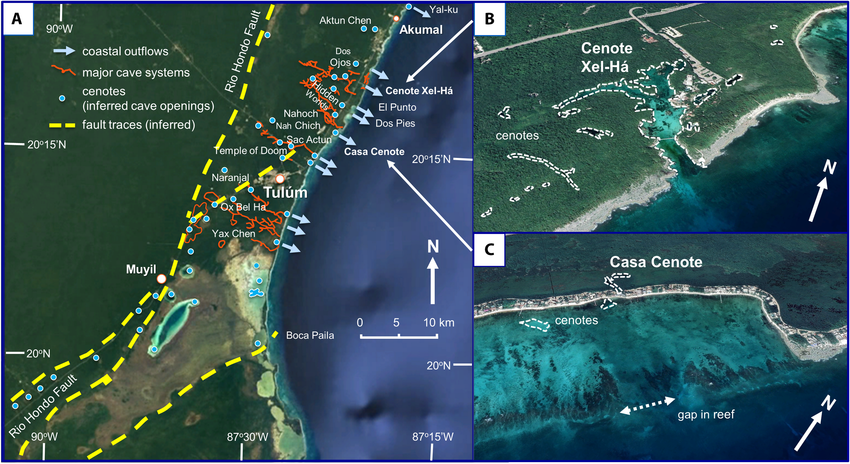
The skeleton was located in a narrow chamber approximately 26 feet below the water’s surface, within an extensive network of limestone caves between Tulum and Playa del Carmen in Quintana Roo. The site forms part of one of the longest underwater cave systems in the world.
Divers working with Mexico’s National Institute of Anthropology and History (INAH) reached the chamber after swimming nearly 650 feet through partially collapsed passages. According to INAH, the remains were positioned on a natural sediment rise, suggesting deliberate placement.
Octavio del Río, an underwater archaeologist affiliated with INAH, said in a public statement that the skeleton’s context indicates a probable funerary ritual.
“The body was found in a confined area that would have required purposeful access,” del Río said. “Its placement strongly suggests intentional deposition rather than accidental death.”
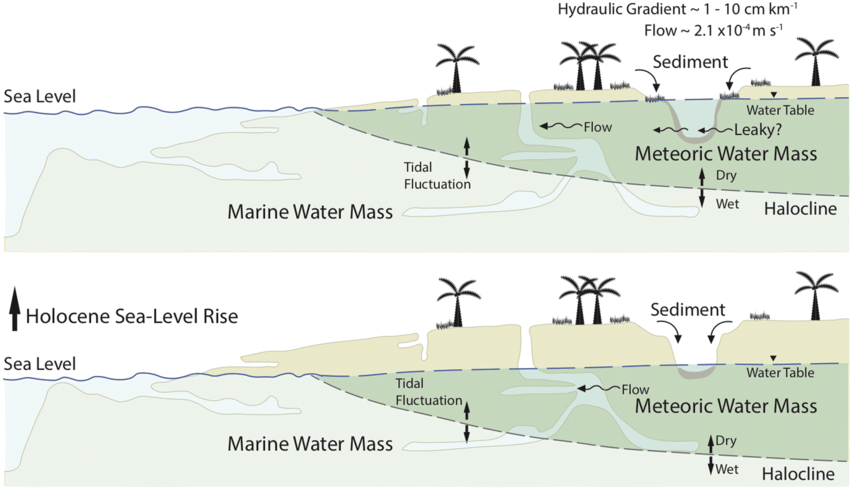
The cave would have been dry and accessible at the time of burial. Geological studies show that sea levels in the region rose dramatically between 10,000 and 6,000 years ago following the last Ice Age.
Geological Context: Why the Cave Is Underwater
The Yucatán Peninsula is composed largely of porous limestone. Over thousands of years, rainwater carved intricate networks of caves and sinkholes known as cenotes.
During the last glacial maximum, global sea levels were significantly lower. According to the National Oceanic and Atmospheric Administration (NOAA), ocean levels were approximately 300 feet lower than today around 20,000 years ago. As glaciers melted, rising seas gradually flooded coastal cave systems.
This natural flooding created sealed underwater chambers that preserved organic materials in stable conditions. Archaeologists say the mineral-rich waters and limited oxygen exposure have slowed decomposition, making the region a valuable site for underwater archaeology.
Dr. Guillermo de Anda, a specialist in submerged cave exploration, has previously described the region as “a time capsule of early human life.”
“These caves offer rare insight into how early communities interacted with the landscape,” de Anda said in earlier INAH research briefings.
Dating the Remains and Scientific Analysis
Preliminary estimates place the skeleton at approximately 8,000 years old. Researchers are conducting radiocarbon testing and sediment analysis to confirm the age.
Radiocarbon dating measures the decay of carbon-14 isotopes in organic material. When combined with stratigraphic analysis of surrounding sediments, scientists can establish a reliable timeline.
Laboratory work will also examine:
- Bone morphology to estimate age and sex
- Isotopic analysis to determine diet
- Potential trauma markers to identify cause of death
- DNA preservation for genetic comparison
INAH officials say results will be submitted to peer-reviewed journals once verification is complete.
Experts caution that analysis could take months.
“Scientific rigor is essential,” del Río said. “We must ensure every conclusion is supported by evidence.”
Evidence of Ancient Burial Practices
The placement of the 8000-Year-Old Skeleton is central to its significance. Archaeologists note that the remains were found away from cave entrances, in a location requiring deliberate movement through dark passages.
Such positioning aligns with known examples of ancient burial practices in Mesoamerica. Anthropological studies have shown that caves often held symbolic meaning for early communities. They were associated with water sources, spiritual realms, and cosmological beliefs.
While no grave goods have been publicly identified, researchers are analyzing surrounding sediments for artifacts or organic traces that could indicate ritual elements.
Dr. Pilar Luna, former head of INAH’s underwater archaeology division, previously stated that cave burials in the region may reflect early spiritual systems tied to water and seasonal cycles.
However, archaeologists stress that interpretations remain tentative until laboratory analysis is complete.
Comparison With Previous Discoveries
The Yucatán cave system has produced several major archaeological discoveries over the past three decades. Among the most notable was the skeleton known as “Naia,” discovered in the Hoyo Negro chamber and dated to approximately 13,000 years ago.
Research published in the journal Science in 2014 found that Naia’s DNA linked early American populations to northeast Asian ancestors. That study significantly advanced understanding of early human migration to the Americas.
The newly discovered 8000-Year-Old Skeleton is not as old as Naia, but it contributes important data about settlement continuity in the region.
Dr. Jennifer Raff, a genetic anthropologist at the University of Kansas, has previously emphasized that Yucatán cave remains are uniquely valuable.
“The preservation conditions allow us to examine genetic and dietary evidence that might otherwise be lost,” Raff noted in published commentary.
If viable DNA is recovered, researchers may compare the individual’s genetic markers with other early remains to track migration patterns and population connections.
Broader Context: Early Human Migration to the Americas
Most scientific consensus holds that early human migration to the Americas occurred at least 15,000 years ago, likely via a land bridge connecting Siberia and Alaska.
Over time, populations spread southward, adapting to diverse climates and environments. Coastal routes along the Pacific and Gulf of Mexico have been proposed as key migration pathways.
The Yucatán Peninsula would have offered freshwater sources and stable ecosystems attractive to early settlers.
Archaeological evidence suggests that by 8,000 years ago, communities in the region had developed complex survival strategies, including fishing, gathering, and early plant cultivation.
The discovery of the 8000-Year-Old Skeleton provides another data point in reconstructing how these communities lived and organized their societies.
Environmental and Conservation Concerns
While the discovery highlights the richness of the Yucatán cave system, experts warn that the region faces mounting environmental pressures.
Tourism, infrastructure development, and groundwater contamination pose risks to fragile cave ecosystems.
INAH has restricted public access to the discovery site to prevent disturbance. Mexico’s cultural heritage laws prohibit unauthorized removal or damage to archaeological remains.
Environmental organizations have also raised concerns about large-scale construction projects near coastal areas.
“These cave systems are both natural and cultural heritage sites,” said a spokesperson for a regional conservation group. “Once damaged, they cannot be restored.”
The Role of Underwater Archaeology
Underwater archaeology requires specialized training, equipment, and safety protocols. Divers often operate in low-visibility conditions with limited air supply.
Mexico has invested significantly in developing underwater archaeological expertise, particularly within INAH.
According to INAH reports, multidisciplinary teams—including geologists, anthropologists, and marine specialists—collaborate to document findings.
Advanced technologies such as 3D mapping and photogrammetry allow researchers to digitally reconstruct sites before recovery.
This approach ensures detailed documentation while minimizing disturbance to the environment.
What Comes Next
Laboratory analysis of the 8000-Year-Old Skeleton is expected to continue throughout 2026. Researchers aim to determine the individual’s biological profile and assess broader implications for understanding ancient burial practices.
Officials say final conclusions will depend on peer-reviewed research and independent verification.
For now, the discovery adds to a growing body of evidence preserved beneath the waters of the Yucatán Peninsula—evidence that continues to reshape understanding of early human history in the Americas.
FAQs About 8000-Year-Old Skeleton Discovered
How was the skeleton found?
Trained underwater archaeologists discovered it during a structured exploration of submerged caves near Tulum.
Why is the cave underwater today?
Post-Ice Age sea-level rise flooded previously dry limestone caves.
Is it the oldest skeleton in the region?
No. Some remains in nearby caves date back more than 10,000 years.
Will DNA testing confirm ancestry?
Researchers are attempting genetic analysis, but preservation results have not yet been released.
Why are cave burials important?
They provide insight into ancient burial practices, belief systems, and settlement patterns.