
A 28000-Year-Old Mystery surrounding one of Europe’s most famous Ice Age burials is being reexamined after new forensic evidence suggests a prehistoric bear attack may have caused the death of a teenage boy known as Il Principe, offering rare insight into the dangers faced by early modern humans living alongside large predators.
Table of Contents
A 28000-Year-Old Mystery
| Key Fact | Detail |
|---|---|
| Burial age | ~28,000 years old |
| Location | Arene Candide Cave, Italy |
| Individual | Male adolescent |
| Cause of trauma | Injuries consistent with bear mauling |
| Survival time | Likely days after attack |
A Burial That Defined Upper Paleolithic Archaeology
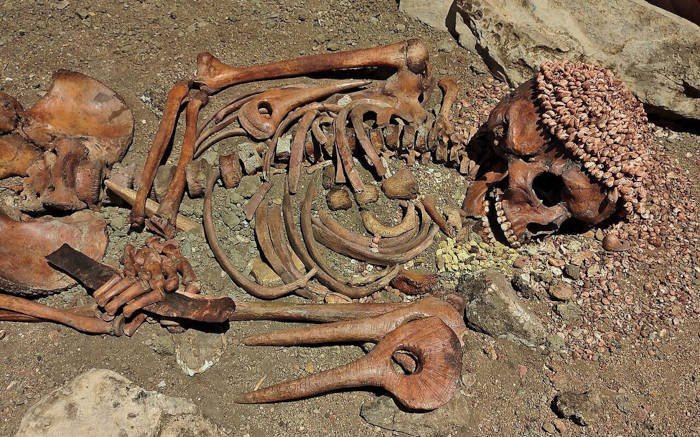
Il Principe, discovered in 1942 in the Arene Candide Cave along Italy’s Ligurian coast, has long occupied a central place in European prehistory. The burial stood out not only for its age but for its elaborate ritual elements, including perforated shells, ivory pendants, red ocher, and a carefully placed flint blade.
Archaeologists interpreted these objects as evidence of symbolic behavior and social differentiation among Gravettian hunter-gatherers. The individual’s nickname, meaning “the Prince,” reflected the apparent care and status implied by the burial.
Yet from the moment the skeleton was uncovered, researchers noted extensive skeletal damage. For decades, the cause of that damage remained unresolved, forming the basis of A 28000-Year-Old Mystery that persisted across generations of scholarship.
Revisiting Old Bones With New Tools
The latest study reexamined Il Principe’s remains using methods unavailable to earlier researchers. High-resolution imaging, microscopic trauma analysis, and comparative databases of modern animal attacks allowed scientists to reassess long-standing assumptions.
The research team concluded that many injuries previously attributed to ritual activity, excavation damage, or interpersonal violence are more consistent with a large carnivore mauling.
“These lesions display patterns that are extremely difficult to reproduce through human action alone,” the authors wrote in their published analysis, pointing to crushing fractures and puncture marks that match known bear attacks.
Injury Patterns That Tell a Violent Story
Where the Skeleton Was Damaged
The injuries are concentrated in areas commonly targeted during bear attacks. These include the face, jaw, shoulder girdle, and lower limbs. Several bones show depressed fractures and puncture marks consistent with powerful bites rather than cutting or scraping tools.
One injury to the fibula, researchers noted, aligns closely with documented bear canine penetration in modern forensic cases. Claw-related trauma may also explain elongated grooves found on the long bones.
Ruling Out Other Explanations
The researchers systematically evaluated alternative explanations. Stone tool injuries tend to produce sharp, linear cuts, which were largely absent. Human-inflicted blunt force trauma rarely creates the depth and spacing seen in the puncture wounds.
Carnivores such as wolves were also considered unlikely. Their bite patterns, researchers noted, typically result in different fracture distributions and less extensive bone crushing.
Taken together, the evidence pointed most strongly to a bear, either a brown bear or the now-extinct cave bear, both present in the region during the Upper Paleolithic.
Evidence of Survival After the Attack
Perhaps the most striking finding involves signs of healing. Microscopic bone remodeling suggests that Il Principe survived the initial encounter for at least several days. This implies that he returned to his community after the attack.
Anthropologists say this detail adds a deeply human dimension to A 28000-Year-Old Mystery. It suggests that others may have cared for him during his final days, despite the severity of his injuries.
Such care aligns with other archaeological evidence showing that Paleolithic groups supported injured or disabled members, challenging outdated views of early humans as purely survival-driven.
Life and Danger in Ice Age Europe
During the period when Il Principe lived, Europe was a harsh and unpredictable landscape. Glacial climates, fluctuating resources, and competition with large predators defined daily life.
Bears occupied caves seasonally, hunted overlapping food sources, and posed serious threats during unexpected encounters. Researchers say a chance meeting while foraging or scouting terrain could easily turn fatal.
“These were not rare animals on the margins,” said one independent paleoecologist. “They were dominant forces in the ecosystem.”
Why Such Evidence Is Rare
Direct evidence of prehistoric animal attacks on humans is exceptionally uncommon. Soft tissue injuries do not preserve, and skeletal trauma is often ambiguous.
This rarity makes A 28000-Year-Old Mystery especially significant. It provides one of the clearest cases in which skeletal evidence, environmental context, and comparative data converge.
Most known examples of ancient human-animal conflict come from later periods, often involving weapons or domesticated animals. A clear Ice Age bear attack offers a rare glimpse into a much earlier chapter of human vulnerability.
How This Changes Archaeological Interpretation
The reinterpretation of Il Principe’s injuries also raises broader methodological questions. Archaeologists increasingly recognize that early interpretations were shaped by limited technology and cultural assumptions.
What was once framed as ritual violence or symbolic damage may, in some cases, reflect real-world hazards faced by prehistoric people.
“This forces us to rethink how often trauma in ancient skeletons might reflect environmental danger rather than social conflict,” said a researcher familiar with the study.
Scientific Caution and Ongoing Debate
Despite the compelling evidence, researchers stress caution. Absolute certainty is difficult when reconstructing events tens of thousands of years old.
The study’s authors emphasize that their conclusions are probabilistic, not definitive. Additional testing, including micro-CT scanning and biomechanical modeling, may further refine interpretations.
Still, many experts agree that the bear attack hypothesis currently offers the most comprehensive explanation for the observed injuries.
What the Burial Still Tells Us
Even if Il Principe died from a bear attack, the burial itself remains extraordinary. The careful placement of grave goods suggests that violent death did not diminish his standing within the group.
This reinforces the idea that Upper Paleolithic societies invested meaning and care into death rituals, regardless of cause.
In that sense, A 28000-Year-Old Mystery is not only about how Il Principe died, but about how his community responded.
Looking Ahead
As forensic science continues to advance, other famous archaeological cases may also be revisited. Researchers believe similar reanalyses could reveal overlooked interactions between humans and Ice Age predators.
For now, Il Principe stands as one of the most detailed windows into the risks, resilience, and social bonds of early modern humans.
The mystery of his death may never be solved with complete certainty, but modern science has brought us closer than ever before.
FAQ
What is A 28000-Year-Old Mystery?
It refers to the long-standing question surrounding the cause of death of Il Principe, now linked to a possible bear attack.
Why is this discovery important?
It may represent the earliest documented fatal bear attack involving a modern human.
Did Il Principe die immediately?
Evidence suggests he survived for several days after the attack.
Is the conclusion final?
No. Researchers describe it as the most plausible explanation based on current evidence.