
Ancient Ostrich Eggshell Engravings: and that statement alone changes how we understand the story of humanity. Long before skyscrapers in New York City, before NASA engineers ran calculations in Houston, before students in classrooms across America learned about angles and grids, early Homo sapiens in southern Africa were carving deliberate, repeating geometric patterns into ostrich eggshells.
This isn’t hype. It’s grounded in archaeological research from Middle Stone Age sites in South Africa and Namibia. Scientists analyzing these engravings found evidence of structured, rule-based design dating back roughly 60,000 years, during a cultural phase known as the Howiesons Poort period. Findings from sites like Diepkloof Rock Shelter have been widely discussed in scientific reporting platforms and supported by archaeological scholarship connected to institutions in South Africa. For professionals in archaeology, anthropology, education, and even STEM innovation, this discovery strengthens a growing consensus: abstract geometric thinking emerged far earlier in human history than once assumed.
Table of Contents
Ancient Ostrich Eggshell Engravings
The statement Ancient Ostrich Eggshell Engravings Show Geometry 60,000 Years Ago is more than a headline. It represents a shift in our understanding of early human cognition. These engraved ostrich eggshell fragments demonstrate intentional, repeatable geometric design during the Middle Stone Age. Statistical analysis confirms structured patterns rather than random marks. This provides strong evidence that abstract reasoning and spatial organization were already present in early Homo sapiens. For educators, researchers, and professionals in STEM, this discovery reinforces a powerful truth: the roots of geometry, design, and structured thinking stretch back tens of thousands of years into our shared human past.

| Category | Details |
|---|---|
| Topic | Ancient Ostrich Eggshell Engravings Show Geometry 60,000 Years Ago |
| Time Period | Howiesons Poort (approx. 65,000–60,000 years ago) |
| Primary Locations | Diepkloof Rock Shelter, Klipdrift Shelter (South Africa); Apollo 11 Rockshelter (Namibia) |
| Material | Engraved ostrich eggshell fragments used as water containers |
| Sample Size | 112 analyzed fragments |
| Key Statistical Finding | Over 80% showed structured geometric organization |
| Cognitive Significance | Evidence of early abstract reasoning and symbolic communication |
| Official Reference | South African Heritage Resources Agency – https://www.sahra.org.za |
| Educational Relevance | Supports early origins of mathematics, pattern recognition, and design thinking |
The Archaeological Context: Where Ancient Ostrich Eggshell Engravings Discoveries Were Made
To understand the importance of these engravings, we need to zoom out and look at the environment in which they were created.
The artifacts were discovered primarily at:
- Diepkloof Rock Shelter (Western Cape, South Africa)
- Klipdrift Shelter (Southern Cape, South Africa)
- Apollo 11 Rockshelter (Namibia)
These are not random dig sites. They are internationally recognized Middle Stone Age locations that have produced stone tools, pigments, and evidence of advanced human behavior.
The Howiesons Poort period, dated to approximately 65,000–60,000 years ago, is particularly significant. According to research cited by the Smithsonian’s Human Origins Program, this period is associated with technological innovation, long-distance material exchange, and symbolic expression.
So when researchers uncovered engraved ostrich eggshell fragments in these sediment layers, it immediately raised an important question:
Were these designs intentional?
What the Patterns Actually Look Like?
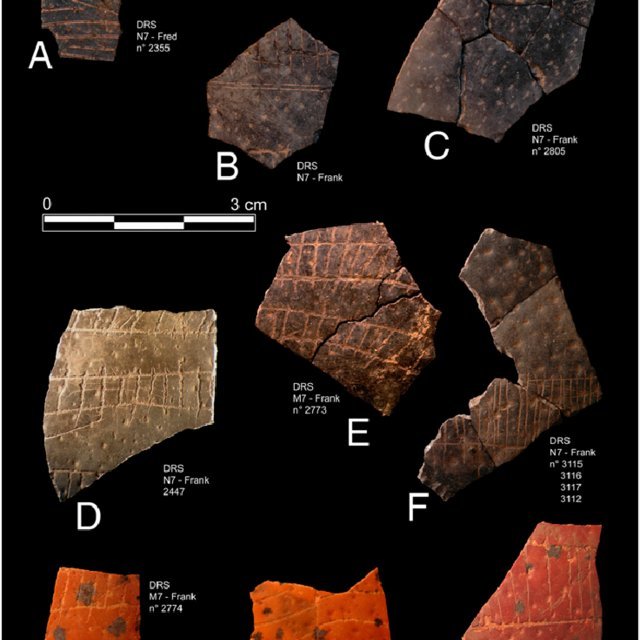
The engravings consist primarily of:
- Parallel lines arranged in groups
- Cross-hatched patterns
- Repeated bands of incisions
- Consistent spacing between markings
- Symmetrical alignments
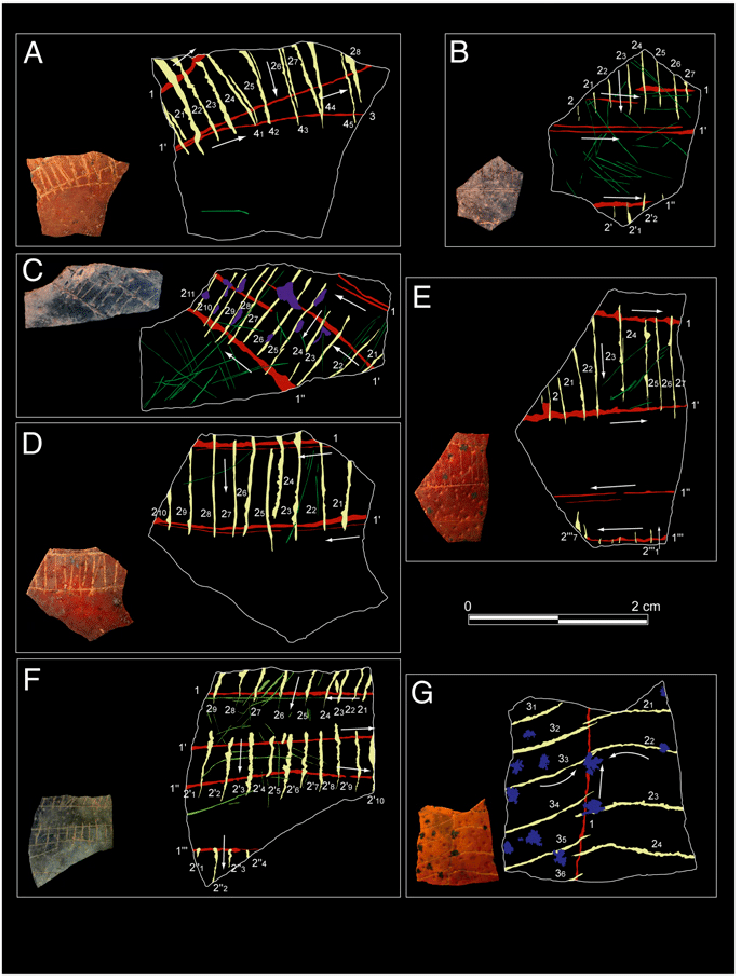
When researchers digitally mapped and measured these designs, they discovered something compelling: the lines were not randomly placed.
Instead, most of the fragments followed structured arrangements that suggest deliberate planning. Over 80% of the 112 fragments studied showed organized pattern repetition and spatial consistency.
This led researchers to describe the engravings as following a kind of “geometric grammar” — meaning early humans were applying repeatable design rules.
Think about that for a second.
Grammar implies structure. Structure implies intention. Intention implies cognition.
Why Ancient Ostrich Eggshell Engravings Matter So Much?
Here in the United States, when we think about prehistoric art, we usually picture cave paintings. But these eggshell engravings are different because they were made on functional objects.
Ostrich eggshells were used as portable water containers. Archaeologists have documented how ancient African populations carefully hollowed out these shells and carried them across arid landscapes.
That means these engravings were carved into everyday survival tools.
This tells us several important things:
- The designs were portable — they moved with people.
- They may have marked ownership or identity.
- They could have served as social signals between groups.
- They were integrated into daily life, not isolated ceremonial art.
In modern terms, imagine engraving a meaningful geometric logo onto your Yeti water bottle before heading out on a road trip across Arizona. It’s functional, but it also says something about who you are.
Anthropologists often connect symbolic behavior to social complexity. When individuals begin marking objects consistently, it suggests shared understanding within a group.
Evidence of Advanced Cognitive Skills
Let’s break this down in simple terms, even a 10-year-old could follow.
If you draw random lines, they don’t usually line up neatly. But if you plan ahead, you can make evenly spaced stripes or repeating diamond shapes.
That’s exactly what these ancient engravers did.
To carve consistent patterns into curved eggshell surfaces, you need:
- Hand-eye coordination
- Planning before engraving
- Awareness of symmetry
- Control of spacing
- Memory of repeated sequences
Those are not basic reflex skills. Those are executive cognitive functions.
Modern cognitive scientists describe abstract reasoning as the ability to manipulate ideas or symbols beyond immediate physical needs. According to research summarized by the National Science Foundation, pattern recognition and spatial reasoning are core elements of problem-solving and engineering thinking.
So when we see structured geometry at 60,000 years ago, we are witnessing the early roots of the same cognitive toolkit engineers use today.
How Scientists Verified the Patterns Were Intentional?
This part is crucial, especially for professional readers.
Researchers didn’t simply eyeball the fragments and make assumptions. They applied systematic analysis:
First, they confirmed the markings were incisions made by tools rather than natural cracks. Microscopic examination revealed consistent depth and directionality.
Second, they digitized the engravings and measured line spacing, angle variation, and repetition intervals.
Third, they conducted statistical comparisons across fragments to determine whether patterns followed predictable rules.
The fact that more than 80% showed structured alignment is statistically significant. If the marks were random, the distribution of spacing and angle would vary widely.
Instead, the data showed clustering around consistent measurements.
That’s empirical evidence.
How Ancient Ostrich Eggshell Engravings Change the Timeline of Geometry?
In American education systems, geometry is typically introduced as part of classical Greek mathematics. Students learn about Euclid, Pythagoras, and the foundations of formal geometric proofs.
But geometry as a concept — organizing space into structured patterns — clearly predates written mathematics by tens of thousands of years.
These engravings suggest that the mental foundations of geometry existed long before formal notation systems.
This does not mean early humans were solving equations. It means they understood:
- Repetition
- Alignment
- Parallelism
- Symmetry
Those are the building blocks of architecture, textiles, mapping, and engineering.
Recognizing this broadens the narrative of mathematical history beyond Europe and into deep African prehistory.
Cultural and Social Implications of Ancient Ostrich Eggshell Engravings
Symbolic markings are often tied to identity.
Some archaeologists propose that these engraved patterns may have functioned similarly to clan symbols or group identifiers.
When you consistently apply a particular pattern across multiple containers, you create visual consistency. That suggests shared cultural meaning.
In anthropology, repeated motifs often indicate social networks. If similar patterns appear across distant sites, it may signal communication or shared tradition.
That has implications for understanding migration, trade, and group cohesion during the Middle Stone Age.
Lessons for Modern Educators and STEM Professionals
For teachers across the United States, this discovery is a gold mine.
Instead of presenting geometry as something that began in ancient Greece, educators can demonstrate how humans have been organizing space visually for at least 60,000 years.
Practical classroom example:
Have students carve patterns into clay using repeating lines. Then discuss how early humans might have planned their designs.
For engineers and designers, this reinforces an important principle: pattern recognition is hardwired into our species.
Innovation isn’t just about new technology. It’s about ancient cognitive capacities being applied in modern contexts.
Addressing Common Misunderstandings
One misconception is that prehistoric humans were primitive thinkers focused solely on survival.
But the archaeological record consistently shows that early Homo sapiens were capable of:
- Symbolic expression
- Tool innovation
- Long-distance resource planning
- Decorative art
The ostrich eggshell engravings add geometric structure to that list.
Another misconception is that symbolic art began around 40,000 years ago in Europe. While European cave art is well documented, African sites show evidence of symbolic behavior even earlier.
The broader academic consensus increasingly acknowledges Africa as the origin point for modern cognitive behavior.
How Ancient Greek Myths Explained Where Humans Came From
New Analysis Indicates Pompeii’s Bathing Pools Had Low Water Quality
Broader Implications for Human Evolution Research
The study of these engravings intersects with cognitive anthropology, archaeology, and evolutionary psychology.
Abstract pattern creation suggests neural development capable of:
- Symbol storage
- Predictive planning
- Conceptual mapping
Those traits are foundational to modern society.
The Smithsonian Human Origins Program emphasizes that symbolic thinking marks a turning point in human behavioral evolution. These engravings align with that framework.
For researchers, the next steps may involve:
- Expanded cross-site comparisons
- 3D modeling of engraving techniques
- Experimental archaeology replicating carving methods
Each of these approaches deepens our understanding of how early humans thought and communicated.