
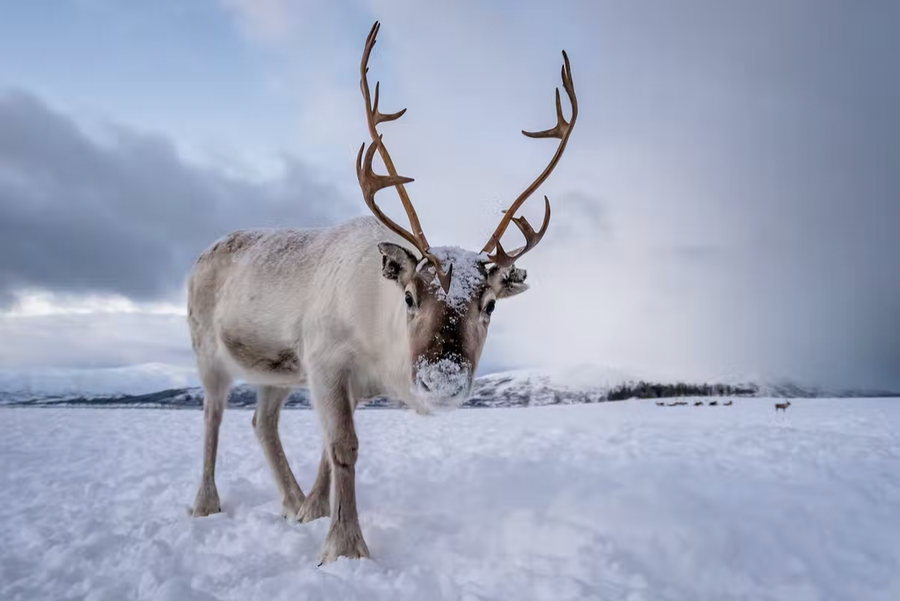
Scientists studying Arctic wildlife say Arctic reindeer eyes change color in winter, a rare biological adaptation that helps the animals survive months of darkness near the North Pole. Researchers report the change occurs annually as daylight disappears, allowing reindeer to see predators and locate food in dim polar twilight.
Table of Contents
Reindeer Eyes Change Color in Winter to Help Them Survive
| Key Fact | Detail/Statistic |
|---|---|
| Seasonal eye color shift | Gold in summer, deep blue in winter |
| Survival function | Improves low-light detection of movement and food |
| Biological mechanism | Changes in reflective eye layer (tapetum lucidum) |
Scientists say the discovery shows how evolution can produce highly specialized solutions to extreme environments. As Arctic conditions shift, researchers continue monitoring whether the reindeer’s unusual vision remains effective, offering broader lessons about how animals — and possibly human technologies — may adapt to rapidly changing light environments.
What the Research Shows About Reindeer Eyes Change Color in Winter
Scientists have long known that many nocturnal animals possess reflective eye layers that improve night vision. However, reindeer (Rangifer tarandus) appear unique because their eyes physically change optical properties twice each year.
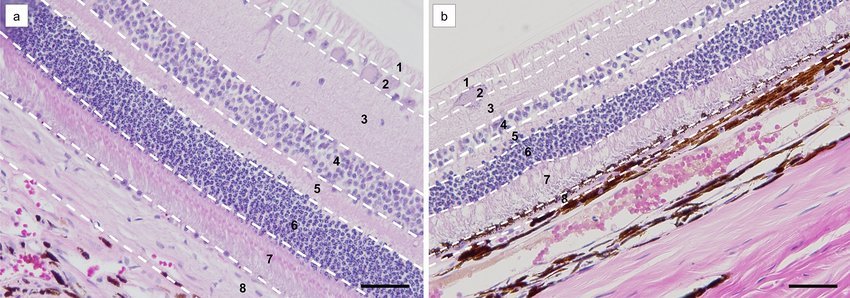
According to vision researchers from University College London (UCL) and collaborating veterinary scientists in Scandinavia, the shift occurs in the tapetum lucidum, a mirror-like tissue behind the retina that reflects incoming light back through photoreceptors.
Dr. Glen Jeffery, a neuroscientist involved in the research, explained in published findings that the Arctic winter environment forces a radical adjustment.
“For several months, the sun never rises above the horizon. The animals must detect movement in extremely dim blue-colored twilight,” he said in a university statement.
In summer, the tapetum reflects yellow-gold wavelengths. In winter, it reflects blue wavelengths that dominate polar twilight.
Field biologists say the adaptation is among the clearest examples of seasonal physiological change in a large land mammal. Unlike fur growth or fat storage, this adjustment occurs at the microscopic structural level inside the eye.
Why the Color Change Matters
Detecting Predators
Arctic wolves hunt reindeer during the polar night, when visibility is limited. The winter eye adaptation increases sensitivity to faint movement.
Researchers say the trade-off is image sharpness. The blue reflective state scatters more light inside the eye, reducing clarity but greatly improving brightness detection. In survival terms, detecting motion matters more than seeing detail.
Wildlife ecologists note that wolves often hunt at twilight because contrast between animal shapes and snow becomes visible at specific wavelengths. Reindeer eyes appear tuned to those conditions.
Finding Food Beneath Snow
Reindeer feed mainly on lichen during winter. Lichen absorbs ultraviolet light while snow reflects it. Because reindeer can perceive ultraviolet wavelengths, scientists say the seasonal eye adjustment amplifies contrast, making food patches visible.
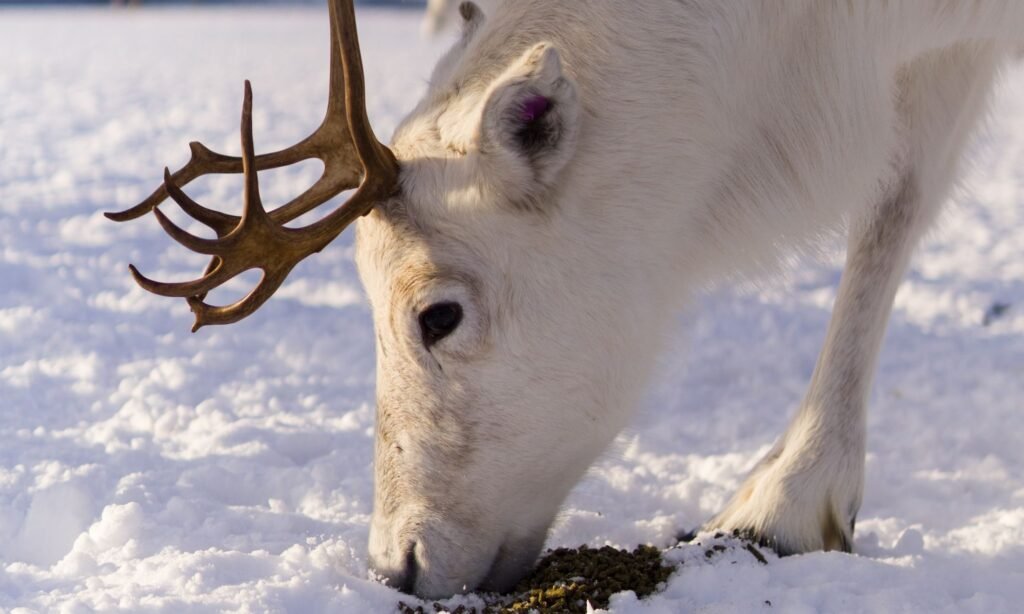
Researchers have observed herds pawing through snow layers several inches thick even in near darkness. Biologists believe ultraviolet detection allows reindeer to identify feeding areas without wasting energy digging randomly — a critical advantage during winter when calories are scarce.
The Science Behind the Fact that Reindeer Eyes Change Color in Winter to Help Them Survive
Eye Pressure Alters Light Reflection
Researchers found that winter darkness keeps reindeer pupils dilated for months. Continuous dilation raises internal eye pressure, compressing microscopic collagen fibers in the reflective layer.
That structural change alters how light waves scatter, shifting reflection toward blue wavelengths — a physical optical transformation rather than a pigment change.
Veterinary ophthalmologists say the phenomenon resembles engineered photonic materials, where microscopic structures control light behavior.
A Natural Optical Device
Optical physicists describe the reindeer eye as a biological example of a tunable reflector — a material whose light properties change depending on structure.
Laboratory studies show the winter state increases light sensitivity dramatically, while the summer state reduces excessive brightness.
Scientists emphasize that the process is reversible and repeats annually.
How Arctic Light Shapes Vision
The Arctic environment differs from ordinary night. Even in darkness, sunlight scattered below the horizon produces long periods of dim blue illumination called polar twilight.
Human eyes struggle in this environment. But reindeer vision appears tuned to the specific wavelengths present in that light.
Biologists note that this adaptation also helps detect predators whose fur contrasts against snow only at certain wavelengths.
Comparison With Other Animals
Many animals — including cats, dogs, and foxes — possess reflective eye layers. However, they do not seasonally alter optical structure.
Owls have specialized night vision, but their eyes remain constant year-round. Polar bears rely more heavily on smell. Arctic foxes use hearing to locate prey beneath snow.
Researchers say this makes reindeer one of the few mammals known to adjust its visual system annually to match environmental light cycles.
Evolutionary Origins
Scientists believe the trait evolved over thousands of years during repeated ice ages. Reindeer ancestors that could navigate winter darkness more effectively were more likely to survive and reproduce.
Genetic studies suggest populations living closest to the Arctic Circle show the strongest seasonal optical changes. Herds living farther south display weaker versions of the adaptation.
Evolutionary biologists say this pattern indicates natural selection driven specifically by extreme light conditions rather than temperature alone.
Field Research in the Arctic
Much of the research comes from northern Norway and Svalbard, regions where winter darkness lasts for weeks.
Researchers often conduct observations at temperatures below −20°C (−4°F). Scientists use headlamps with filtered light so they do not disrupt animal behavior.
Veterinarians working with herders examine domesticated reindeer during seasonal migrations. These examinations helped confirm the timing of the eye transformation.
Scientists also collect post-mortem tissue samples from animals that died naturally, allowing microscopic study without harming wildlife populations.
Broader Implications for Science
Scientists studying optical physics and medicine are interested in the discovery beyond wildlife biology. The mechanism could inspire low-light imaging technology or improved camera sensors.
Biomedical engineers say the reindeer eye demonstrates a passive optical system — it works without electronics, batteries, or neural processing changes.
Potential applications include:
- military and rescue night-vision optics
- deep-sea exploration cameras
- autonomous vehicle sensors
- medical imaging devices
Researchers caution that translating biological structures into manufactured materials may take years, but the principle is already influencing photonics research.
Seasonal Cycle: Summer vs Winter
| Season | Eye Reflection | Function |
|---|---|---|
| Summer | Golden | Protects against constant daylight |
| Winter | Blue | Maximizes sensitivity in low light |
During summer, the Arctic experiences nearly continuous daylight. The golden reflection reduces glare and protects the retina from excessive brightness.
During winter, survival depends on gathering every available photon.
Environmental Context
Climate scientists say the adaptation evolved because reindeer inhabit regions above the Arctic Circle, where daylight patterns are extreme. Months of midnight sun alternate with months of near darkness.
Wildlife ecologists note that few large land mammals remain active year-round in these conditions. Reindeer do not hibernate and must forage continuously.
Impact of Climate Change
Researchers are now studying whether warming temperatures may affect the usefulness of the adaptation.
Key concerns include:
- changing snow reflectivity
- ice crust formation after rain
- artificial light from expanding settlements
- altered predator behavior
If snow conditions change significantly, ultraviolet contrast between lichen and snow may weaken, potentially reducing the benefit of the winter eye state.
Cultural and Human Connections
Reindeer have long been central to the culture of Arctic Indigenous communities, including Sámi herders in Scandinavia.
Herders depend on the animals’ ability to migrate and forage through winter. Understanding sensory adaptations helps veterinarians improve herd management and health monitoring.
Anthropologists note that traditional knowledge recognized unusual night-time awareness in reindeer long before scientific confirmation.
Current Status and Future Research
Researchers are continuing to study whether changing Arctic conditions could affect the adaptation. Increasing artificial light in northern settlements and climate-driven snow changes may alter how effectively the visual system works.
Scientists are also investigating whether young calves develop the eye change immediately or gradually as they experience seasonal darkness.
Some researchers suspect other Arctic species, such as musk oxen, may possess undiscovered sensory adaptations.
Dr. Jeffery said future studies will focus on how young reindeer develop the ability and whether similar mechanisms exist in other polar species.
FAQs About Reindeer Eyes Change Color in Winter to Help Them Survive
Do reindeer permanently change eye color?
No. The change is seasonal. Eyes shift to blue during winter darkness and return to gold in summer daylight.
Is the change in the iris?
No. The iris remains the same. The change occurs in a reflective tissue behind the retina.
Can humans see ultraviolet light like reindeer?
No. Human vision cannot naturally detect ultraviolet wavelengths.
Do baby reindeer have blue eyes in winter?
Calves develop the seasonal change as their visual system matures and they experience extended darkness.
Does the change hurt the animal?
Researchers report no evidence of discomfort. It is a natural physiological adaptation.