


Millions of Americans filing 2025 tax returns in early 2026 are tracking the IRS Refund Status Timeline, a process federal officials say usually takes about three weeks but can extend into March for certain households. The delays largely stem from mandatory fraud-prevention reviews and identity checks rather than system backlogs, according to the Internal Revenue Service (IRS) and independent tax analysts.
Table of Contents
IRS Refund Status Timeline
| Key Fact | Detail / Statistic |
|---|---|
| Typical refund speed | About 21 days after acceptance for e-filed returns |
| Main delay factor | Earned Income Tax Credit and Child Tax Credit verification |
| Paper filing timeline | Often 6–8 weeks or longer |
With filing season continuing toward April, the IRS anticipates peak activity in March. While some households will still experience waiting periods, tax officials say the IRS Refund Status Timeline is operating as designed, balancing quick payments with identity-theft protection for taxpayers.
Understanding the IRS Refund Status Timeline
The U.S. tax filing season typically opens in late January and continues until April 15. The IRS expects roughly 160 million individual tax returns this year, making it one of the largest annual administrative operations in the federal government.
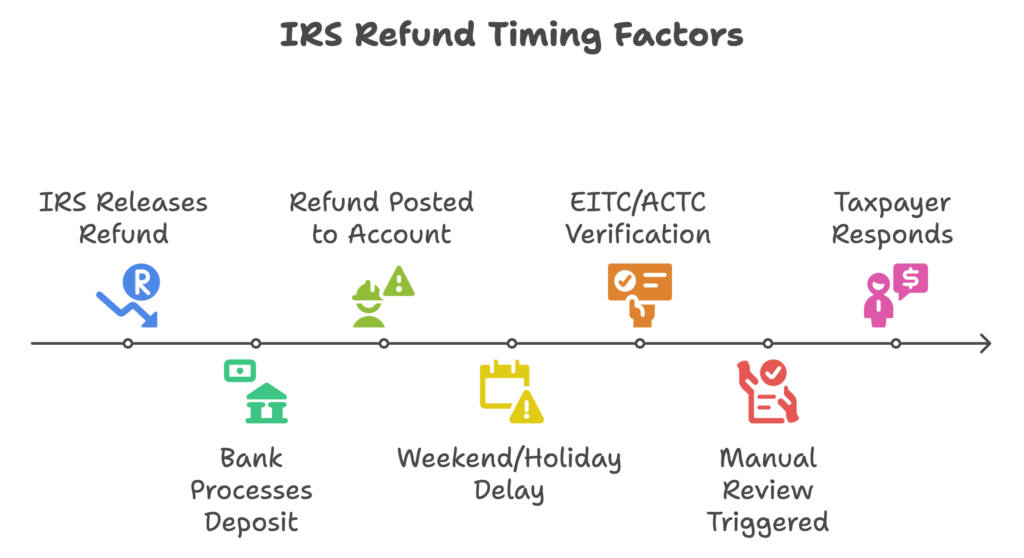
The IRS Refund Status Timeline follows a standardized sequence:
- Return accepted — IRS confirms receipt
- Return processed — identity and income verification checks
- Refund approved — payment authorization issued
- Refund sent — direct deposit or mailed check
Taxpayers can monitor progress using the agency’s Where’s My Refund tool, which updates daily once a return is entered into the system.
“Most refunds are issued in less than 21 days,” the IRS says in official filing guidance. However, officials caution that some returns require manual review, which increases overall tax refund processing time.
Why the Refund System Exists in Its Current Form
The modern refund system reflects decades of evolving tax enforcement policy. Before electronic filing became common in the 1990s, tax refunds frequently took two to three months to arrive.
The shift to e-filing dramatically changed processing speed. Today, more than 90% of taxpayers file electronically. That technological transition allows automated verification of employer-reported wages through W-2 forms submitted separately to the government.
However, rapid processing also created a vulnerability: refund fraud. Criminals began filing fake returns early in the season using stolen identities, claiming refunds before legitimate taxpayers filed.
According to the Treasury Inspector General for Tax Administration, fraudulent refund claims once reached billions of dollars annually, prompting Congress to require additional verification procedures.
Why Some Refunds Take Longer
Anti-fraud laws play a major role
The largest cause of delays is the Protecting Americans from Tax Hikes (PATH) Act of 2015. The law requires the IRS to hold refunds claiming certain credits until mid-February.
These credits include:
- Earned Income Tax Credit (EITC)
- Additional Child Tax Credit (ACTC)
Because of this law, EITC delay refunds affect millions of households every year.
The IRS uses the extra time to match reported wages against employer payroll data and detect identity theft attempts.
“By law, we cannot issue refunds involving these credits before the review period ends,” the IRS says in taxpayer notices.
Tax policy specialists say the delay is intentional and preventative.
“It reduced refund fraud substantially,” said Dr. Elaine Maag, senior fellow at the Urban-Brookings Tax Policy Center. “But legitimate taxpayers understandably feel the impact because they often depend on that refund.”
Filing Method Strongly Affects Payment Speed
How a return is submitted plays a decisive role in the tax refund processing time.
Fastest option: e-file with direct deposit
Electronic filing plus direct bank deposit is consistently the quickest route, often delivering funds within two to three weeks.
Slower options
- Paper filing: typically six to eight weeks
- Refund check by mail: adds mailing delays
The IRS reports paper returns are far more likely to require manual review because handwritten forms must be digitized.
Other Reasons Refunds May Be Delayed
Outside statutory credit holds, refunds may slow due to administrative review. Common causes include:
- Identity verification audits
- Social Security number mismatches
- Missing employer income forms
- Banking errors in deposit information
- Amended returns
During these reviews, the IRS may send a letter requesting confirmation of identity. Officials stress that this is a protective measure, not an accusation.
What the Tracker Status Messages Mean
The Where’s My Refund tool shows three core messages:
Return Received — IRS has accepted the return
Refund Approved — payment scheduled
Refund Sent — funds issued
Tax professionals say most anxiety occurs in the middle stage.
“People assume a delay means a problem,” said Mark Steber, chief tax information officer at Jackson Hewitt. “In reality, it usually means the return is moving through verification.”
Economic Importance of Tax Refunds
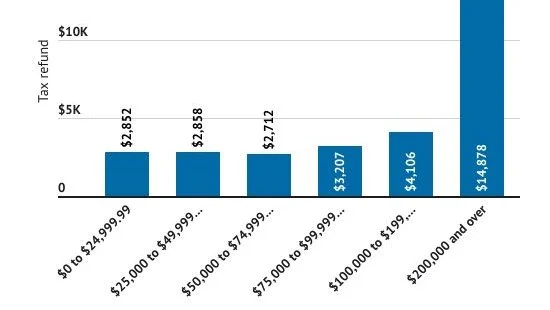
Tax refunds represent a major seasonal financial event in the United States. The average refund historically exceeds $2,500.
For many lower-income households, it functions as a yearly financial reset.
Economists note refunds act as a short-term economic stimulus. Retail sales often rise in late February and March as payments reach bank accounts.
“Tax refunds are often the largest single payment many families receive all year,” said Professor James Poterba, an economist at the Massachusetts Institute of Technology.
Many recipients use refunds to pay debt, repair vehicles, or cover overdue rent.
International Context: How the U.S. Compares
The U.S. system is unusual among developed countries. In many nations, governments pre-calculate taxes using employer records, reducing the need for refunds.
Examples:
- United Kingdom: automatic tax reconciliation through HM Revenue & Customs
- Japan: employer-adjusted withholding
- Denmark: pre-filled tax returns
In the United States, the refund structure exists partly because withholding formulas intentionally err on the side of overpayment to avoid under-collection.
How Taxpayers Can Receive Refunds Faster
Experts recommend several practical steps:
- File electronically
- Choose direct deposit
- Double-check Social Security numbers
- Ensure employer W-2 forms are available
- Avoid filing extremely early if documents are incomplete
Filing too early can sometimes trigger manual review because employer wage data has not yet reached IRS systems.
Common Myths About Refund Timing
Myth 1: Calling the IRS speeds processing
It does not. Phone agents cannot override automated processing.
Myth 2: Large refunds are delayed intentionally
Refund size alone does not cause a delay.
Myth 3: The IRS holds refunds to earn interest
Federal law prohibits the agency from delaying refunds for financial gain.
FAQs About IRS Refund Status Timeline
When should I worry about a delayed refund?
More than 21 days after e-filing or six weeks after mailing.
Why is my refund stuck on “received”?
The IRS is verifying income or identity information.
Do tax credits slow refunds?
Yes. EITC and ACTC claims cannot be released before the mid-February review period ends.
Can calling the IRS help?
No. The processing timeline cannot be accelerated.
What Happens Next
The IRS expects the largest wave of refunds to arrive from late February through early March as verification holds expire and system processing stabilizes.
Officials emphasize accuracy remains the fastest route to payment.
“Accurate electronic filing with direct deposit remains the best way to receive a refund quickly,” the agency says.