
A team of international scientists has reported a breakthrough in molecular science where quantum computing meets the Möbius molecule, creating and verifying a previously unknown type of molecular structure. The research, published in the journal Science in March 2026, describes a synthetic molecule whose electrons twist around its ring in a pattern resembling a Möbius strip—an unusual topology confirmed using quantum computer simulations. The finding offers a new glimpse into how quantum technology could accelerate discoveries in chemistry, materials science, and nanotechnology.
Table of Contents
Möbius Molecule
| Key Fact | Detail / Statistic |
|---|---|
| New molecular topology | First molecule with a half-Möbius electronic topology observed |
| Molecular formula | Carbon ring molecule C₁₃Cl₂ assembled atom-by-atom |
| Verification method | Quantum computing simulations used to model complex electron behavior |
| International collaboration | Researchers from multiple European universities and industry labs |
Quantum Computing Meets the Möbius Molecule
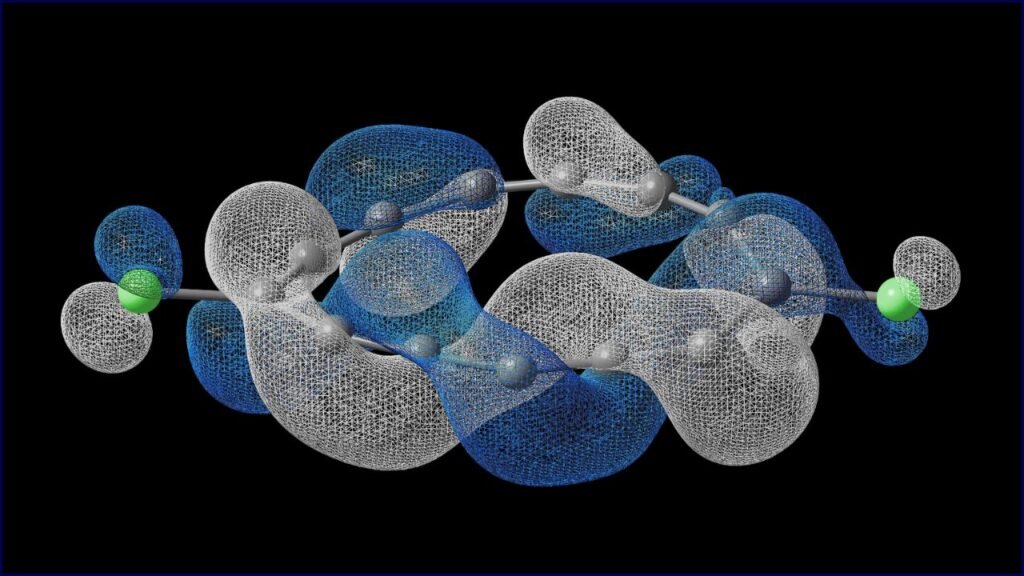
The newly reported discovery demonstrates a striking convergence of two fields: advanced molecular chemistry and quantum computing. Scientists created a ring-shaped molecule whose electrons circulate in a helical pattern that resembles a half-twisted Möbius strip, a geometric object known for having only one surface and one edge.
The molecule was synthesized atom-by-atom in a laboratory environment and later analyzed using quantum simulations. Researchers say the unusual structure represents a new class of electronic topology—meaning the behavior of electrons depends not just on chemical bonds but also on the spatial structure of their quantum wavefunctions.
Electronic topology plays a critical role in modern condensed-matter physics, where the arrangement of electrons in materials can create exotic states such as topological insulators or superconductors. Extending these ideas to individual molecules could significantly broaden the range of materials scientists can design.
“This discovery shows that electronic topology can be engineered, not just discovered in nature,” said one of the study’s lead researchers in a statement accompanying the publication.
Scientists involved in the research say the work demonstrates that quantum computers can already contribute to solving highly complex chemical problems. Although today’s quantum processors remain limited, their ability to simulate quantum systems gives them a natural advantage when studying molecular structures.
Historical Background: From Mathematical Curiosity to Molecular Reality
The concept behind Möbius molecules originates in mathematics. In 1858, German mathematician August Ferdinand Möbius described a geometric surface created by twisting a strip of paper once and joining the ends together. The resulting shape has only one continuous side.
For decades, the Möbius strip remained largely a mathematical curiosity. However, chemists began exploring whether similar topological structures might exist at the molecular level during the 20th century.
In the 1960s, theoretical chemists proposed the possibility of Möbius aromaticity, a concept suggesting that electron orbitals in a twisted molecular ring might follow Möbius-like patterns. Such structures would behave differently from conventional aromatic molecules such as benzene.
Despite decades of theoretical interest, creating stable Möbius-type molecules proved extremely difficult because the required twisted structures are often unstable. The new research provides one of the clearest experimental confirmations of a molecule with a Möbius-like electronic topology.
Engineering an Unusual Molecular Structure
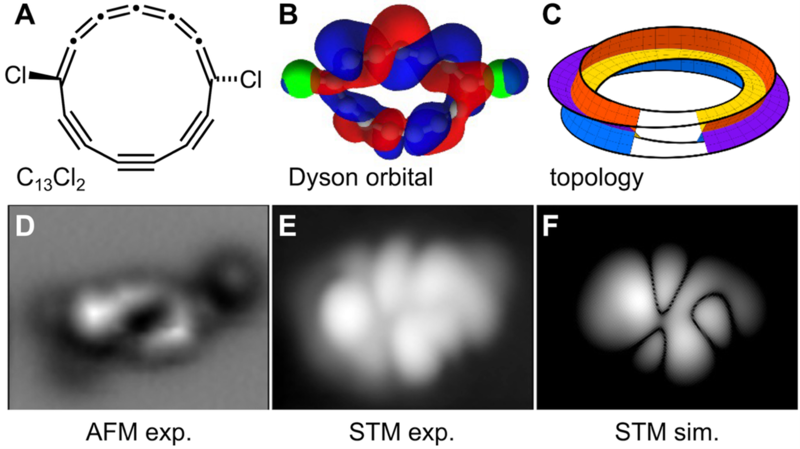
The molecule at the center of the study has the chemical formula C₁₃Cl₂, consisting of a ring of thirteen carbon atoms and two chlorine atoms. Researchers assembled the structure by manipulating individual atoms on a surface under ultra-high vacuum conditions at temperatures near absolute zero.
This method, sometimes described as bottom-up molecular engineering, allows scientists to construct complex molecules piece by piece. The approach relies on advanced instruments capable of positioning atoms with extreme precision.
Scientists used scanning probe techniques—such as scanning tunneling microscopy (STM) and atomic force microscopy (AFM)—to observe the molecule and map its electron distribution. These technologies allow researchers to view and manipulate matter at the atomic scale.
Unlike ordinary ring molecules, where electrons travel around a flat loop, the electrons in this molecule follow a twisted path. Each circuit around the ring shifts the quantum phase of the electron orbitals by about 90 degrees. It therefore takes four loops for the system to return to its original quantum state.
This unusual property is what gives the molecule its half-Möbius topology.
Why Quantum Computing Was Needed
Understanding the molecule’s electronic structure posed a major computational challenge. The interactions between electrons in such systems are highly entangled and can grow exponentially complex, making them difficult to simulate with classical computers.
Traditional computational chemistry methods approximate electron behavior using mathematical shortcuts. While these methods work well for many molecules, they become less reliable when dealing with unusual electronic topologies or large interacting electron systems.
Quantum computers, however, operate using quantum bits, or qubits, that follow the same quantum rules governing electrons. This makes them particularly well suited for simulating molecular systems.
To analyze the molecule, researchers ran calculations on quantum processors using algorithms designed to explore large “active spaces” of interacting electrons. This allowed them to model electronic states beyond the reach of conventional computational chemistry methods.
The simulations confirmed that the molecule indeed possesses a half-Möbius topology, validating experimental observations from microscopy measurements.
A New Direction in Topological Chemistry
Experts say the discovery adds a new chapter to the emerging field of topological chemistry, which studies how the geometric properties of molecules influence their electronic behavior.
Topological concepts have already transformed physics, leading to discoveries such as topological insulators and quantum Hall effects. Applying these ideas at the molecular scale could open entirely new directions in chemical design.
Researchers believe that molecules with engineered topologies could exhibit unusual electrical or magnetic properties. Such materials might conduct electricity in new ways or respond differently to external fields.
The discovery also highlights how interdisciplinary collaboration—combining chemistry, physics, and computer science—can produce advances that would be difficult to achieve within a single field.
Switchable Quantum States
Another striking feature of the molecule is its switchable topology. Using precise voltage pulses delivered by a microscope tip, researchers could flip the molecular system between three configurations:
- Right-handed half-Möbius state
- Left-handed half-Möbius state
- Untwisted, conventional state
This reversible switching demonstrates that electronic topology can be actively controlled at the molecular scale.
Such controllability is particularly important for future quantum technologies. In principle, molecular states that can be switched between stable configurations might be used to encode information or perform nanoscale logic operations.
Although practical applications remain years away, scientists say the ability to manipulate quantum topology within a single molecule represents a powerful new research tool.
Implications for Quantum Technology and Materials Science
The study highlights how quantum computing may become a key tool for scientific discovery rather than simply a theoretical technology.
Physicist Richard Feynman famously proposed decades ago that quantum systems should be simulated with quantum machines. According to the research team, the experiment provides a real-world example of that idea in practice.
Beyond the immediate discovery, scientists say the work could eventually support research into:
- advanced molecular electronics
- quantum materials
- nanoscale sensors
- energy-efficient electronic components
- future quantum computing architectures
Materials built from molecules with controlled electronic topology could also play roles in next-generation nanotechnology and quantum devices.
Challenges and Future Research
Despite the breakthrough, researchers caution that the work represents an early step in understanding Möbius-type molecular systems.
The experimental process required extremely controlled laboratory conditions, including ultra-high vacuum environments and temperatures close to absolute zero. Replicating such structures in practical materials will require additional advances in molecular engineering.
Scientists are also interested in exploring whether larger molecular networks with similar topology can be created. If multiple Möbius-type molecules could be linked together, they might form new classes of quantum materials.
Future studies will likely focus on:
- synthesizing more complex topological molecules
- improving quantum simulations of chemical systems
- studying how these molecules behave in larger structures or devices
Researchers believe that advances in both quantum computing and nanoscale fabrication will accelerate progress in this field over the coming decade.
Outlook
Researchers emphasize that the work represents an early step in combining quantum computing with experimental chemistry. As quantum processors improve in size and reliability, scientists expect them to tackle increasingly complex molecules and materials.
The study demonstrates how the intersection of quantum technology and molecular science could lead to entirely new categories of matter. By designing molecules with controlled electronic topology, researchers may gain new ways to build advanced materials and devices.
For now, the discovery illustrates a fundamental shift: the possibility that new forms of matter may be designed atom-by-atom and understood through quantum computation.
FAQ
What is a Möbius molecule?
A Möbius molecule is a ring-shaped molecular system whose electron orbitals twist similarly to a Möbius strip, giving it unusual quantum properties.
Why are quantum computers useful in chemistry?
Quantum computers can directly simulate quantum systems such as molecules, allowing scientists to model complex electron interactions that classical computers struggle to calculate.
What makes the new molecule different?
The newly synthesized molecule exhibits a half-Möbius electronic topology, meaning its electron orbitals twist by about 90 degrees around the ring.
Could this discovery lead to new technologies?
Potentially. Scientists say controlling molecular topology could help develop new quantum materials, molecular electronics, and nanoscale devices.
How long might applications take?
Most experts believe practical applications could take years or decades, depending on progress in quantum computing and nanoscale fabrication technologies.