
Deep inside Madagascar’s rainforest, researchers found something that didn’t quite fit the usual rules of nature. A spider was building a complete circular web not between two branches, but across open water. When the discovery was first documented, biologists were genuinely surprised.
Spiders normally avoid wide empty spaces, especially windy river channels, because a broken web means wasted energy and no food. Yet this particular species ignored that risk completely. The moment researchers began observing it, the mystery deepened. Scientists Study A Spider Whose Web Can Stretch Across An Entire River, and what they uncovered was far more than a curious wildlife story. This spider had essentially turned a river into a hunting ground. It wasn’t just bigger or stronger than other spiders. Its behavior, its silk, and even its web design was all specialized for a habitat most spiders would never attempt to use.
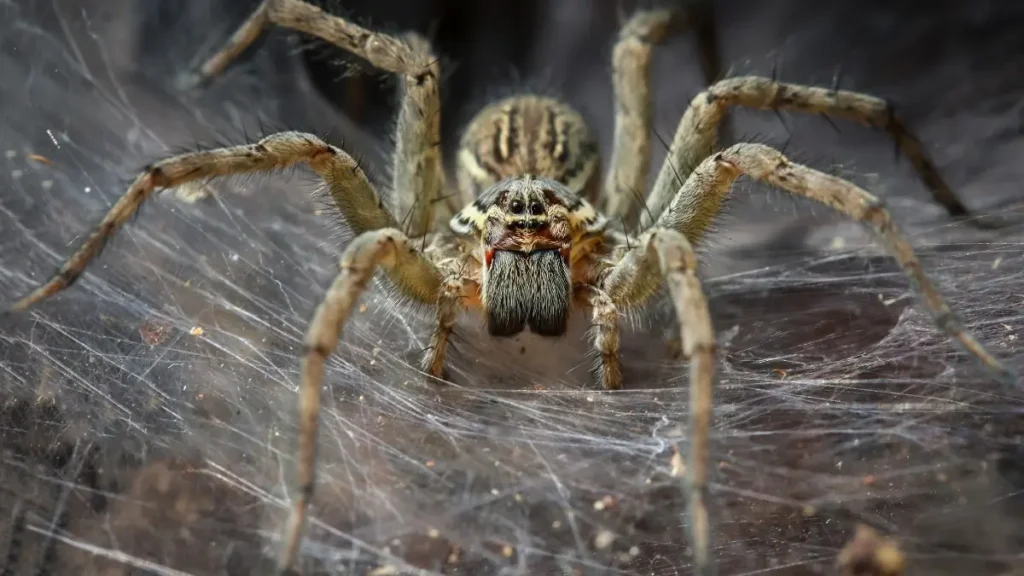
Scientists quickly realized they were watching a unique survival strategy in action. This species, commonly known as the Darwin’s bark spider, deliberately chooses rivers and streams as its home territory. Instead of competing with other spiders in crowded forest branches, it targets open airspace above water where flying insects travel in steady numbers. To build its web, the spider releases a strand of silk into the wind and lets air currents carry it across the river until it sticks to vegetation on the opposite side. Once anchored, the spider tightens the line and walks across it, reinforcing the connection. From that single bridge line, it constructs a massive orb web hanging over moving water. Scientists Study A Spider Whose Web Can Stretch Across An Entire River because this behavior shows an extraordinary ecological adaptation. The spider has discovered a food source that other predators rarely exploit.
Table of Contents
Spider Whose Web Can Stretch Across an Entire River
| Feature | Details |
|---|---|
| Species | Darwin’s bark spider (Caerostris darwini) |
| Habitat | Rainforest rivers and streams in Madagascar |
| Bridge line span | Up to around 25 meters |
| Web size | Among the largest orb webs ever recorded |
| Silk quality | Extremely tough and elastic |
| Hunting method | Captures insects flying above water |
| Construction technique | Uses wind to carry silk across river |
| Scientific importance | Materials science, evolution, and biomimicry |
One of the most interesting findings was that the spider’s web is not just large but carefully engineered by instinct. The upper part of the web contains stronger support threads, helping stabilize the structure against wind pressure. The lower capture area remains flexible, allowing it to absorb the energy of struggling prey. Another surprising observation was how the spider chooses its location. It prefers areas where rivers narrow slightly, creating natural insect flight paths. This increases the chances of capturing food while reducing the effort needed to rebuild the web frequently. Scientists Study A Spider Whose Web Can Stretch Across An Entire River partly because it demonstrates how behavior can evolve alongside physical traits. The spider did not simply grow stronger silk first and then move to rivers. Instead, its behavior and silk properties likely developed together over generations, producing a perfect match between habitat and biology.
Introduction
- Material scientists soon took interest in the discovery. The silk’s toughness turned out to be extraordinary. Unlike rigid materials that snap under sudden force, this silk stretches and absorbs energy. In practical terms, it behaves like a natural shock absorber.
- Further studies revealed that special proteins inside the silk fibers give them their elasticity. The spider’s silk glands produce long molecular chains that align as the thread forms, creating a fiber both strong and flexible. Scientists Study A Spider Whose Web Can Stretch Across An Entire River because this natural material could inspire new technologies, including lightweight protective gear and flexible cables.
Methodology Behind the Spider Whose Web Can Stretch Across an Entire River
Understanding how this spider builds such enormous structures required patience. Researchers spent long nights near riverbanks observing the spider’s routine. The building process typically begins in the evening when winds are gentle but consistent.
- First, the spider climbs to a high perch and releases a thin silk thread into the air. It does not aim the thread; instead, it relies entirely on the wind. Eventually, the drifting strand touches a branch, rock, or plant on the opposite bank and sticks. Once the connection holds, the spider carefully pulls the thread tight and reinforces it multiple times, creating a strong bridge line.
- Only after the bridge line is secure does the spider begin constructing the orb-shaped capture web below it. The spider moves in precise patterns, laying radial threads outward from the center and then adding sticky spiral threads that trap insects. Scientists Study A Spider Whose Web Can Stretch Across An Entire River because the building process itself shows remarkable efficiency. The spider avoids unnecessary movement and conserves energy, which is essential when constructing such a large structure.
- Researchers also collected silk samples for mechanical testing. In laboratories, they stretched the fibers and measured how much force they could withstand. The results were astonishing. The silk could stretch dramatically without breaking, allowing it to survive wind gusts, rain, and the impact of larger insects.
Why This Matters Beyond Spider Trivia
At first glance, the discovery may seem like a fascinating wildlife story, but its importance reaches far beyond biology. The spider demonstrates how evolution can solve engineering challenges in ways humans are only beginning to understand. Modern materials are often designed for strength alone. Spider silk shows that flexibility combined with strength can be far more effective. A rigid material breaks when overloaded, but a tough elastic material bends and survives. Engineers studying this spider hope to apply similar principles to medical sutures, sports equipment, safety ropes, and even spacecraft materials.
The ecological lesson is just as important. By occupying a space above rivers, the spider avoids competition and gains a steady food supply. It shows how small behavioral changes can open entirely new survival opportunities. Scientists Study A Spider Whose Web Can Stretch Across An Entire River because it reveals how species adapt not just physically, but strategically. The discovery also reminds us how much remains unknown in natural ecosystems. A species hiding in a remote rainforest changed our understanding of both evolution and materials science. Observations like these encourage conservation efforts, since unknown organisms may hold solutions to future technological problems.
The spider’s success comes from balance. Its silk is strong but flexible, its behavior bold but efficient, and its web large but carefully positioned. These combined traits make it uniquely suited to its environment. Over time, researchers believe this spider may influence the development of synthetic fibers that are lighter, safer, and more sustainable than current materials. Instead of relying on petroleum-based products, industries could learn from biological design. That possibility alone explains why scientists study a spider whose web can stretch across an entire river with such enthusiasm.
FAQs on Scientists Study a Spider Whose Web Can Stretch Across an Entire River
1. What is the name of the spider that builds webs across rivers?
The species is known as the Darwin’s bark spider. It lives primarily in Madagascar and is famous for creating giant webs over water.
2. How does the spider get its silk across the river?
It releases a silk strand into the air and lets the wind carry it to the opposite bank. Once the thread attaches, the spider reinforces it and walks across.
3. Why doesn’t the web break in the wind?
The silk is extremely elastic. Instead of snapping, it stretches and absorbs energy from wind and moving prey.
4. Why do scientists study a spider whose web can stretch across an entire river?
Researchers are interested in its unique hunting strategy and the remarkable strength of its silk, which could inspire new materials.