

The “Cursed” Amethyst: The “Cursed Amethyst” — also called the Delhi Purple Sapphire — is one of the most famous spooky gemstones in history. From mysterious deaths to eerie misfortunes, the tale behind this purple stone has all the makings of a Hollywood movie. But is the legend true, or is it just another story passed down to entertain and warn? If you’ve ever wondered about haunted objects, cursed jewels, or the fine line between history and myth, then saddle up. In this article, we’ll walk you through every detail about the Cursed Amethyst, from its colonial-era origins to its present-day home in a museum. You’ll get practical insights into gemstone science, cultural symbolism, and why we humans are so drawn to tales of doom and luck.
Table of Contents
The “Cursed” Amethyst
The story of the Cursed Amethyst is a fascinating blend of legend, science, culture, and human emotion. While the “curse” adds intrigue, the real power of this stone lies in its rich history and the lessons it teaches us about storytelling, colonial history, and how people make sense of the world. In truth, amethyst isn’t cursed — it’s a beautiful reminder of how stones carry stories, and how those stories live on through the people who share them.
| Aspect | Details |
|---|---|
| Stone Name | Delhi Purple Sapphire (actually an Amethyst) |
| Mineral Type | Violet Quartz (Amethyst) |
| Hardness | 7 on the Mohs scale |
| Myth Status | Said to be cursed; no scientific evidence |
| Historical Era | Looted during the Indian Rebellion of 1857 |
| Associated Individuals | Colonel W. Ferris, Edward Heron-Allen |
| Current Location | Natural History Museum, London |
| Official Resource | Amethyst – Wikipedia |
What Is The “Cursed” Amethyst?
Let’s clear the air right off the bat: despite the dramatic name Delhi Purple Sapphire, this gemstone isn’t a sapphire at all. It’s a deep purple amethyst, which is a variety of quartz — the second most abundant mineral in Earth’s crust.
So why the confusion?
Well, back in the 19th century, gemstone knowledge wasn’t as precise as it is today. When the stone arrived in England, it was likely mislabeled or even purposefully misbranded to make it seem more exotic and valuable.
The stone gained its “cursed” reputation after a string of unfortunate events allegedly followed its owners. And as stories go, this one snowballed into one of the most chilling object-based legends in European history.
The Colonial Origins of the Curse
The amethyst was reportedly stolen — looted, to be precise — from a sacred Hindu temple in Kanpur, India during the Indian Rebellion of 1857. This was a time of major unrest, when Indian soldiers and civilians rose up against British colonial rule.
The gemstone’s first known Western owner, Colonel W. Ferris, was part of the British Bengal Cavalry. After taking the stone back to England, strange things started happening. According to family accounts:
- Ferris’ health deteriorated.
- His fortune crumbled.
- His descendants, too, suffered similar fates.
The curse didn’t stop with Ferris. The next owner, a friend of the family, committed suicide. Then came Edward Heron-Allen, a British scientist and writer who collected the stone in the 1890s. Heron-Allen claimed that:
- Everyone he gave the stone to experienced immediate misfortune.
- A singer who wore it lost her voice permanently.
- He himself became plagued by ill health and distressing events.
In 1904, Heron-Allen became so afraid of the stone that he threw it into the Regent’s Canal in London. Yet, like something out of a Stephen King novel, the stone was later found and returned to him. Finally, he packed it in seven sealed boxes, left a warning note, and deposited it in a bank vault with strict instructions: do not open until three years after my death.
In 1944, Heron-Allen’s daughter donated the stone and letter to the Natural History Museum in London, where both are displayed today in the Vault Collection.
Is the Curse Real? Science Says No
Now here’s the cold, hard truth: there is no scientific evidence that this or any gemstone can cause curses, accidents, or death.
Scientists believe the “curse” around the amethyst is simply a mix of:
- Coincidence: Life is full of ups and downs, and unlucky timing can feel supernatural.
- Pattern-seeking: Humans love finding connections, even when they don’t exist — a concept known as apophenia.
- Confirmation bias: People remember the scary stuff and forget the ordinary. If you hear a gem is cursed and then have a bad day, you’ll connect the two, even if there’s no actual link.
- Colonial Guilt & Storytelling: Historians point out that stories like this may reflect subconscious guilt over colonial actions, turning a stolen item into a cursed one.
The Mineral Science of Amethyst
Let’s look at what the stone actually is.
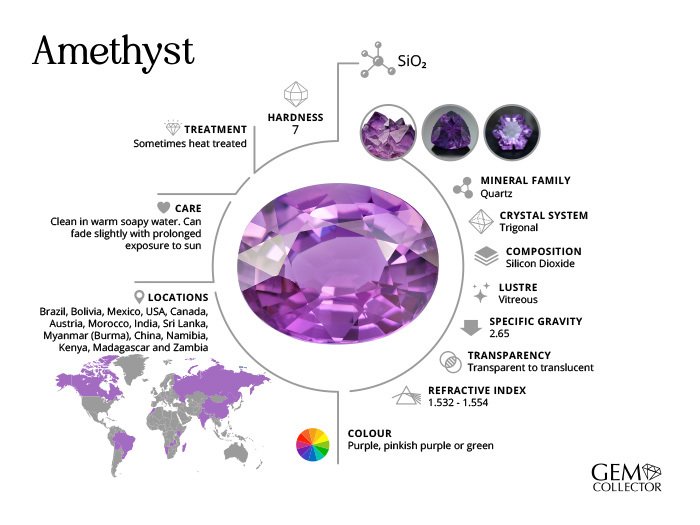
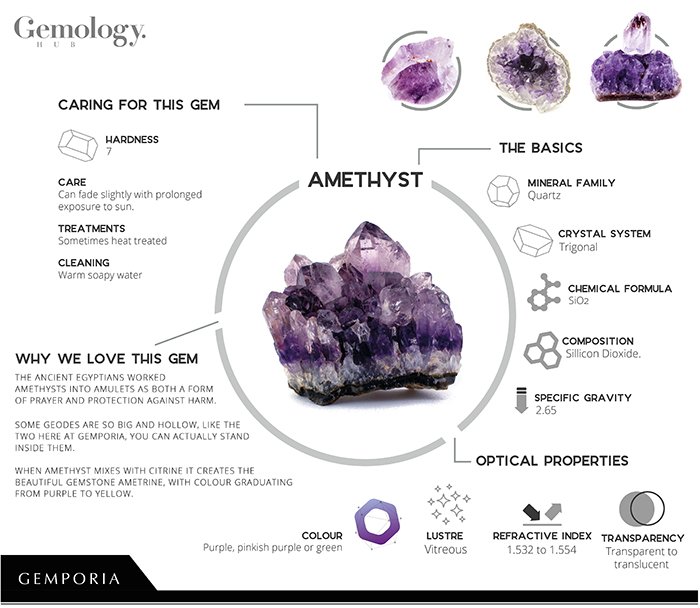
- Chemical Formula: SiO₂ (Silicon Dioxide)
- Color: Ranges from light lavender to deep purple
- Hardness: 7 on the Mohs scale (quite durable)
- Crystal Structure: Trigonal
- Found In: Brazil, Uruguay, Russia, Zambia, and the U.S.
Amethyst forms inside geodes — large, hollow rocks lined with crystals — through volcanic processes over millions of years. The purple color comes from trace amounts of iron and natural radiation exposure over time.
It’s been treasured since ancient Egypt and Greece, where it was believed to prevent drunkenness. In fact, “amethyst” comes from the Greek amethystos, meaning “not intoxicated.”
Cultural Symbolism of Amethyst
Across cultures, amethyst is seen as a peaceful, protective stone, not a cursed one.
- Native American Tribes: Some associate purple stones with healing, clarity, and connecting to the spirit world.
- Catholic Bishops: Amethyst rings have long been worn to symbolize wisdom and purity.
- Feng Shui: It’s used for calming energy and balancing spiritual vibrations.
So while the “cursed” version gets all the headlines, most traditions see amethyst as a symbol of peace and clarity.
Why Do People Believe In The “Cursed” Amethyst?
Here’s where psychology steps in.
Humans have been telling stories about “cursed” items for centuries. Think of King Tut’s tomb, the Hope Diamond, or haunted houses. We use superstition and narrative to:
- Explain suffering
- Warn others
- Pass down cultural values
It’s also more exciting to say, “The gem ruined my life,” than “I had a string of bad luck.”
This is especially true in the 1800s, when science was just developing, and folklore still dominated many belief systems. In this context, the cursed amethyst story becomes part spooky tale, part colonial reckoning.
Where Is The “Cursed” Amethyst Now?
Today, you can visit the stone at the Natural History Museum in London, in the Vault Collection — a secured exhibit for rare and mysterious minerals. Alongside the stone is Heron-Allen’s famous letter, which warns:
“Whoever shall then open it, shall first read this warning and then do so as he pleases. But not until after I am dead and buried.”
Is It Worth Anything? Real Gem Value
From a gemologist’s point of view, the stone is beautiful, but it’s not priceless. Amethyst is semi-precious, and its value depends on:
- Color saturation (deep violet fetches higher prices)
- Clarity and inclusions
- Cut and polish
- Carat weight
On average, high-quality amethyst sells for $20–$50 per carat, though museum-quality stones can fetch more.
So while this stone is famous, it’s not the most valuable gem on Earth — its worth lies more in its story than its market price.
Practical Advice for Professionals & Collectors
- Gem Collectors: Always verify gemstones through a certified gemologist or GIA certificate.
- Historians & Students: Approach legends like this as historical artifacts — blending myth and truth.
- Teachers & Parents: Use this story to teach kids about history, critical thinking, and science.
The Chronovisor Story — The Alleged Vatican Device Said to View the Past
The Best-Preserved Dinosaur Embryo Ever Found May Unlock Secrets of De-Extinction
Archaeologists Identify the Oldest Poisoned Arrows Ever Found, Dated 60,000 Years