
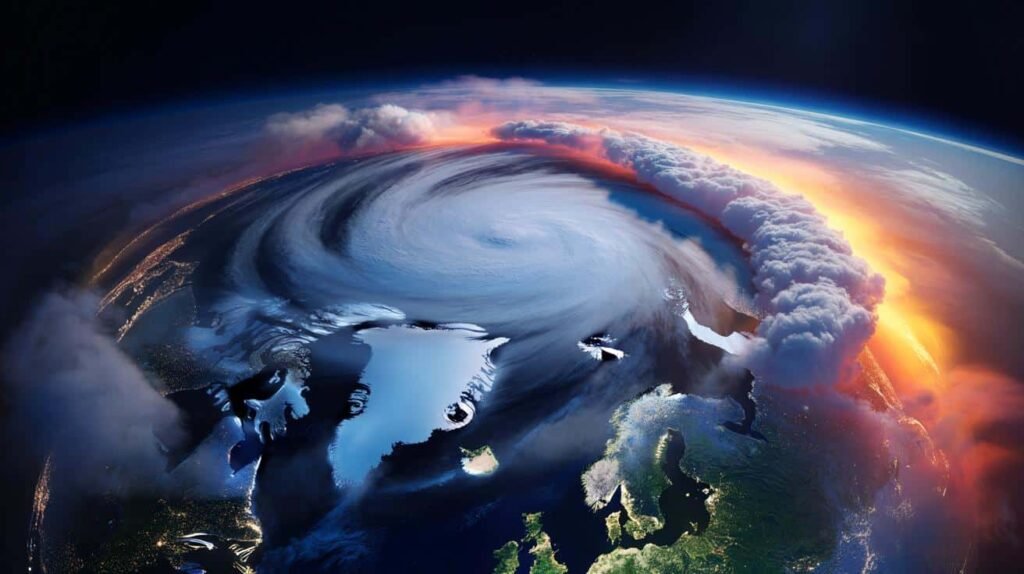
Meteorologists say The Polar Vortex — the high-altitude ring of winds that usually traps Arctic cold near the North Pole — is weakening earlier in the season than expected. Researchers across North America and Europe are closely tracking the shift because it can disrupt the jet stream, reshape winter weather patterns, and increase the risk of severe cold waves weeks later across large parts of the Northern Hemisphere.
Table of Contents
The Polar Vortex Is Shifting Earlier
| Key Fact | Detail |
|---|---|
| What is changing | Earlier weakening of stratospheric winds |
| Main trigger | Sudden stratospheric warming (SSW) |
| Impact | Cold outbreaks and unstable jet stream |
Scientists say monitoring will intensify in coming winters as Arctic warming continues. Forecasting models are improving, but variability is expected to grow. As Cohen noted, “We are observing an atmosphere adjusting to new conditions, and understanding The Polar Vortex is central to predicting future winter weather.”
What The Polar Vortex Is and Why It Matters
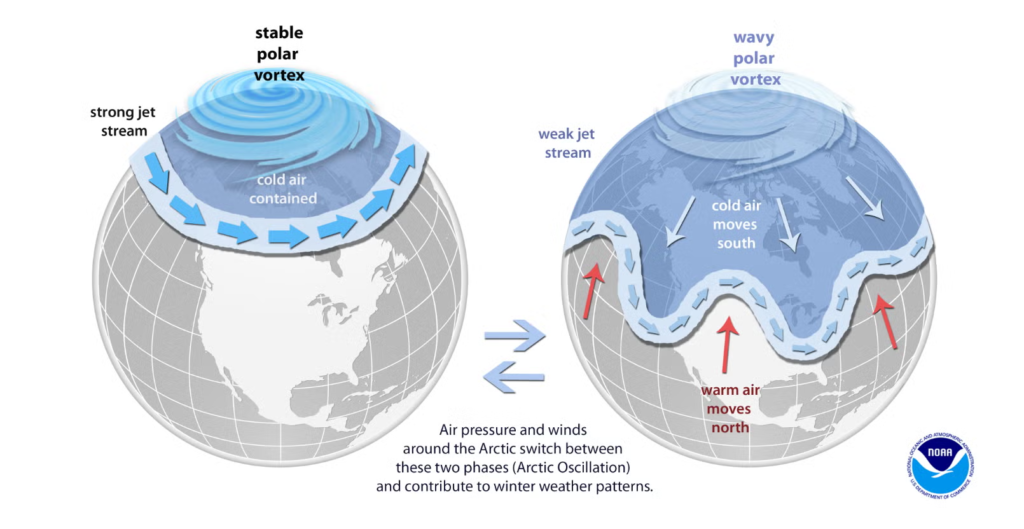
The Polar Vortex is a massive circulation of strong west-to-east winds located about 10 to 30 miles above Earth in the stratosphere. During a normal winter, it forms a tight atmospheric ring around the Arctic and acts as a barrier that keeps extreme cold air confined near the pole.
“When the vortex is strong, the cold stays in the Arctic,” said Dr. Amy Butler, atmospheric scientist at the U.S. National Oceanic and Atmospheric Administration (NOAA). “When it weakens or breaks apart, that cold air can move south into the mid-latitudes.”
The system operates as part of a layered atmosphere. Above the familiar weather zone — the troposphere — lies the stratosphere, where winds circulate around the pole at speeds exceeding 150 miles per hour. Those winds indirectly control surface weather by shaping the jet stream, the high-speed current of air that steers storms.
A stable vortex produces predictable winter weather. A disrupted vortex often produces extremes — both cold and warm.
Scientists Are Tracking Sudden Stratospheric Warming
Researchers are particularly watching for sudden stratospheric warming (SSW) — a rapid temperature increase in the upper atmosphere that can weaken or even reverse the vortex winds.
During such an event, temperatures in the stratosphere can rise by more than 40°C (72°F) in only a few days. That warming changes pressure patterns, slows the winds, and sometimes splits The Polar Vortex into two centers — one often drifting toward North America and the other toward Eurasia.
According to the American Meteorological Society (AMS), surface weather impacts usually follow 10 to 30 days later.
“The atmosphere works from the top down,” said Dr. Laura Ciasto of NOAA’s Climate Prediction Center. “What happens in the stratosphere eventually communicates downward into the weather we experience at the surface.”
Meteorologists now monitor the stratosphere daily using weather balloons, satellites, and computer models. Improvements in observation technology over the past decade have significantly improved early warning capabilities.
Why the Changes Are Happening Earlier
Historically, The Polar Vortex weakened late in winter — often in February or March.
Now researchers report disturbances appearing earlier in the season.
Scientists are investigating multiple causes.
Arctic Amplification
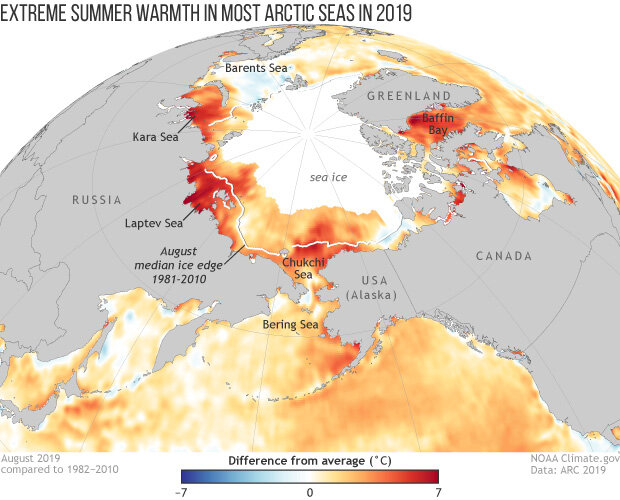
The Arctic is warming roughly four times faster than the global average, according to the World Meteorological Organization (WMO). Reduced sea ice exposes dark ocean water that absorbs heat, warming the atmosphere.
This process — known as Arctic amplification — changes atmospheric pressure patterns that help stabilize The Polar Vortex.
Jet Stream Interaction
A warmer Arctic weakens the temperature contrast between the pole and mid-latitudes. That temperature difference normally powers the jet stream.
“When the gradient weakens, the jet stream meanders,” said Professor Judah Cohen of Atmospheric and Environmental Research. “Those large waves allow Arctic air to spill south.”
A wavy jet stream is associated with prolonged cold spells and stalled weather systems.
Stratospheric Wind Cycles
Scientists are also monitoring the Quasi-Biennial Oscillation (QBO), a repeating shift in equatorial winds occurring every 28 months. Certain QBO phases make sudden stratospheric warming more likely.
What It Means for Global Weather
A weakened The Polar Vortex does not make the entire planet colder. Instead, it redistributes cold air unevenly.
Possible impacts include:
- Severe cold waves in North America
- Heavy snowstorms in Europe
- Rapid temperature swings in East Asia
- Altered winter storms across Central Asia
The United Kingdom’s Met Office reports that Europe’s 2018 “Beast from the East” cold wave followed a major sudden stratospheric warming event.
In the United States, a 2021 Arctic outbreak pushed temperatures below −30°C (−22°F) in parts of Texas, overwhelming infrastructure and causing widespread power failures.
Historical Case Studies
Meteorologists often reference past disruptions to explain potential risks.
January 1985: A vortex collapse triggered record cold across the eastern United States.
February 2018: Europe experienced widespread snowfall and transport shutdowns.
February 2021: Texas power grid failures left millions without electricity.
“These events show how upper-atmosphere processes can have direct societal consequences,” said Dr. Martin Jucker, atmospheric scientist at the University of New South Wales.
Economic and Infrastructure Impacts
Extreme cold outbreaks linked to The Polar Vortex carry measurable economic costs.
The U.S. National Centers for Environmental Information estimates the 2021 winter storm caused more than $80 billion in damages. Costs included:
- Energy demand spikes
- Frozen pipelines
- Transportation shutdowns
- Crop losses
Air travel disruptions can also ripple globally because major Northern Hemisphere airports serve as international hubs.
Insurance companies now closely monitor long-range winter forecasts tied to stratospheric conditions.
Implications for India and South Asia
South Asia rarely experiences direct Arctic air outbreaks, but The Polar Vortex still influences the subtropical jet stream, which controls winter western disturbances.
According to the India Meteorological Department (IMD), these disturbances determine:
- Himalayan snowfall
- Northern India cold waves
- Winter rainfall across the plains
Changes in winter weather patterns affect agriculture, especially wheat and mustard crops that depend on winter moisture.
Hydrologists also monitor snowfall because Himalayan snowpack feeds major rivers including the Ganges and Indus.
The Role of Climate Change
Researchers emphasize The Polar Vortex does not contradict global warming.
Global average temperatures continue rising, yet localized cold events can still occur.
“The warming Arctic may paradoxically increase certain winter extremes,” said Butler. “Climate change influences patterns, not just temperature averages.”
Climate models suggest variability — swings between mild and extreme conditions — may increase.
Improving Forecasting
Meteorologists increasingly use stratospheric monitoring to improve long-range forecasting.
Weather agencies now include stratospheric data in seasonal outlooks. A detected sudden stratospheric warming can significantly improve 2-to-4-week forecasts.
“The Polar Vortex is one of the few atmospheric signals that gives advance warning,” Butler said.
Satellite observations and artificial intelligence modeling are also improving predictions of jet stream shifts.
FAQs About The Polar Vortex Is Shifting Earlier
Is The Polar Vortex new?
No. It forms every winter. What is changing is its stability and timing.
Does a weak vortex mean global cooling?
No. It redistributes Arctic air regionally while long-term warming continues.
Can it be predicted?
Yes, partially. Sudden stratospheric warming events improve forecasting several weeks in advance.
Why does the media report it often now?
Improved monitoring and recent extreme winters have increased public awareness.