
Trees That Trap Gold in Their Leaves: Yes, you read that right — Finland has discovered gold hiding in tree needles, thanks to some surprising microscopic helpers: bacteria. In the snowy boreal forests of Lapland, researchers found that Norway spruce trees (Picea abies) contain gold nanoparticles in their leaves, or more specifically, their needles. And no — it’s not some mystical fairy tale. This is solid, peer-reviewed science, with far-reaching implications for mining, environmental protection, and biotechnology. This discovery, made by a Finnish-led research team and published in the journal Science of The Total Environment, may revolutionize how we search for minerals underground — using biology instead of bulldozers.
Table of Contents
Trees That Trap Gold in Their Leaves
What started as a curiosity in a Finnish forest has now evolved into a serious conversation about how we explore the Earth responsibly. Gold in trees may sound magical, but it’s backed by hard data, smart science, and global potential. It offers hope for a cleaner, greener mining future, where technology and biology work hand in hand — and where forests don’t just survive industrial progress, but guide it.
| Topic | Details |
|---|---|
| Discovery Site | Boreal Forests of Lapland, Finland |
| Tree Species Studied | Picea abies (Norway spruce) |
| Gold Form Detected | Nanoparticles (1–100 nanometers in diameter) |
| Role of Bacteria | Endophytic microbes help reduce dissolved gold ions inside the tree |
| Scientific Basis | Biomineralization and microbial biofilms |
| Main Implications | Sustainable mineral exploration without environmental destruction |
| Reference Authority | Geological Survey of Finland (GTK), Study link |
How Trees Trap Gold in Their Leaves?
Let’s break it down into plain language.
Deep underground, tiny amounts of gold dissolve into groundwater. This water then moves upward through the soil — and when tree roots draw it in, they also unknowingly absorb the dissolved gold.
As this water travels up into the tree’s vascular system — kind of like blood in our veins — it reaches the needles. And this is where the magic (a.k.a. science) happens.
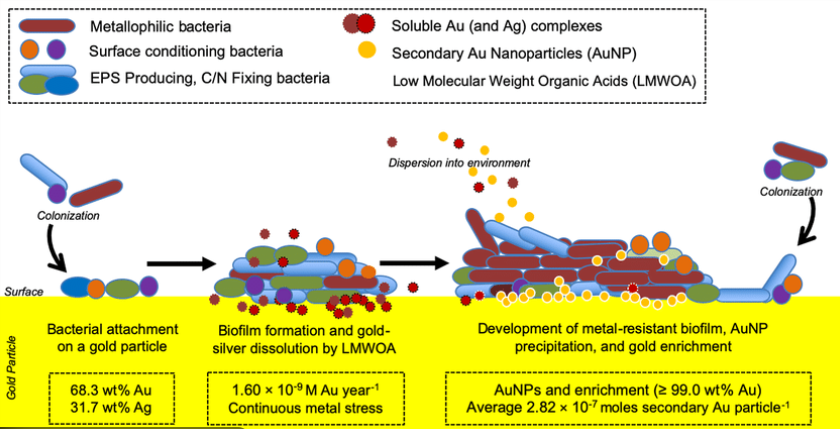
Scientists discovered that in certain needles, gold particles were present, but only where microbial biofilms were found.
Inside these needles lived endophytic bacteria — microbes that dwell inside plant tissues without causing harm. These bacteria may help reduce gold ions from liquid form into solid gold nanoparticles, which then stay embedded in the tissue.
This process is called biomineralization — where biological organisms help form mineral deposits. It’s the same natural phenomenon that makes pearls in oysters or calcium in our bones.
The Microbial Connection: Nature’s Hidden Engineers
The study identified specific bacteria that were only present in the gold-containing needles. These include:
- Cutibacterium
- Corynebacterium
- P3OB-42 — a relatively unknown microbial group
So why are these bacteria important?
Because they likely:
- Create microzones of low oxygen
- Secrete substances that influence chemical conditions
- Trigger reduction reactions that turn dissolved gold into solid gold
This is biomineral chemistry in action. The presence of biofilms in these needles means bacteria aren’t just passive hitchhikers — they may be driving gold precipitation inside a living tree.
The Science in Action: Trees That Trap Gold in Their Leaves
The study, led by scientists from the Geological Survey of Finland, involved:
- Sampling trees near the Kittilä gold mine in northern Finland
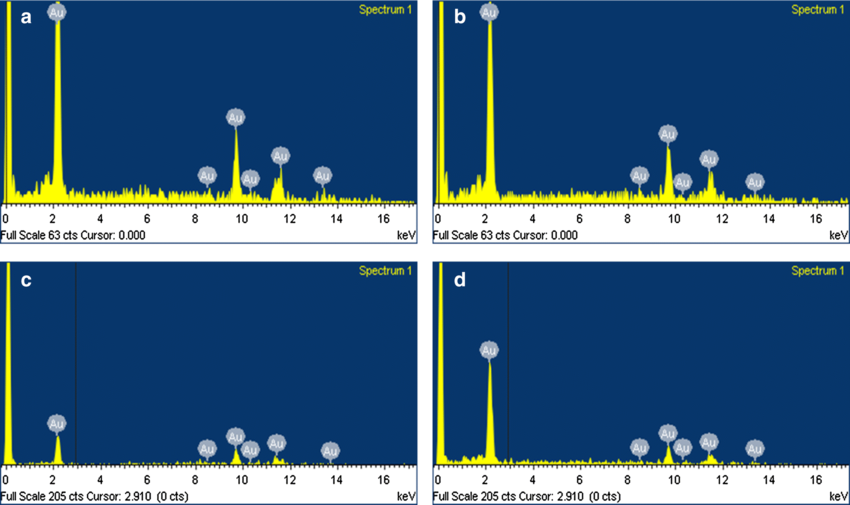
- Using electron microscopes to locate gold particles in needles
- DNA sequencing to analyze the needle microbiome
- Geochemical analysis to detect gold concentrations at parts-per-billion levels
This wasn’t just a random hunch. It was meticulously designed and data-driven — the kind of work that blends fieldwork, chemistry, microbiology, and advanced imaging.
From Pickaxes to Petri Dishes: Why Trees That Trap Gold in Their Leaves Matters
The implications of this discovery go far beyond just being cool.
Historically, mineral exploration meant:
- Digging up soil samples
- Using heavy equipment
- Causing ecological disruption
- Spending millions on hit-or-miss drilling
But now, with biogeochemical indicators like gold-in-needles, prospectors can:
- Sample living trees instead of drilling holes
- Detect hidden underground deposits
- Work in environmentally sensitive areas
- Reduce the cost, risk, and footprint of exploration
In short, this discovery brings together two major global concerns:
- Demand for rare minerals (especially for clean tech and electronics)
- The urgent need to preserve nature
And trees might be the perfect allies to help us balance both.
Not a New Idea — But a Groundbreaking Confirmation
The concept of plants absorbing metals isn’t new. In fact:
- Australia discovered traces of gold in eucalyptus leaves as far back as 2013
- Researchers in Brazil and Indonesia have studied nickel-accumulating plants
- Projects on phytomining (growing plants to harvest metals) are being trialed in the Philippines and the UK
But what makes Finland’s discovery stand out is the confirmed role of bacteria in gold trapping — which opens the door for engineering or selecting microbial communities to help plants become even better mineral indicators.
This is next-level ecological engineering — using living organisms as biosensors for what’s under the surface.
Could This Work Elsewhere?
Absolutely. Similar methods can be applied in:
- Canada’s boreal forests
- Russia’s Ural Mountains
- Scandinavian mining belts
- Even temperate zones in the U.S. and Europe
As long as the trees are:
- Native
- Healthy
- Connected to underlying geology
- And paired with a diverse microbiome
This method is adaptable — and scalable.
Practical Applications: A Guide for Professionals
Whether you’re in environmental science, geology, or sustainability, here’s how you can explore this method:
1. Identify Target Tree Species
Focus on native, deep-rooted trees in mineral-rich regions. Spruce, eucalyptus, birch, and poplar are great candidates.
2. Train Field Teams in Biosampling
Collect leaf, bark, and root tissue samples from various depths and elevations. Avoid contamination.
3. Use DNA Sequencing for Microbial Mapping
Sequence the bacterial DNA from each sample to detect microbial markers correlated with gold presence.
4. Run ICP-MS and SEM Analyses
Use inductively coupled plasma mass spectrometry (ICP-MS) to quantify metals and scanning electron microscopy (SEM) to image particles.
5. Build Geo-Bio Overlays
Combine mineral, microbial, and ecological maps to pinpoint high-likelihood zones for deeper exploration.
Challenges and Caveats
While this is exciting, there are limits:
- The gold concentrations are tiny — not enough for direct harvest.
- Trees in non-mineralized areas won’t show these signs.
- Not all microbial biofilms behave the same — regional studies are needed.
- Sampling methods need to be standardized and validated across climate zones.
Also, local ecological ethics must be considered — especially in Indigenous territories where trees and forests hold cultural value.
Future Potential: What’s Next?
This discovery lays the foundation for:
- Low-impact mining innovations
- Smart forestry programs
- Bioindicators for environmental monitoring
- Bioremediation of polluted soils
Imagine being able to:
- Map underground metals with tree leaves
- Detect toxic metals before they poison groundwater
- Use engineered microbiomes to locate rare earth elements
This isn’t science fiction. It’s science in progress.
Japan Loses 5-Ton Satellite After Rocket Mishap During Launch
Why Shilajit Has Been Used for Over 3,000 Years — And 4 Modern Ways People Use It
Scientists Find That Just 27 Minutes of Meditation Can Create Measurable Changes in the Brain