

American agriculture is stepping into a year that feels markedly different from the recent past. For several seasons, strong commodity prices and substantial government payments helped stabilize rural incomes. Now, the conversation has shifted. U.S. farm earnings in 2026 are projected to decline, and producers across the country are preparing for tighter margins.
The reality is that U.S. farm earnings in 2026 are being shaped by cooling crop prices, elevated borrowing costs, and stubbornly high input expenses. Federal aid remains part of the picture, but it is no longer enough to guarantee stability on its own. From family-owned corn farms in Iowa to large scale cattle operations in Texas, producers are adjusting budgets and expectations. The fundamentals driving this shift are clear. Commodity markets are normalizing after years of volatility, global supply has strengthened, and the cost of doing business has not retreated at the same pace as revenues. Understanding how these forces interact is critical for anyone following farm income trends this year.
The outlook for U.S. farm earnings in 2026 reflects a transition from unusually high income years to a more balanced but challenging environment. Net farm income is forecast to fall as crop receipts decline and operating costs remain elevated. Although government payments continue to provide support, they are expected to cushion the downturn rather than eliminate it. Lower corn and soybean prices, rising interest expenses, and global competition are central to the forecast. Farmers, lenders, and agribusinesses are closely watching how these pressures unfold, knowing that even small shifts in commodity prices or weather patterns can significantly impact profitability.
Table of Contents
U.S. Farm Earnings Are Expected to Dip in 2026
| Category | 2025 Estimate | 2026 Projection | Key Drivers |
|---|---|---|---|
| Net Farm Income | Stabilized By Federal Aid | Moderate Decline | Lower Crop Prices & Higher Costs |
| Government Payments | Elevated Support Levels | Continued But Limited Offset | Farm Programs & Disaster Assistance |
| Corn & Soybean Prices | Gradual Softening | Ongoing Pressure | Global Supply Growth & Slower Exports |
| Input Costs | High Fertilizer & Fuel Prices | Remain Elevated | Inflation & Supply Chain Factors |
| Interest Expenses | Increased Borrowing Costs | Continued Financial Strain | Higher Interest Rates |
| Livestock Margins | Mixed Performance | Volatile Conditions | Feed Costs & Consumer Demand |
The projected decline in U.S. farm earnings in 2026 should be viewed as a normalization following several unusually strong income years. It reflects shifting market fundamentals rather than systemic instability. Producers are responding by focusing on cost discipline, marketing strategies, and financial resilience. Locking in favorable prices when available, monitoring input purchases carefully, and maintaining liquidity are becoming central strategies. Federal programs will continue to provide a safety net, but they are not a substitute for market competitiveness. In the long run, global supply and demand dynamics will remain the primary drivers of farm profitability.
Net Farm Income Forecast
- The projected drop in U.S. farm earnings in 2026 is largely tied to weaker crop revenues. During previous years, global disruptions tightened supply chains and lifted commodity prices. That environment has shifted. Production in major exporting countries has expanded, inventories have improved, and markets are moving toward balance.
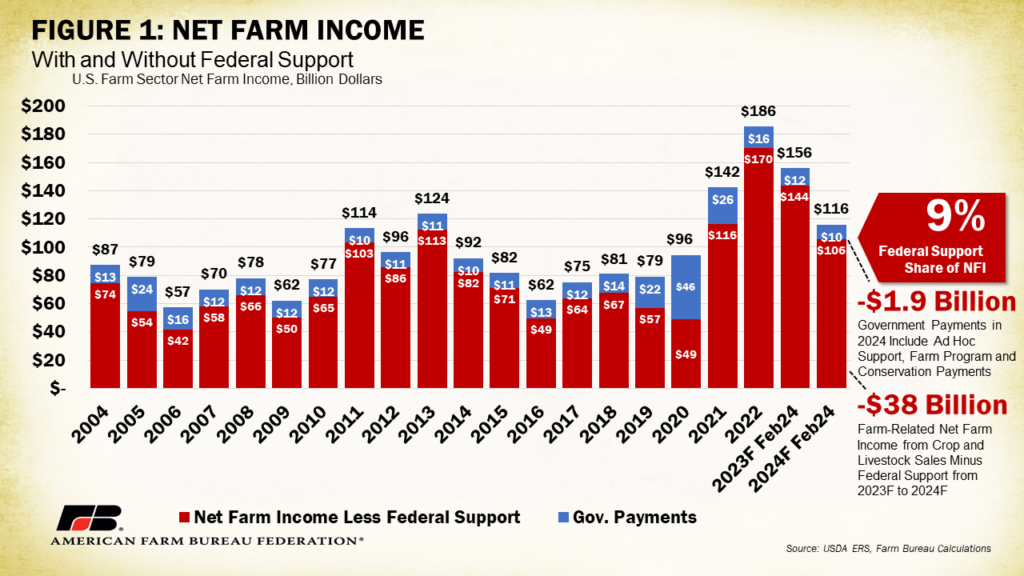
- Net farm income, which measures the profitability of the agricultural sector, is expected to decrease compared to the previous year. This does not signal a collapse, but it does indicate that profit margins are narrowing. Producers who made significant capital investments during stronger income years may now face tighter cash flow.
- Corn and soybean prices are at the heart of the issue. Even modest price declines can translate into significant revenue reductions when applied across thousands of acres. For operations with thin margins, this makes careful marketing and cost management more important than ever.
Federal Support Programs Provide A Cushion
- Federal assistance continues to play a stabilizing role in the agricultural economy. Programs tied to conservation efforts, commodity price support, and disaster relief inject billions of dollars into rural communities each year. These funds help stabilize farm household income, particularly during volatile market conditions.
- However, the anticipated dip in U.S. farm earnings in 2026 highlights the limits of government support. Many commodity programs are structured around reference prices. If market prices do not fall dramatically below those benchmarks, payments may remain modest. That means aid can soften financial pressure but may not fully offset lower crop receipts.
- Crop insurance programs remain critical. They protect farmers against catastrophic losses from weather or yield disruptions. Still, insurance is designed to manage risk, not guarantee profit. As margins tighten, producers must rely on strategic marketing decisions and disciplined budgeting alongside federal support.
Crop Sector Faces Price Pressure
- The crop sector is expected to experience the most visible impact on U.S. farm earnings in 2026. Corn and soybean markets have shifted from tight supply conditions to more comfortable global inventories. Expanded acreage and favorable weather in South America have strengthened export competition. When supply increases while demand grows more slowly, prices tend to soften. That is precisely the environment many grain producers face this year. Even with steady yields, lower market prices reduce total farm revenue.
- Wheat markets show similar trends. Increased global production has tempered price growth. Specialty crop producers encounter a different mix of pressures, including labor shortages and water availability challenges, but they are not immune to cost increases. Farmers who locked in forward contracts during stronger pricing periods may see some protection. Those relying on spot markets are more exposed to volatility. In this context, timing and marketing strategy can significantly influence final earnings.
Livestock Producers Navigate Volatility
- Livestock operations present a more mixed outlook. Cattle producers have benefited from historically tight herd supplies, supporting strong prices in recent years. As herd rebuilding begins, supply could expand, placing downward pressure on prices.
- Feed costs remain a major factor. Even moderate changes in grain prices can significantly affect margins for poultry and pork producers. Consumer demand trends also matter. Shifts in household spending patterns can alter meat consumption, affecting pricing dynamics.
- While the livestock sector may offer some resilience, it is unlikely to fully counterbalance the pressure facing the crop sector. As a result, overall U.S. farm earnings in 2026 remain under downward pressure.
Rising Costs Continue To Squeeze Margins
- One of the most persistent challenges facing farmers is the cost side of the equation. Fertilizer prices, although lower than peak levels, remain above historical norms. Fuel costs fluctuate but continue to weigh on operational budgets. Machinery and equipment expenses remain elevated due to supply chain factors and higher manufacturing costs.
- Land rents and property values have stayed firm in many regions. While strong land values protect asset bases, they increase financial barriers for expansion and add pressure to tenant farmers.
- Interest rates add another layer of complexity. Borrowing costs for operating loans, land purchases, and equipment financing are higher than they were several years ago. For leveraged operations, rising interest expenses can significantly reduce profitability. These combined cost pressures play a central role in shaping U.S. farm earnings in 2026.
Regional Differences Shape the Outlook
The impact of the earnings slowdown varies by region and commodity mix. Grain focused operations in the Midwest may experience sharper revenue declines due to commodity price trends. Meanwhile, producers in areas dependent on specialty crops face higher labor and irrigation expenses. Weather remains the most unpredictable factor. Drought conditions, flooding, or extreme storms can rapidly alter supply levels and pricing. In some cases, reduced production can lift prices. In others, severe weather can damage yields and worsen financial strain.4 Farms that diversify across crops, livestock, and value-added enterprises may be better positioned to absorb volatility. Concentrated operations, while often more efficient, face greater exposure to price swings in a single commodity.
Long Term Structural Challenges
- Beyond immediate forecasts, structural changes continue to reshape agriculture. Farm consolidation has increased operational efficiency but intensified competition for smaller producers. Larger operations often have greater access to capital and technology, giving them advantages in managing cost pressures.
- Technological innovation offers potential relief. Precision agriculture tools, data analytics, and automation can improve productivity and reduce input waste. However, these investments require capital at a time when margins are tightening.
- Land access remains another challenge. High property values benefit current owners but make it difficult for new farmers to enter the industry. This dynamic influences the long term structure of rural economies.
- These structural realities interact with U.S. farm earnings in 2026, shaping both short term profitability and long term sustainability.
FAQs About U.S. Farm Earnings Are Expected to Dip in 2026
Why Are U.S. Farm Earnings In 2026 Expected To Decline
Lower commodity prices and persistent input costs are the main factors. Federal support continues, but it is not sufficient to fully offset shrinking margins in major crops.
Will Government Aid Increase This Year
Government payments are expected to remain significant, but most programs are tied to market benchmarks. Large increases in aid are not guaranteed.
Which Commodities Are Most Affected
Corn and soybeans face the most pressure due to global supply growth. Wheat and certain livestock segments also experience volatility.
How Do Interest Rates Affect Farm Profitability
Higher interest rates increase borrowing costs for operating loans and equipment financing, directly reducing net income.